
Are Youngstown nursing homes pandemic ‘hotspots?’
COLUMBUS — Despite recent reports, Mahoning County officials on Tuesday said less than a third of the county's COVID-19-related deaths were reported in area nursing homes.
State and local officials also responded to questions about where cases cluster, and whether those "hotspots" can be identified and reported by locality.
Dr. Amy Acton, Ohio Department of Health director, during a Tuesday briefing on the state's coronavirus response, pointed to larger "hotspots" across the state where COVID-19 cases have flared — specifically citing Youngstown nursing homes as part of the clustering cases.
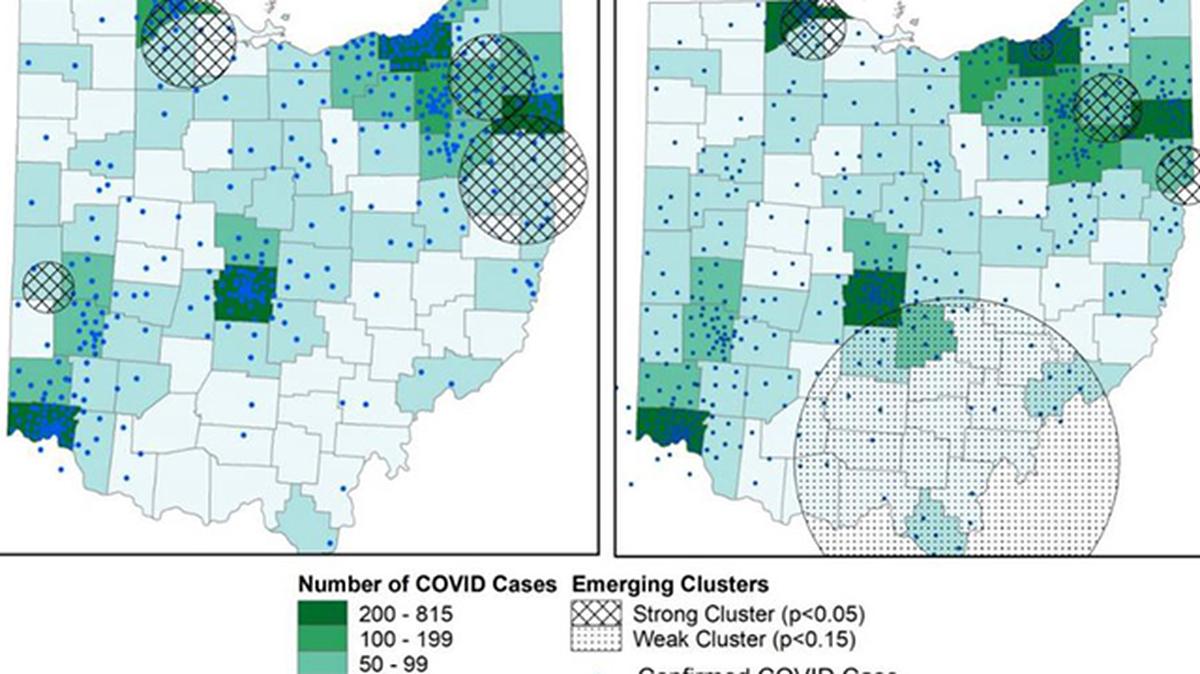
Acton presented a map of "strong" and "weak" emerging clusters across the state reported between March 29 and April 3 which shows Mahoning County is between two "strong" cluster areas.
"These are 'hotspots' that will flare up. They'll recede, then they'll flare up again," she said.
"Prisons, nursing homes, hospice care, [Veterans Affairs] homes we have in our state ... places where people have to be closer together for various reasons are more at-risk," Acton continued.
Mahoning County health officials earlier Tuesday said about 29 percent of the county's 17 total virus-related deaths were reported in long-term care facilities such as nursing homes.
If new confirmed cases are reported at Ohio nursing homes, local health officials work with those facilities to investigate and trace those who came into contact with that patient, and ask them to self-quarantine, Mahoning County Health Commissioner Ryan Tekac said Tuesday.
The Ohio Department of Health may also provide the facility with extra epidemiologists to help their investigation or coordinate with local emergency management agencies to find whatever resources they need, said Melanie Amato, ODH spokesperson.
The state health department last week updated its best-practice guidelines for nursing homes, which includes prohibition of all visitors — while allowing exceptions for end-of-life situations; daily symptom screenings for residents and staff; and cancelation of all communal events.
You can read the full guidelines below:
Ohio Department of Health inspectors conduct at least one unannounced inspection at each nursing home in the state every nine to 15 months and will be subject to the same enhanced screening the state urges for all nursing home visitors. To report nursing home complaints to the state health department, call 1-800-342-0553 or visit the department's website for more information.
John Saulitis, director of the ombudsman program at Direction Home of Eastern Ohio, which advocates for nursing home residents and their families, said now that the pandemic has caused facilities statewide to lock down, transparency is more crucial than ever.
"Especially if and when there are positive outbreaks or situations identified in a particular nursing home — because I would think that the rumor mill would start almost immediately," he said.
Saulitis said it's "vitally important" nursing homes in the state have an adequate supply of personal protective equipment such as N95 masks or face shields as well as enhanced isolation protocols for residents who are suspected of having the virus.
"In the interest of caution, those people need to be treated as if they're positive — until you know otherwise," he said. "You don't want to wait for the test results to jump in terms of preventative measures."
When asked Tuesday about offering more precise locations of the county's total 272 confirmed cases — now 300, as of 2 p.m. Tuesday — possibly by ZIP code, county Health Commissioner Ryan Tekac said the county's relatively fewer number of cases, combined with its limited testing capacity, might instead give residents a "false sense of security."
However, the Cuyahoga County County Board of Health provides a breakdown of coronavirus cases on a ZIP code map. It is featured on Cleveland.com here.
As of Tuesday, Cuyahoga County had 911 confirmed cases; Mahoning County had 300.
Dr. James Kravec, the county health board's chief medical officer, called ZIP code-level reporting "irrelevant" and said the entire county should be treated as a "hotspot" — a statement that appears to be backed by the state's cluster mapping from March 29, showing the majority of the Mahoning Valley inside a "strong" cluster.
Acton on Tuesday again called for Ohioans to continue social distancing, which is "flattening the curve," while at the same time acknowledging the public and private sacrifices being made across the state.
"We've got to know the sacrifices we're making do not let up. They have to be worth it," she said.
This story was originally published April 8, 2020 at 3:52 AM with the headline "Are Youngstown nursing homes pandemic ‘hotspots?’."