
DeWine: ‘I am not focused on the loudest voices’
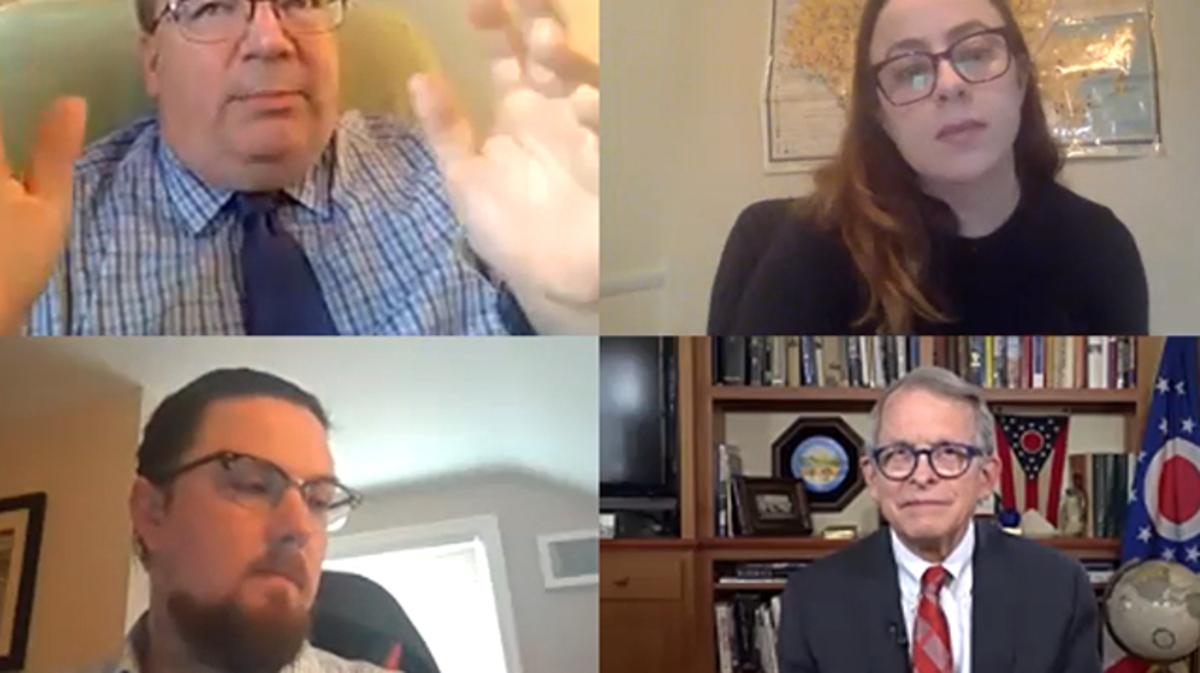
YOUNGSTOWN — Gov. Mike DeWine's polished demeanor rarely cracks.
In a roundtable with Mahoning Matters, a question about the role of partisanship in his policy-making process riled the seasoned politician.
He interrupted defensively. He is not taking marching orders from his party. Rather, he listens to Ohioans, and he prides himself on being a good listener.
Recovering, he explained, "I'm not focused on the loudest voices or the people who are demonstrating."
'Republican talking points'
When asked about his reasoning for not enacting a second lockdown in the face of unprecedented COVID-19 cases and hospitalizations, DeWine has repeatedly pointed to the mental health effects of shutting down the state, citing rising suicides.
The reasoning reflects the words of President Donald Trump, who, in March, said about an economic shutdown: "You're going to lose people. You're going to have suicides by the thousands."
In a Washington Post op-ed, Dr. Jeremy Samuel Faust, an emergency physician at Brigham, said the data doesn't bear out.
"No matter how we looked, we kept finding the same thing. Suicide rates did not budge during the stay-at-home advisory period (March 23 until a phased reopening began in late May) in Massachusetts, which had one of the longest such periods of any state in the nation."
When faced with the perception that his mental health arguments amount to a Republican talking point, DeWine bristled.
"The one thing you should have learned in this pandemic, is I'm not taking Republican talking points," he said. "There are facts. I've got Lori Criss who I listen to a lot."
He said Criss, director of the Department of Mental Health & Addiction Services, recently sent DeWine a memo asking that he avoid shutting schools down, due to mental issues. Mahoning Matters requested a copy of the memo, but it has not been provided.
The alternative to the shutdowns as the sole source of mental health issues are many: Healthcare workers in Ohio's hospital crisis will surely emerge from the pandemic with PTSD. Some people have depression triggered by a seemingly endless tragedy made worse because some people refuse to wear masks.
"Everything you've mentioned weighs very heavily on me," DeWine said.
The emails that affect him the most are those from superintendents of local schools, he said. They detail the pain of their students — pain from missing out on sports and pain from uncontrollable community spread of this devastating virus.
"I'm not asking you to feel bad for me," he said. "But I'm telling you I listen to what people say to me. I have to make the final decision. The buck stops with me. I'll take responsibility for the decision I'm making. But, they rarely present a clear cut case."
The decisions he's had to make during the pandemic are rarely between good and bad, he said.
"It's usually between bad and worse than bad."
Watch the full interview below
Amy Acton on call
DeWine also provided a look behind the scenes regarding his former health director, Dr. Amy Acton.
In a Nov. 2 New Yorker article, Acton said she worried she'd have to sign health orders that violate her most basic tenet as a practitioner of medicine: the Hippocratic oath to do no harm.
DeWine said he didn't know what she was referring to; when asked if he stopped listening to her, he definitively said, "No."
In fact, he still relies on her expertise.
"I continue to talk with her," DeWine said. Acton has even helped DeWine identify national experts from whom to seek advice and guidance.
In her absence, DeWine is confident in the people he's tapped to lead the Ohio Department of Health.
He praised former interim director Lance Himes' institutional knowledge and health director Stephanie McCloud's managerial expertise. According to DeWine, Ohioans are in good hands with the team he's assembled.
Public health in Ohio
While the pandemic has relegated some of DeWine's non-pandemic policy aims to the back burner, it's made others more critical than ever.
There are 123 health departments in Ohio. The pandemic has slapped Ohio with the reality that this decentralized, underfunded system is clunky and cracking.
"A goal we had before the pandemic was to have a much more robust public health system in the state of Ohio," DeWine said Wednesday.
To shore up the state's public health abilities, DeWine said he's worked to make sure local health departments have what they need during this crisis. He gets on the phone with local health commissioners every Monday morning.
When asked if any of those local officials have advocated for a second, March-like shutdown in response to the current COVID-19 surge, DeWine said no.
To more nimbly respond to the pandemic, the state has worked to create a system for sharing hospital data, which had previously been managed by individual systems. When Ohio nursing homes started to experience devastating effects of the pandemic, the state has been forced to evaluate its review of long-term care facilities.
"Merely because there is a tragedy in a nursing home does not mean that nursing home hasn't done a good job. It may mean that, but it doesn't necessarily mean that," he said, responding to data showing 80 percent of deaths in Mahoning County were at long-term care facilities.
Nursing homes have borne the brunt of the perfect storm that is the coronavirus: they often house folks with underlying conditions and do so in a group setting. Though understanding of the virus remains hazy, medical experts do know that it is extremely contagious and has more serious effects on older people with health issues.
But state inspections haven't been a good predictor of nursing homes' ability to weather the pandemic safely. As a result, DeWine is pushing his team to reconsider this process in the long term, to ensure they accurately reflect infection control and quality of care.
"In the long run, making sure Ohioans have consistent care throughout all our nursing homes is one of the priorities of our administration," DeWine said.
Reaching protestors
Months before resigning, Acton started to face anti-Semitic harassment; armed protestors gathered at her home. Her original appointed successor, Joan Duwve, stepped down before starting after her family became the subject of online harassment. Now, groups congregate outside the home of new health director Stephanie McCloud.
In the minds of protestors, the pandemic is a hoax, and the state's action to mitigate it is tyranny.
DeWine, a self-described optimist, isn't optimistic about his ability to change their minds.
"I don't think you're going to reach them," he conceded.
In the last few days, protests at his Cedarville home have pushed DeWine and his wife Fran to sleep in the guest house on their property in an effort to get some sleep. One night they felt the walls of the building vibrating, and Fran went to check outside.
The volume of the protestors' speakers — making a point to violate the governor's 10 p.m. curfew — was rattling the windows of the building.
"If we hadn't been through these things before, I think it would have been tougher," DeWine said, smiling, "We've done this and I have a very understanding wife, which is a godsend for me."
This story was originally published December 10, 2020 at 11:02 AM with the headline "DeWine: ‘I am not focused on the loudest voices’."