
DeWine says he’s ‘not satisfied’ with speed of vaccine distribution
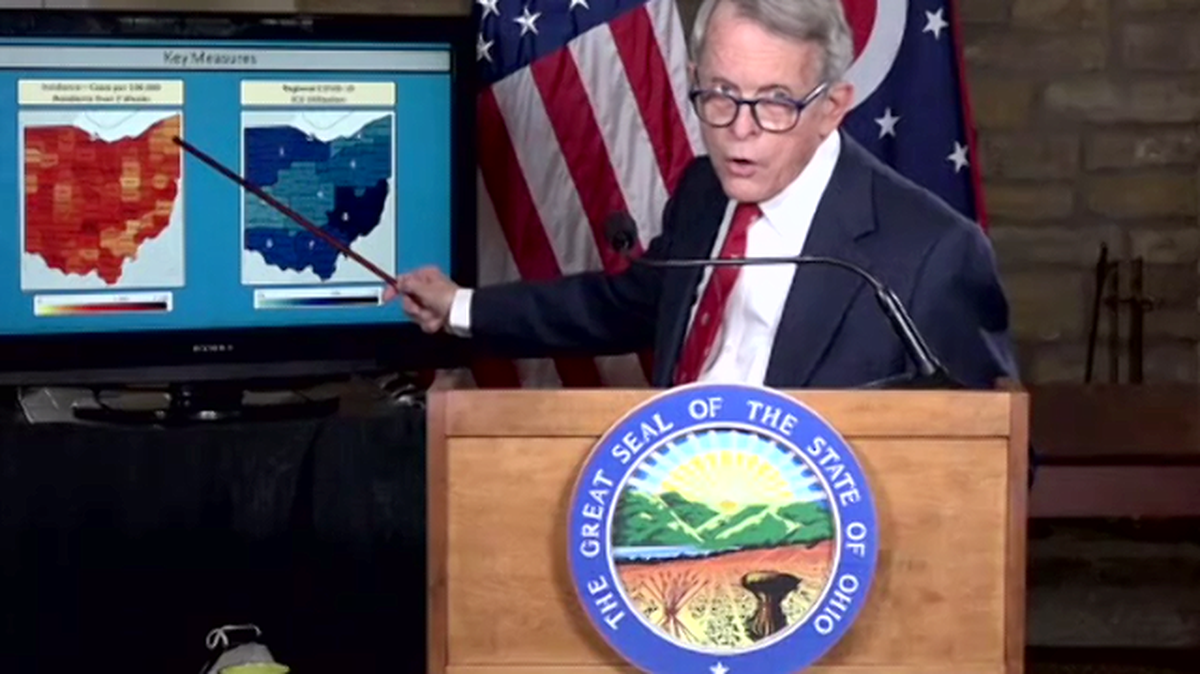
CEDARVILLE — A little more than 94,000 coronavirus vaccine doses administered isn’t where Gov. Mike DeWine expected to be after two weeks since vaccinations began in Ohio.
That’s less than a fifth of about 529,000 doses that have already shipped across the state.
During a Wednesday briefing on the state’s coronavirus response, the governor pleaded for “urgency” from health care providers and other administering agencies.
“We can’t control how fast the vaccine comes into the state of Ohio, and we know there’s a scarcity,” he said. “But we can control how fast they get it out.”
DeWine on Wednesday set the bar for health care providers to administer vaccines within 24 hours of receiving them, and report those doses to the Ohio Department of Health no more than 24 hours after that.
In some cases, the number of administered doses aren’t properly being reported to the state because agencies are finding difficulty interfacing with the state’s system, DeWine said.
But Mahoning Valley health officials told Mahoning Matters on Wednesday they’re struggling most with the logistics of such a large-scale operation.
“This is a big operation, and it’s going to get bigger,” DeWine said Wednesday. “When we go from [the Phase 1A-eligible group] to the next group, a lot more people are going to be eligible, and we’re going to have a lot more sites. … This is a once in a 100 years operation.
“I think you can tell by my tone today I’m not satisfied with where we are in Ohio. We’re not moving fast enough, but we’re going to get there. We’re going to speed this up.”
About 3,500 Mahoning Valley residents have started their vaccinations, according to the state's vaccination dashboard.
So far, Trumbull County Combined Health District has received about 600 doses of the coronavirus vaccine, said district Director of Nursing Sandra Swann.
The district partnered with Burghill Vernon Fire Chief George Snyder to vaccinate EMS workers throughout the county. Using about 200 doses from the district, Snyder hosted a clinic earlier this week, she said.
The next 400 doses have been set aside for county group homes. Group homes and health care facilities are able to register on the district’s website to request vaccines for their facilities.
Meanwhile, county long-term care facilities are acquiring vaccine shipments from pharmacies partnered under a federal program.
For Swann, the most frustrating aspect of the vaccine rollout has been timing.
“Logistically, it came over the holidays,” she said. “This week I have no staff. I can’t plan a clinic this week because I have no staff. Everyone’s off for the holidays.”
Swann is planning a vaccine clinic Jan. 6. She intends to vaccinate everyone in group 1A — who wants the vaccine — within the next few weeks.
“We’re not sitting on [the] vaccine,” she said. “We want to get it out there.”
For Mercy Health workers, the logistics and scheduling of vaccinations are rigid, said Dr. James Kravec, chief clinical officer for Mercy Health.
The health care provider started administering its first round of 4,800 Moderna-produced vaccine doses Dec. 22. Everyone vaccinated that day must come back for the vaccine’s required booster shot, which has to be the Moderna shot and has to be administered Jan. 19 and at the same Mercy facility where they received their first shot, Kravec said.
“Not that it’s hard — it’s just another level of logistics,” he said.
The process, overall, takes longer than your annual flu shot, Kravec said. Patients are first registered for the Ohio Department of Health’s vaccination records, then have to schedule their booster shot, then have to be supervised for at least 15 minutes to be sure they don’t have any adverse effects.
The goal has been to have the first round of vaccine doses administered by Jan. 8, and Kravec said Mercy is on track, with about 40 percent administered thus far.
Another 4,800 booster shots are expected to be delivered for the Mercy Health workers who will have begun their vaccinations — but there have been no updates on when those could come, Kravec said. They just have to “trust” they’ll be available when the time comes, he said.
The state is expecting about 238,000 more doses of the coronavirus vaccine next week, according to a release from the governor’s office. Of those, nearly 70,000 are Moderna shots, DeWine said during Wednesday’s briefing.
Health Commissioner Erin Bishop said Youngstown City Health District expects to vaccinate about 160 people this week. About 40 city first responders received their first doses of the vaccine Wednesday. Another 300 people are scheduled to receive the vaccine next week, and another 300 vaccinations are expected the week after.
Bishop said the department expects to have administered its first vaccine shipment, 800 doses of the Moderna shot, by Jan. 15.
The health department is also working with Mahoning County Public Health to make sure everyone in the county who is eligible for the first round of vaccines gets one, she said.
Youngstown City Health District can put in another request to receive a second shipment to start the next phase of vaccinations, which is for Ohioans age 65 and older and adults who work in schools. Bishop said she expects that phase to begin Jan. 18.
Youngstown City Health District plans to vaccinate residents and caregivers of Gateways to Better Living from 8 a.m. to 4 p.m. today at the Eugenia Atkins Recreation Center, 903 Otis St. About 120 people are expected to be vaccinated, she said.
Next week, the health department will begin to travel to other group homes in the city to vaccinate residents and staff.
DeWine said Wednesday it’s still unclear when vaccines will be available for the general public, though Kravec said Mercy Health is already planning its public distribution effort.
“We already have staff and locations in the works that we’ll be able to announce when the time comes,” he said. “We’re ready, once we get the green light from the state.”
Other news
The state is no longer recommending K-12 students quarantine after being exposed to coronavirus in the classroom — a change in the state’s guidance to schools DeWine announced Wednesday.
But that's only if guidelines on masks and social distancing were followed and if the exposure occurred in a classroom, rather than an extracurricular setting such as athletics or after-school programs.
Ohio had been following Centers for Disease Control and Prevention guidelines for coronavirus exposure in the classroom, which recommend quarantine, but two recent independent studies in Ohio and Mississippi suggested students who were reportedly exposed to the infected classmate actually weren’t any more likely to have contracted the virus compared with other students who weren’t nearby, Dr. Bruce Vanderhoff, the Ohio Department of Health’s chief medical officer, said Wednesday.
“It shows the close contacts of children with COVID-19 were more likely to be family members,” he said. “Our schools have been doing a tremendous job of implementing robust safety measures. When they’re applied daily across the state, our schools represent the safest place for our students.”
The guidance change also extends to adults in the classroom, Vanderhoff later clarified.
Traci Hostetler, Mahoning County Educational Service Center superintendent, last month told Mahoning Matters though coronavirus infections have affected a majority of school districts in the county, districts are more often struggling with substituting staff who have been quarantined.
DeWine also announced an extension to the state's 10 p.m. to 5 a.m. curfew through Jan. 23, 2021.
"Our numbers are sort of in a flux. They're not going down, and we've gotta see what happens in regard to the holidays and if there's an 'aftermath' to the holidays," the governor said.
— Reporters Justin Dennis, Jess Hardin and Ellen Wagner contributed to this report.
This story was originally published December 31, 2020 at 4:25 AM with the headline "DeWine says he’s ‘not satisfied’ with speed of vaccine distribution."