
Here’s the latest on enhanced orders ahead of pandemic’s ‘most dangerous phase’
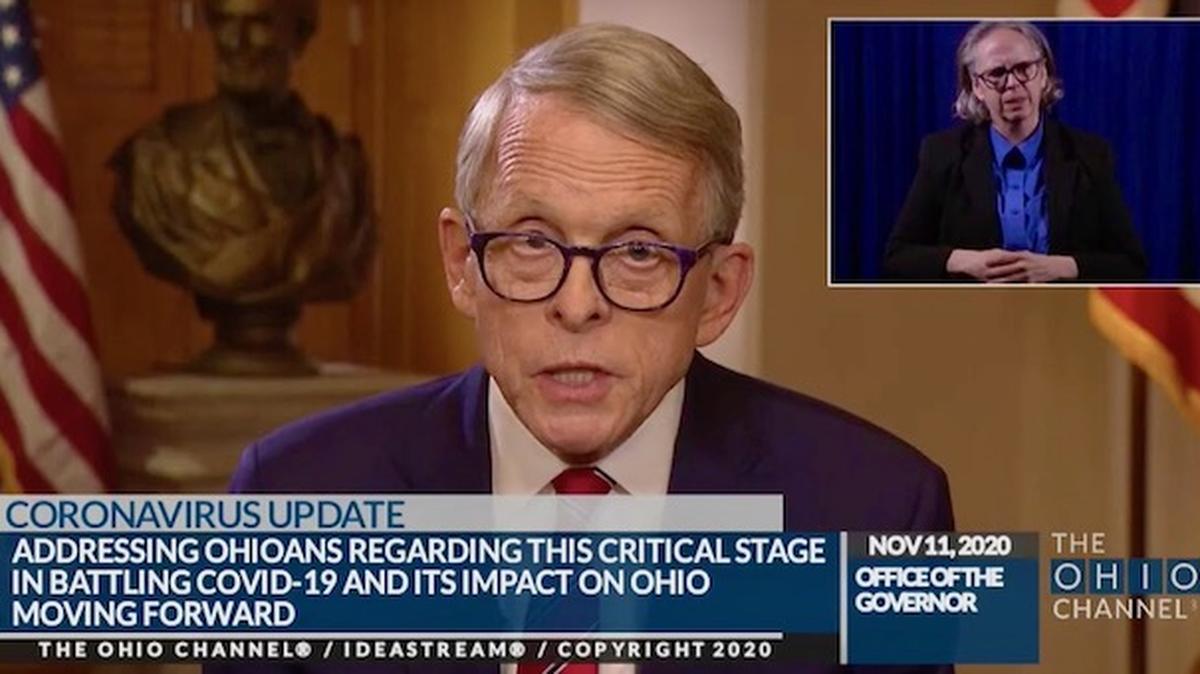
COLUMBUS — During his primetime address televised Wednesday, Gov. Mike DeWine announced the state would begin retightening COVID-19 restrictions.
He also delivered stark statistics heralding the “most dangerous phase” of the state's outbreak, as he reemphasized Ohio remains in a state of emergency.
An average of 5,000 new cases per day were marked in the last week — five times more than at the end of September.
Seven-hundred Ohioans were in intensive care units as of Wednesday — nearly three times as many from a month ago.
In the first week of October, 86 Ohioans died of COVID-19; another 104 died in just the first week of November, the governor said.
“A hundred-and-four families left to mourn and grieve a loved one. … To those families, please know that Ohio grieves with you,” DeWine said.
DeWine, however, led his Wednesday address with promising news on Pfizer’s coronavirus vaccine, which early data shows to be 90 percent effective and could be available as early as December.
“We will be ready to get it out just as soon as we receive it,” DeWine said — first to the most vulnerable Ohioans and essential workers. “We’ll then be able to move to the general population. We hope to achieve significant immunity in Ohio.”
Health orders enhanced
Though DeWine said most businesses have been complying with the state’s July mask order, “it is clear there are some businesses where mask-wearing is simply lacking.”
The Ohio Department of Health intends to reissue that order with new penalties, including temporary closure for retail businesses found to be violating the order, the governor said.
Under the enhanced order, each retailer would be required to ensure customers and employees are wearing masks and post signs indicating face coverings are required. A new "retail compliance unit” composed of Ohio Bureau of Workers Compensation agents would ensure mask order compliance.
On a first violation, businesses would be subject to a written warning. On a second violation, businesses would be forced to close for up to 24 hours, DeWine said.
Though the state’s 10-person limit on public and private gatherings remains in effect, new restrictions on larger social gatherings following weddings and funerals are expected "in the next few days.”
Open congregate settings would no longer be “open.” Guests would be required to be seated and to wear masks at all times, unless eating or drinking, DeWine said.
He also warned the state is considering a second shutdown of Ohio bars, restaurants and fitness centers "if the current trend continues and cases keep increasing."
“I am very well aware of the burden this will place on employees and owners, but these are places where it is difficult or impossible to maintain mask-wearing, which we know now is the chief way of slowing this virus,” DeWine said.
Businesses call for public to ‘buckle down’
During his Wednesday evening shift at Station Square Ristorante along Belmont Avenue in Youngstown, manager Adam Zagotti watched DeWine’s live briefing.
Though the eatery’s business has thawed since Ohio's retail and hospitality sectors reopened, it hasn’t fully bounced back. The restaurant is working with fewer tables and stricter seating guidelines and has been underselling large events to keep within state guidelines.
“I think [DeWine's] given us a week and we better not squander this week,” Zagotti told Mahoning Matters.
“We gotta’ put on our masks and behave and get the case count to come down again … or we will shut down again,” he said, though candidly, he feels it’s inevitable.
“It’ll be devastating if we have a second shutdown. People have really got to buckle down.”
Joe Bell, spokesperson for Eastwood Mall owner Cafaro Co., said the beefed-up mask order won’t change operations at the mall.
“We’ve been enforcing this for months now, so have all of our retailers. I haven’t seen anywhere where it hasn’t been enforced. We’ve all seen how well that’s working,” Bell said.
He worried about possible confrontations with angry customers unwilling to comply with the mask mandate when it was first issued in July. But he’s not witnessed any issues in terms of enforcement from Eastwood’s retailers.
Bell did, however, opine that “blaming” businesses is a misguided approach.
“To try to pin the blame for rising cases on businesses is kind of foolhardy,” he said. “Let’s face it. Viruses do what viruses do. They spread. And they will spread until they don’t have enough hosts to infect. We’re very thankful to see that there’s perhaps a vaccine to make that process shorter, but that’s just basic biology we’re talking about there.”
The responsibility for acting safely should lie with individuals, he said.
Stemming spread in the Valley
Before the address, Mercy Health Chief Clinical Officer Dr. Jim Kravec hoped DeWine would issue an order giving the mask mandate more teeth and providing an enforcement mechanism.
“First of all I think it’s a good order,” he said, about DeWine’s plan. “It will reduce cases. It will reduce spread. I’m glad there’s focused attention on this again … I’m more encouraged than just saying, 'it’s mandated with no enforcement'.”
He added: ”I still have a lot of questions as well.”
Kravec hasn’t yet spoken with Mahoning County Public Health officials on how to enforce the new order.
Youngstown Health Commissioner Erin Bishop said the mask compliance task force announced Wednesday will help the health department with the enforcement of restrictions for businesses.
“We can’t keep up with all the businesses,” Bishop said. “No one is able to sit there and watch people coming in and out without masks on. We don’t have the time for that.”
Bishop was surprised DeWine threatened other potential shutdowns in a week. She would like to avoid another round of shutdowns and hopes the warning compels people to take the restrictions seriously to avoid further restrictions.
“People were upset when they shut down because those are people’s businesses,” Bishop said. “I hope people hear that and don’t want to go there.”
She reiterated the masking requirements for visits to restaurants and bars. Customers still need to wear a mask when interacting with others even when they are seated and ordering.
Bishop also urged people to consider protecting family and guests before attending or planning an event; the health department is seeing most community spread from gatherings like weddings and funerals.
Meanwhile, hospitalizations continue to climb statewide — including in the Mahoning Valley, Kravec told Mahoning Matters.
As the virus’ spread lulled in summer, the number of Ohioans hospitalized at once reached a little more than 1,100, DeWine said. Last week, there were 2,000, and that number’s “approaching” 3,000 this week, he said. State hospital leaders asked him to confirm Ohio remains in a state of emergency — “it most certainly is,” he replied.
“We worry about ventilators, hospital space. … Today, the question is whether or not we have enough people,” DeWine said. “Our health care workers are, quite frankly, exhausted. They’ve been running a marathon for nine straight months, and with this new wave and flu season, it’s like they’re starting the race all over again.”
DeWine said “if nothing changes,” Ohio’s health care providers could see COVID-19 treatment supersede routine or emergency care “in just a few short weeks.”
Kravec could not estimate when local hospitals could reach capacity but said, “We're seeing a rise, every day, and keeping in mind that people are admitted usually several weeks after they’re exposed. So, the impact of today’s rising cases will not be felt by already overloaded hospitals for several weeks.
“We are seeing so many [inpatient cases] in hospitals that if spread continues, we will not be able to care for our patients,” he said.
When asked if Wednesday night’s improved mandates will be enough to stem the state’s unprecedented coronavirus spread, Kravec said, “I’m not sure. I hope so.”
(Remote) lesson plans
Kravec said school closures are likely “the next conversation” if cases continue to rise.
An Ohio school official who wrote DeWine concerned over the virus' spread in her community, said though coronavirus exposures largely happen outside schools, “they are having a profound effect on our ability to keep our school open,” DeWine said Wednesday.
“It is up to each and every one of us," he said. "What you do in the community — what we all do in the community — impacts whether our kids will be able to stay in school."
The governor commended the “vast majority” of Ohio colleges and universities that have so far chosen not to return to campus.
“Unless we dramatically slow the community spread of the virus, colleges may have to remain virtual when schools reopen in January,” he said. “With widespread COVID, they may have no choice.
“Again, it’s up to us.”
Youngstown State University President Jim Tressel said he would discuss with faculty this week before deciding whether the university will return after Thanksgiving break.
“We’ve said we had to be ready at a moment’s notice to go remote,” Tressel told Mahoning Matters.
He said most of the faculty has already moved classes online or would be able to — but alternatives for in-person classes like labs and clinicals are still up for discussion.
YSU planned to have students return after break on Nov. 30 for the remainder of the semester, which ends Dec. 12.
Tressel said YSU is ready to go remote if needed, but a decision would not be made until early next week.
“I just want to make sure we are dotting every ‘I’ and crossing every ‘T’,” Tressel said.
——
Reporters Justin Dennis, Jess Hardin and Ellen Wagner contributed to this report.This story was originally published November 12, 2020 at 3:52 AM with the headline "Here’s the latest on enhanced orders ahead of pandemic’s ‘most dangerous phase’."