
Husted: Ohio will be a ‘backwards-looking state’ without broadband funding
YOUNGSTOWN — An estimated 1 million Ohioans do not have access to the internet. More than 32,000 of them live in the Mahoning Valley, according to statistics from Lt. Gov. Jon Husted's office.
In addition to laying bare deep health inequities, the coronavirus pandemic has also illuminated the digital divide when those without access to high-speed internet became unable to participate in schooling and telehealth services.
Eastgate Regional Council of Governments wants to alleviate the digital divide regionally, but needs help when it comes to the project's hefty pricetag.
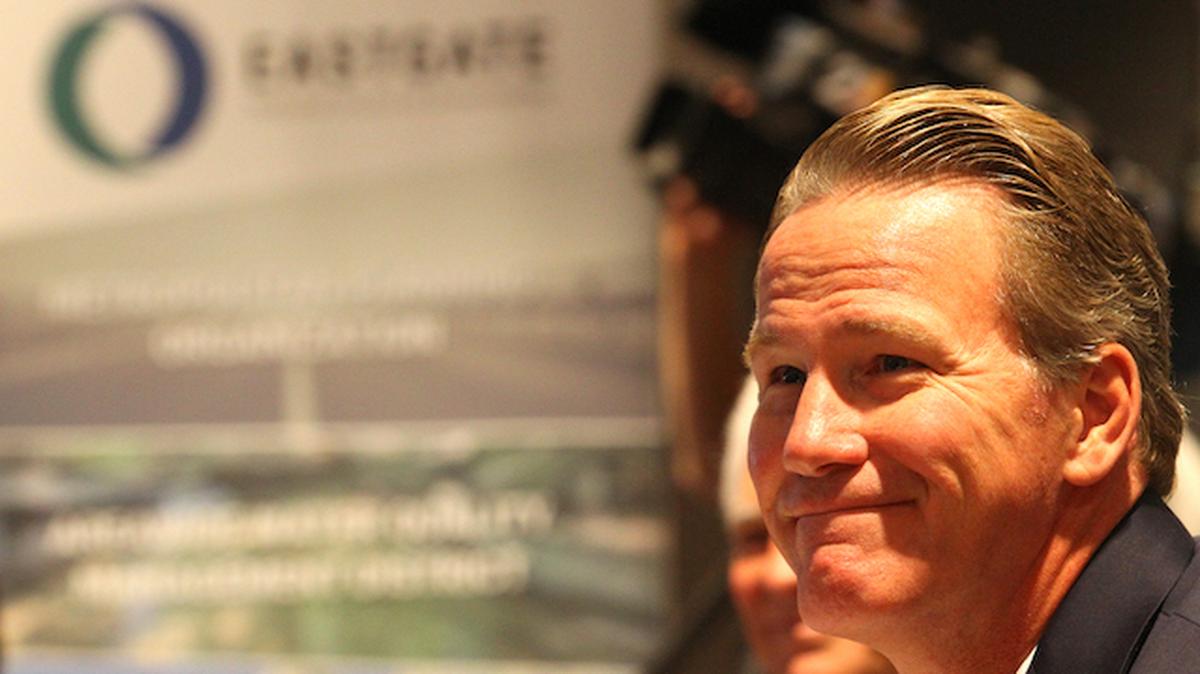
Husted joined Valley business leaders Wednesday to discuss how the state can help.
Youngstown proposal
Earlier this year, Eastgate Regional Council of Governments conducted a survey of broadband use in the Mahoning Valley.
The study found the Valley not only contains pockets with no or slow broadband connectivity but also areas where broadband isn't affordable, said Eastgate Executive Director Jim Kinnick.
Of the 811 survey respondents, 53 percent cited cost as a barrier to access.
To address the region's internet needs, the study proposes to install a 100-mile high-speed fiber line, which would stretch from Lake Erie to the Ohio River. It would serve more than 620,000 Valley residents from Mahoning, Trumbull, Ashtabula and Columbiana counties.
The estimated cost of the project is between $12 million and $15 million.
"The idea of a broadband backbone will fill in the gaps," said Kinnick.
Husted pointed out such a massive price tag would require stakeholders to know whether people will purchase the product.
"Do you know if you built this they will come?" he asked. "As you know, you can't put $12 to $15 million of investment and not know the correct, solid answer to that question."
State goals
When Gov. Mike DeWine and Lt. Gov. Jon Husted were elected, they tried to get private companies on board with their plan to increase broadband access throughout the state.
"We found pretty quickly they for the most part didn't have much interest," Husted said. "Including some major companies that go to Capitol Hill and testify and say that they want to close to digital divide and tell everybody how much they care, but when you ask them to actually care, they didn't."
The state, however, managed to get traction by working with local partners.
For example, in East Cleveland, the state launched a pilot project that aimed to connect residents with reliable, low-cost high-speed internet.
The partnership includes Case Western Reserve University, Connect, Cuyahoga County, Eaton Corporation, East Cleveland City Schools, GE Lighting, Greater Cleveland Partnership, InnovateOhio, Microsoft, OARnet, PCs for People, University Hospitals and the Urban League of Cleveland.
PCs for People will serve as the internet provider, and distribute antennas and modems. Case Western Reserve University, Connect, East Cleveland City Schools, OARnet, and University Hospitals will assist with the technical infrastructure.
The first phase of the project will connect 1,000 households; the program eventually wants to bring $15 internet to more than 2,000 households.
The state is currently accepting project proposals for expansion opportunities like this one.
Legislative hurdles
But, budget language added by the Republican-controlled State Senate would make projects like the one in East Cleveland impossible.
In the process of establishing the budget, DeWine requested $250 million for expanding residential broadband. The House proposed $190 million. The Senate's version of the budget not only doesn't fund increasing broadband, but it also hamstrings local governments in creating networks.
"It would make Ohio a backwards-looking state if we don't get this done," Husted said Wednesday. "Failure is not an option on this one. We're going to stay the course until we get this done."
Husted said enough people have spoken out against the move by Senate GOP that he believes the funding will be restored and the restrictive language will be removed, but "you never know until it's over."
The budget must be completed and signed by July 1.
"If we want to have an inclusive recovery, this is a fundamental infrastructure issue that must be solved," Husted said.
The long view
One crucial aspect of the state's goal to provide broadband is affordability.
In many communities, only one provider is available, thus giving broadband companies a monopoly and the leverage to drive up prices.
"Monopolies don't work," Husted said repeatedly Wednesday. But he also said the state wouldn't competing against private sector providers.
So how will the state compel private companies to lower inflated internet costs?
Husted maintained building more broadband infrastructure will encourage other companies to compete and could be fodder for public-private partnerships.
In terms of a timeline, Husted estimated all Ohioans could have some form of internet access in five years.
"I don't want to put a timeframe on this, because we're at the beginning of this project," he said. "But we can't go fast enough."
This story was originally published June 24, 2021 at 4:11 AM with the headline "Husted: Ohio will be a ‘backwards-looking state’ without broadband funding."