
Is your road on the list? Here are the plans for Mahoning’s proposed quarter-percent sales tax for roads
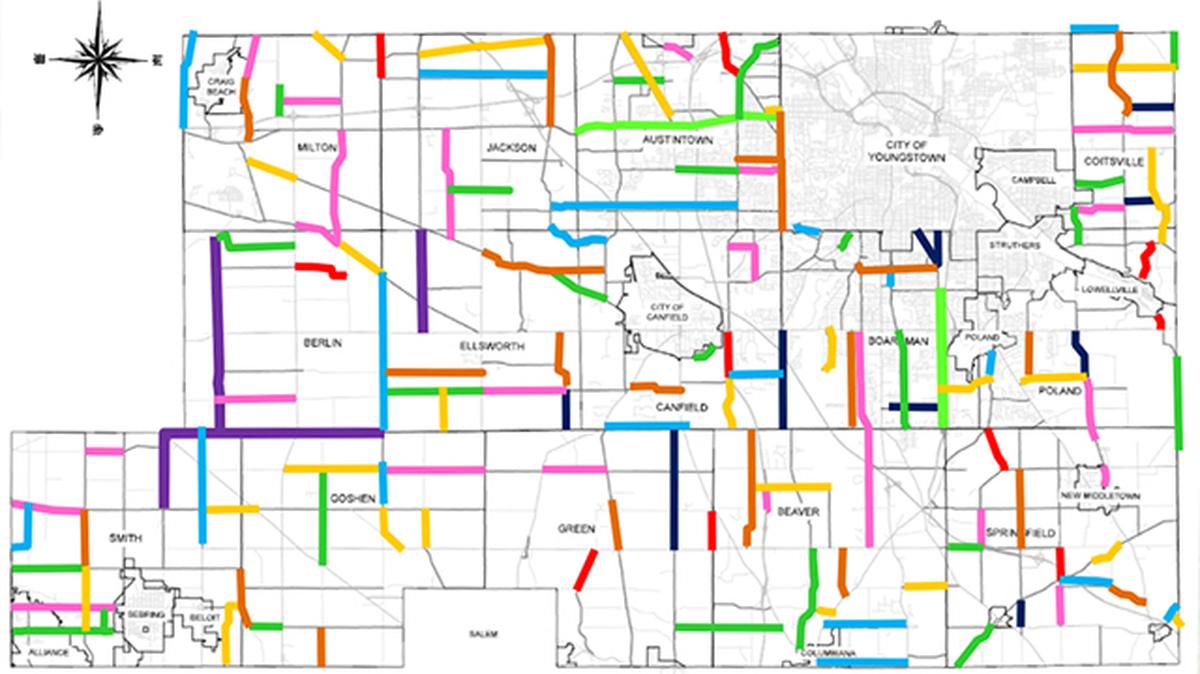
CANFIELD — No objections were heard during a Monday public hearing on a newly proposed quarter-percent sales tax in Mahoning County, which officials say could raise $45 million to catch up on much-needed road work in all the county's townships.
A couple of dozen people attended the meeting at the Mill Creek MetroParks Farm in Canfield, and the only feedback came from two township trustees eager for a boost to their cash-strapped resurfacing budgets.
What they're saying
"I'm in favor of this because it affects everyone, whether or not you have a vehicle," said Green Township Trustee Dave Slagle, adding that now-booming delivery services and public transit count on smooth rides. "We have a quarter-percent sales tax on right now for [Western Reserve Transit Authority]. Probably the majority of us in here don't use it, but WRTA has to travel on all these roads.
"There was a time when I was raising kids and I didn't have a lot of money. … One morning I went to work and the tie rod had fallen out because of the rough roads," Slagle said — and he missed work that day. "I would have been real glad to pay a quarter on $100 to avoid that."
But sentiment toward the new tax was overwhelmingly negative on Mahoning Matters' Facebook page, with many visitors saying they're "taxed out" on gas, license plate fees and other local road levies.
Some see the county's anticipated $42 million in American Rescue Plan funding as an alternative solution. Although that money can be put toward a wide range of critical infrastructure needs, roads aren't among them, Mahoning County Engineer Pat Ginnetti confirmed.
How it would work
Commissioners intend to put the measure on the Nov. 2 ballot. If the five-year tax passes, customers would pay an extra 25 cents on every $100 spent in Mahoning County, beginning in April. It would be a one-time tax, and wouldn't be up for renewal after five years, officials said.
Of the $9 million the tax could generate each year, $8 million would be split evenly between county- and township-owned roads and the other $1 million would be used to fix county infrastructure within city and village corporation limits, Ginnetti said in a later email to Mahoning Matters.
Officials plan to hit at least one road in every township each year, Ginnetti said. His Monday presentation outlined the road projects officials plan to tackle during each of the levy's five years:
Up to 40 percent of the new tax is estimated to be collected from out-of-county residents spending in Mahoning, according to Ginnetti's email.
If the measure passes, the Mahoning County auditor would be expected to create a new fund in order to track the tax revenue spending. The funds can't be used for salaries, equipment or new building, Ginnetti said.
Why do they want it?
"Our budget has been stagnant for decades," Ginnetti said during the Monday hearing. The department's budget was $10.6 million in 1999 and only rose $200,000 over the next two decades, to $10.8 million in 2019, he said.
"It's hard to survive off the same money that doesn't spend like it did 20 years ago," he said. Meanwhile, the price of construction materials has about doubled, he added.
Road projects are funded solely by the state and federal gas taxes as well as fees on license plates. The engineer's department doesn't collect sales, property or income taxes.
The federal gas tax, however, has not gone up since 1993, Ginnetti said. Though Gov. Mike DeWine approved a 10.5-cent state gas tax hike to take effect in July 2019 — bringing it to a total 38.5 cents, which was expected to generate $1.9 million for Mahoning — the advent of COVID-19 and a statewide shutdown months later meant fewer travelers on the roads, Ginnetti said.
"We didn't really see any gain in our budget," he said.
Low-traffic areas are often passed over for competitive grant funding for road work, Ginnetti said, and much of Mahoning County is rural.
Berlin Township Trustee Jodi Kale said the county's plan to wrap projects from smaller townships and larger cities together is "more cost effective."
Also, they won't be competing against each other for the same funds. They can focus on the worst roads first, Ginnetti said.
"With all the hype going on right now with electric vehicles, we look for gas revenues to further decline," Kale said. "[The tax] really will provide us with an opportunity we wouldn't normally have."
Commissioner Anthony Traficanti said he sees the levy as a five-year "insurance policy" for the county's paving program. In 2019, "there would not have been a paving program" had commissioners not diverted a $3.5 million surplus to the engineer's department, he said. They also pitched in nearly $1 million last year for bridge repairs.
"Every day, someone's complaining about a road. [Ginnetti] doesn't have the means budgetarily to address it. Columbus has cut it short. The federal government has cut it short. His budget has not grown," Traficanti said.
Though officials have said the levy wouldn't automatically go up for renewal, on Monday they didn't rule out asking again five years down the road.
"Let the public grade it," Traficanti said. "If the public doesn't think this program was merited, maybe we don't put it back on or they vote it down."
If the measure fails, Ginnetti said his department will "continue to do what we do. … We'll be on the same cycle where every year our paving program seems to shrink because of rising costs and relatively flat budgets."
The next meeting is set for 11 a.m. Thursday in the Mahoning County commissioners' hearing room, in the basement of the county courthouse, 120 Market St., Youngstown.
This story was originally published July 20, 2021 at 3:52 AM with the headline "Is your road on the list? Here are the plans for Mahoning’s proposed quarter-percent sales tax for roads."