
New COVID-19 system reveals troubling trends in Trumbull County
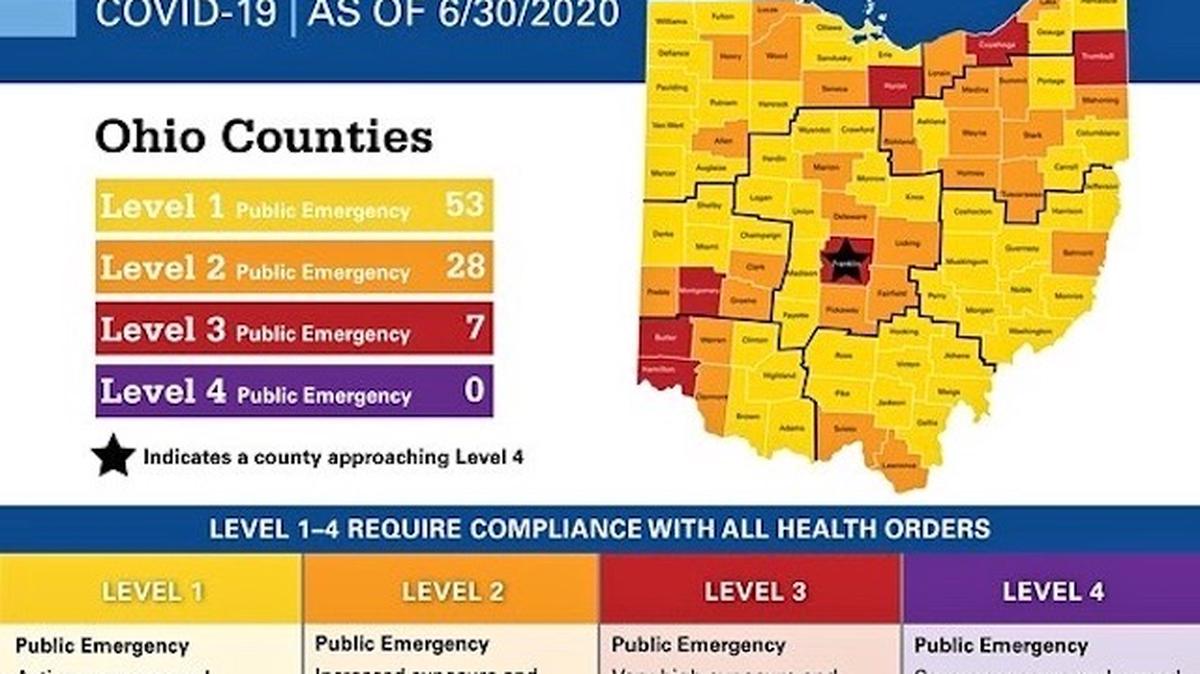
COLUMBUS — When it comes to the spike in coronavirus cases in Ohio, the spotlight is on Trumbull County, which is one of the seven counties in "Level 3" of the state's new advisory system announced Thursday.
Gov. Mike DeWine revealed a regional approach for containing new virus spread — called the Ohio Public Health Advisory System — which includes categorizing counties into four levels, with Level 4 being the most severe situation.
No counties are currently at that level, but Franklin County — home to Columbus — is close, the governor said.
Of Trumbull County's 903 cases, 280 were added in the month of June. Average new cases per capita in the county have doubled, and the average number of emergency room visits has tripled.
"In addition to multiple outbreaks in congregate settings, Trumbull County also currently has an outbreak in a healthcare facility," DeWine said during Thursday's state coronavirus briefing.
It's unclear what DeWine was referring to. Spokespeople for St. Joseph's Hospital Warren and Trumbull Regional Medical Center said there is nothing unusual going on at their respective facilities.
Dan Tierney, DeWine's spokesman, instructed Mahoning Matters to reach out to the Trumbull County Combined Health District, which was closed by the time the governor's two-hour news conference ended. Moreover, discerning the location of the spike is made even more challenging by the fact that the health district has yet to provide ZIP code breakdowns for cases in the county.
Mahoning Matters sought the ZIP code breakdowns in a Freedom of Information Act request two weeks ago.
Trumbull County Commissioners don't plan to mandate mask-wearing locally, said Commissioner Dan Polivka Thursday afternoon.
"Right now we're just reviewing the information," said Polivka. "We're encouraging everyone to wear masks as much as possible."
Polivka said the county was initially aggressive in its fight against the virus, resulting in low case and death numbers, but "everybody started laying their guard down."
Trumbull County is in level three of the state's new system because it met four of the indicators considered in ranking counties.
There are seven indicators in total, so far:
- New cases per capita
- Sustained increase in new cases
- Proportion of cases not in congregate settings, like prisons or nursing homes
- Sustained increase in emergency room visits
- Sustained increase in outpatient visits
- Sustained increase in new COVID-19 hospital admissions
- ICU bed occupancy
Trumbull County has met four of the indicators: new cases per capita, the proportion of cases not in congregate settings like prisons or nursing homes, sustained increase in emergency room visits and sustained increase in outpatient visits.
Level 1 counties, represented by the color yellow, have reached thresholds for 0 or 1 of the indicators. As of June 30, 53 counties are at this level.
Level 2 counties, represented by the color orange, have triggered 2 or 3 of the indicators. As of June 30, 28 counties — including Mahoning County — are at this level. DeWine said Ohioans in these counties should limit unnecessary trips to visit people
Level 3 counties, represented by the color red, have triggered 4 or 5 of the indicators. As of June 30, 7 counties — including Trumbull County — are at this level. DeWine said Ohioans in these counties should limit activities as much as possible and wear a mask.
Level 4 counties, represented by the color purple, have triggered 6 or 7 of the indicators. As of June 30, no counties are at this level, but Franklin County is on the watch list, DeWine said. People living in level four counties should only leave home for supplies and services.
The system does not outline any provisions for rolling back reopening when coronavirus cases in a county surge, as in other states, like neighboring Pennsylvania. The briefing also did not include a state mandate to wear masks, although DeWine praises requirements set by Ohio cities, like Dayton.
When asked if he's shifting the responsibility to enact these sorts of requirements to local officials, DeWine seemed agitated and responded: "It is giving mayors and community members more information so they can make decisions, but it does not mean that I am not engaged and it does not mean that I will not in the future make decisions if I think those decisions are needed to protect the people of the state of Ohio.
"So I am just as much engaged today, and I am just as much able to make decisions that will be unpopular with many to protect human life in the state of Ohio."
DeWine was grilled by reporters regarding his response to the statewide surge in cases, but without the knowledge of the state's latest COVID-19 data prior to the briefing.
On Thursday, the state coronavirus website, which updates daily numbers at 2 p.m., was not available and did not become available with partial information until around 5 p.m. Thursday — the night before a holiday weekend. Neither DeWine nor any other state official provided a review of the numbers during the briefing, as is customary.
The state's number of confirmed cases rose by 1,260 cases to 50.523 on Thursday — the largest single-day spike since April 19 and the second-largest single-day spike throughout the entire pandemic.
This story was originally published July 3, 2020 at 3:52 AM with the headline "New COVID-19 system reveals troubling trends in Trumbull County."