
What you need to know about Ohio’s new COVID-19 death reporting process
COLUMBUS — The state announced Tuesday it's using a new process to report COVID-19 deaths after the Ohio Department of Health failed to report 4,000 COVID-19 deaths between October and February.
If you've noticed changes on the state coronavirus dashboard and find the new system confusing, you're not alone. We've tried to preempt the confusion by answering some of the questions you might have about the reporting changes.
If you have additional questions about the new system, email us at news@mahoningmatters.com.
On Monday, the Ohio death toll was 17,346. On Tuesday it was 17,189. Why did the state death toll go down?
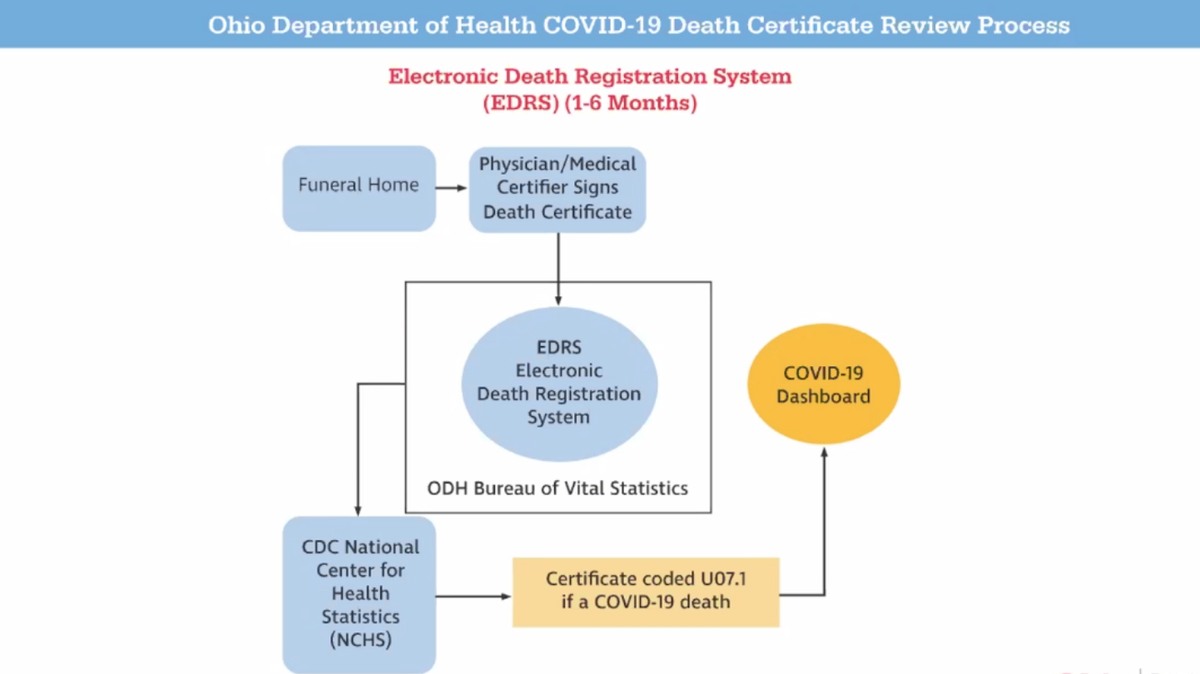
The "decrease" reflects the state's switch to using the Electronic Death Registration System to report deaths. This system, which relies on death certificate data to track deaths, uses a different process to verify deaths, resulting in a different number of state deaths.
What happened to probable deaths?
A probable death is the death of a person who was considered a probable case. The new death reporting system EDRS, does not track probable cases. Rather, deaths are verified through death certificate data, so the state dashboard no longer shows "probable deaths."
Wait. What is the EDRS? Who runs it?
The Electronic Death Registration System is a nationwide system promoted by the Centers for Disease Control and Prevention. It was established by the Bureau of Health Statistics and Registries in 2016. It provides higher quality data than the Ohio Disease Reporting System but takes a bit longer to show death data. Users authorized to complete a death certificate, like funeral directors and coroners, are granted access to the system.
How did the department verify deaths before?
Previously, the Ohio Department of health relied on the Ohio Disease Reporting System, a 20-year-old system, and reconciled that information with death data from EDRS. ODRS uses data manually entered by various sources including hospitals, local health districts and urgent care facilities. It is considered to be "real time."
Why is EDRS better?
While it takes a bit longer for EDRS to verify deaths, the data is more reliable. It's considered the "gold standard" of death data. But, the data may lag, because death certificate information can be delayed up to six months.
When will the state's COVID-19 death toll be updated?
ODH said Tuesday the state's death toll will be updated twice weekly instead of daily, but the data will not be updated on specific days of the week.
Why is the state making this switch now?
The switch to using EDRS data is partly in response to a reporting error discovered on Feb. 10. ODH failed to report more than 4,000 COVID-19 deaths, because the data wasn't reconciled and thus did not appear on the state dashboard. The state was relying on a manual reconciliation process; ODH determined that one employee stopped reconciling the data in mid-October.
Furthermore, ODRS is extremely outdated and requires an upgrade. It was originally slated to be upgraded at the beginning of the coronavirus pandemic. ODH Director Stephanie McCloud described upgrading the system as "building the plane as we fly it." McCloud was unable to put a price tag on the upgrade Tuesday, but ODH will be working with the Ohio Department of Administrative Services and the state legislature to determine and cover the expenses.
But the state dashboard still shows probable cases. Why?
The Ohio Department of Health is still using the Ohio Disease Reporting System to track other coronavirus metrics, including cases and probable cases. So you will still see "probable cases" on the state dashboard. As a reminder, a probable case is an individual who has not had a confirmatory test performed but has either received a positive "rapid" antigen test or meets the clinical criteria of infection and is at high risk of contracting COVID-19, like, for example, a health care worker.
What's the difference between "Ohio Resident Deaths" and "Deaths in the State of Ohio"?
"Ohio resident deaths" measures the death toll of Ohio residents, no matter where they died. For example, if an Ohio resident died at a Pennsylvania hospital, that death would be added to this count. "Deaths in the state of Ohio" measures the death toll of anyone who dies in Ohio, regardless of their state of residency. So, if someone who lives in West Virginia died of COVID-19 while staying in Ohio, their death would be added to this count.
This story was originally published March 3, 2021 at 7:57 PM with the headline "What you need to know about Ohio’s new COVID-19 death reporting process."