
When will K-12 stages see a revival? While sports thrive amid COVID-19, schools are timid on arts
[EDITOR'S NOTE: This article has been corrected to reflect that this year's statewide choir competition, in which Canfield choir students are participating, is virtual.]
The lights are back on in once-empty classrooms across Ohio, as the vast majority of students have returned to in-person learning.
Many Ohio schools' scoreboards have also lit back up, as their athletes continue to compete, their families cheering them on from the stands.
But still dim are many of those schools' stages, their young performers left waiting in the wings.
The COVID-19 pandemic was a curtain call last March for large, in-person performances at schools as well as other arts venues. Earlier this month, Gov. Mike DeWine suggested high school dramas and musicals could return live this spring, and promised new, specific guidance in the coming weeks, but that hasn't materialized.
The state issued guidelines for the return of performing arts and sporting venues last summer, which were slightly updated this month to include the state's new requirements on audience capacity and ventilation system filters.
While sports programs have somewhat thrived in their public venues, arts programs largely have not.
"This is something we will be able to see this spring — theater in our high schools, in our colleges," DeWine said during a March 1 media briefing.
"Theater is tougher. It's inside, you're projecting [your voice]," the governor said, when asked about schools' performing arts programs at a briefing last month.
"We're trying to figure out how that can maybe still take place. … We can certainly give [schools] guidance and the local health department can give them guidance as well."
After a brief survey, only a few Mahoning Valley schools have pledged at least one upcoming live arts performance, including Canfield Local Schools — but administrators and parents there are still working out the details.
Flipping the script
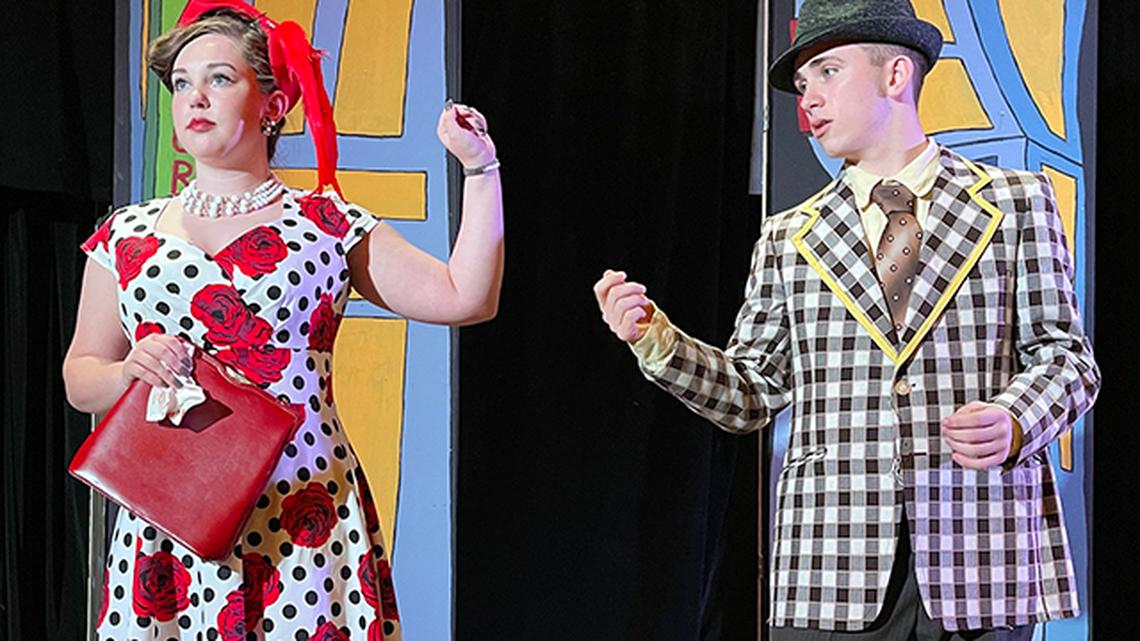
The only way Lisbon's Stage Left Players could continue its more than 15-year tradition of producing a show for students in grades 7 to 12 was to flip the script and rework the show for the COVID age, said Kandace Cleland, artistic director.
This year's 21-person cast of "Guys and Dolls" memorized their lines and songs and rehearsed choreography largely at home, using audio files of the music accompaniments and videos of the dance moves. Players wore masks during the show's few in-person rehearsals, which started in December, and used props that were regularly sanitized.
"They were awesome — so professional, so on top of their game," Cleland told Mahoning Matters, adding many were "one-take wonders" when it came time to record the show for streaming online.
They used mobile phones to record scenes on Stage Left's Trinity Playhouse stage and in front of outdoor set pieces found around town, before the worst of winter set in. Because they shot the scenes in smaller, safer groups and later spliced the footage together, some actors were able to play multiple roles, Cleland said.
"I'm proud of their work ethic. … They showed up, they did the work, they protected each other, they nurtured each other, and man — they pulled off some good stuff," she said.
But it just wasn't the same performing for an empty theater. Actors feed off the energy of a live audience, Cleland said — the applause, the laughter.
"[The show will] be funny. People at home will laugh," she said, but for her isolated actors: "We would wait and we would 'cut' and then we would applaud them."
Some of Stage Left's young actors have been putting on shows there since second grade, Cleland said. For those who've stuck with the troupe all that time, the annual youth show was the culmination of years sharing the stage with friends and their theater "family" — and their senior year "experience" had been stunted by the pandemic, Cleland said.
"These kids — a lot of them don't fit in any other place. They love music and they love acting, they love performance, a lot of them love dance. So, you have that personality that really needs that creative outlet. That's just who they are," she said.
"They might be more introverted kids that are welcomed in. I've had so many parents year after year say, 'My child bloomed here. They arrived awkward. They left confident, and they can stand up in front of 200 people and act and sing,'" she said.
"And it's just an amazing thing to watch kids develop that way. I think that's why it's been hard for that to be gone."
Stage Left Youth Players' latest production of "Guys and Dolls" debuted last weekend on the relatively new show-streaming platform ShowTix4U, which arose during the pandemic as an alternative to live performances, while still feeling "live."
Tickets are bought in advance for a one-time video stream that starts at showtime. Your private box seat is right in front of your streaming device. Playbill is even offering virtual programs which can be downloaded as a PDF, Cleland said.
This week's shows are set for 7 p.m. Friday and Saturday and at 2 p.m. Sunday. Click here to buy tickets; they're $12 for a single ticket and $40 for a family pass.
Last weekend, the show garnered a "decent" number of views, who were "very impressed," Cleland said. Many ticket-buyers made additional donations, which she said will help the theater.
Performing arts venues were allowed to reopen last year but with indoor capacity limited to 15 percent (the state, however, eased that restriction to 25 percent last month).
After paying for costumes, sets and the rights to produce shows, Stage Left expects to lose money putting on musicals, which it later recoups through fundraisers. But last year's restrictions made it entirely undoable, Cleland said.
The Trinity Playhouse only seats 130 people and would have been limited to just 19 usable seats (32 under new restrictions). The nonprofit theater's since survived on CARES Act funding and extra chip-ins from the community, she said.
"We're in good shape for the shape we're in. … It's been good in the bad times," Cleland said. "People have been very generous. They want us to be there for the doors to open. I'm very optimistic about that."
The show must go on
Canfield Local Schools administrators, spurred by pleas and a petition from the district's young performers and their parents to bring back in-person arts performances, worked with county health authorities to make this spring's band concert happen on March 18, albeit with limited capacity for families. The high school's auditorium can seat 920 people, but only 230 under the state's new restrictions.
They're also working with arts educators and the health department to ensure other shows can go on safely, like the district's May choir concerts — officials have yet to decide whether they'll remain virtual shows — and dramas and musicals.
Administrators previously rejected music directors' plans for a winter concert, said Dema Esper, Canfield's choir boosters president and parent of two students in the district's arts programs. Canfield singers are still participating in a statewide choir competition, but it's virtual this year and submissions are recorded, she said.
She and other student performers and their parents spoke out at a February school board meeting, urging administrators to light up Canfield's stage again. Of the district's more than 2,500 students, 120 students play in the band, 95 sing in choir and about 55 get involved in each theater performance, some of whom are also in choir or band.
"They miss performing in front of a live audience. It's not the same for them," she said. "Last year, they didn't get to perform. [For seniors,] this is their last concert. … We just don't want that opportunity to be missed.
"The arts, to us — what we believe as a parents group — only makes them more well-rounded as an individual. We just want to continue that exposure and balance."
But there are a lot of factors for administrators to consider, said Canfield Superintendent Joe Knoll — not just the well-traveled capacity, masking and social distancing guidelines, but also a potential rework of the auditorium's ventilation system.
They also remember how coronavirus spread after indoor athletics returned.
"I think a lot of people think sports went off without a hitch and that's not really true," Knoll told Mahoning Matters. "We had a lot of times where we had to 'sideline' or take a pause with our programs.
"When [athletics] came indoors, that made it really hard … even with all the protocols and procedures they had in place."
The district has reported 101 total cases of COVID-19, mostly among students, since Sept. 7, when the Ohio Department of Health started recording them. That's the second-highest total among all Valley schools, just behind Boardman Local Schools's 107 total cases, according to ODH.
The Ohio High School Athletics Association took point in regulating school sporting events by COVID-19 rules and even sent compliance agents to events, Knoll said.
So far, no state-level agency has stepped into that role for arts programs. But the Ohio Music Education Association now has a seat at DeWine's "table," according to Dr. Manu Sethi.
Sethi — an anesthesiologist and parent of Canfield senior Meera Sethi, drumline captain — advises a state-level committee formed by Canfield's band director in response to the pandemic's effect on band programs, he said.
Like other U.S. doctors, he's been following the ever-evolving science on COVID-19, but he said it's "a moving target." A state evaluation released in January suggested students who had close contact with a COVID-positive classmate while both were properly wearing masks at the time were just as unlikely to contract coronavirus as other classmates who weren't exposed.
DeWine has maintained that with near-universal mask compliance at Ohio's schools, the virus isn't spreading there.
Other recent studies that Sethi has read are "promising" for the safety of band programs, he said. The one consistency between them: performers stuck to the basic guidelines, wearing masks when not performing, staying socially distant and washing their hands.
"I think if you continue to do that — again, in my opinion — I would find it very hard to justify that a student playing an instrument in a band concert is at any higher risk than a kid involved in a wrestling tournament or a basketball game or a football game. That's the way I look at it," he said.
Knoll said Canfield administrators continue to meet with county health officials, who are reviewing the county's plans for future performances. Arts educators have told him the restrictions haven't affected any arts programs' schedules, he said.
"Coming to be a superintendent here, I knew the importance of performing arts," he said. "I was not surprised to hear the passion from our parents, community members or students. I know they're passionate in what they're doing. They're also supportive of my No. 1 directive, which is making sure we continue in-person learning.
"It's been a hard road to navigate, but I think everyone's been respectful of the decision that we've made."
This story was originally published March 11, 2021 at 3:52 AM with the headline "When will K-12 stages see a revival? While sports thrive amid COVID-19, schools are timid on arts."