
Youngstown mayor candidates Brown, Winbush and Hill speak to their plans, the city’s future
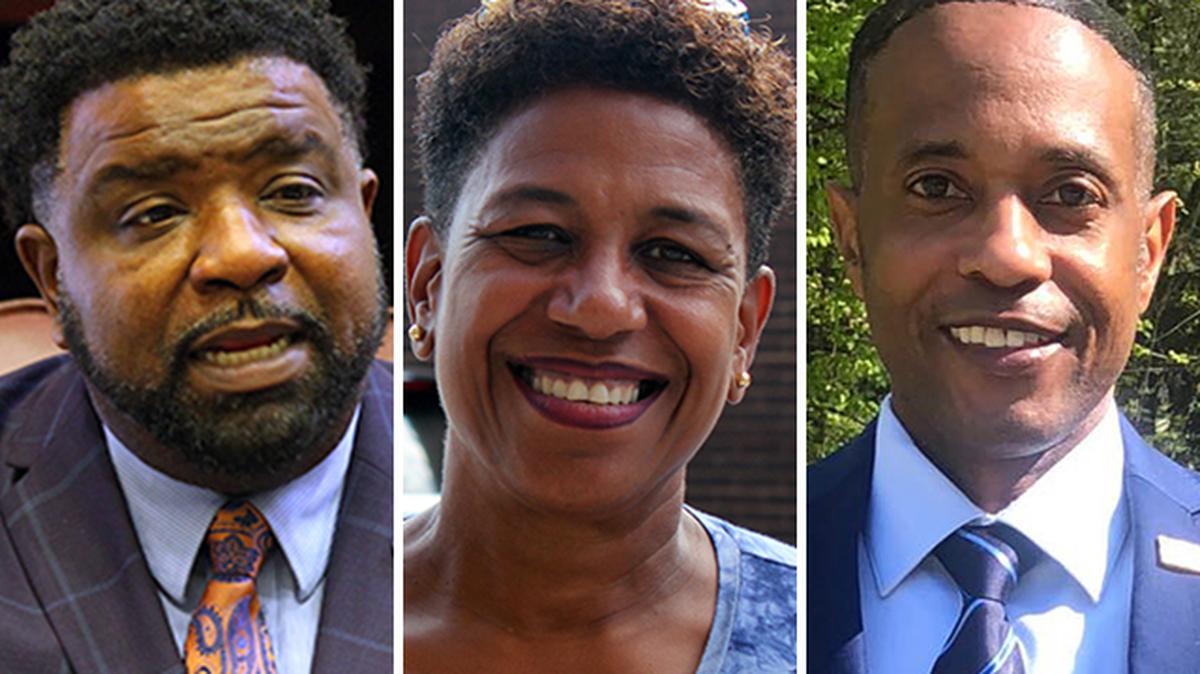
YOUNGSTOWN — Three candidates for Youngstown mayor will appear by name on city voters' ballots for the Nov. 2 general election.
Incumbent Mayor Jamael Tito Brown is the Democratic candidate, longtime political activist Tracey Winbush is the Republican candidate and local insurance agent and city courts supervisor Richard Vincent Hill has filed to run as an independent.
Mahoning Matters interviewed the three on their backgrounds and their plans for office, if elected.
Several other write-in candidates have also been certified for the general election on Tuesday: Calvin Hill; Cecil B. Monroe; Claudette R. Moore; Tayana C. Smith; Lynette Wesley; and Amber Leigh White.
For more information on other Mahoning County races and issues up for voter approval on Tuesday, see our Mahoning County voter guide.
The candidates' backgrounds
Brown, 49, graduated from Rayen High School and earned a Bachelor's degree in criminal justice from Youngstown State University. He also received a Master's degree in clinical counseling from YSU.
Brown is a former caseworker for Mahoning County Children Services. He also worked as a community organizer for Youngstown State University's Urban and Regional Studies Department. He has also served as Mahoning County's deputy treasurer.
Brown previously served on Youngstown City Council as a councilman from 2008 to 2011 and as president of council from 2011 to 2013.
He was also a member of the Youngstown City Schools education board from 2004 to 2007.
Brown was elected to his first term as Youngstown mayor in 2017, winning the Democratic nomination over the party-endorsed incumbent John McNally, then edging out independent candidate Sean McKinney in the general election.
Brown is now seeking his second term in office.
Winbush, 56, was schooled at Youngstown's Rayen, East and Mount Calvary schools, as well as Hubbard High School. But Winbush said she felt as if she never fit in, so she regularly skipped classes to spend time on the Youngstown State University campus. Though Winbush never formally attended college, it was on YSU's campus that she said she gained an informal education.
"My education comes from experience of life," she told Mahoning Matters. "I've been homeless, I've flown on private jets. I visited the White House and met with past presidents. I've lived paycheck to paycheck and I've had a surplus.
"I've seen one extreme to the other and I've lived it."
Winbush's background is in marketing and sales. She's also been a political consultant for the last two decades, she said. She owns a terrestrial radio broadcasting company at one time affiliated with stations in Youngstown and Cleveland, and most recently hosted the talk show "Tracey and Friends."
Winbush was also a Youngstown City Schools board member from 2000 to 2004. She unsuccessfully ran for president of city council in 2004.
Hill, 45, is a Cardinal Mooney graduate who earned his undergraduate degree from Youngstown State University. He also earned a Master's degree in public administration, with a concentration on economic development, from the University of Akron.
Hill currently works as a supervisor in the Youngstown Municipal Clerk of Courts' criminal traffic division, a position he's held for 21 years. He also owns Prism Insurance LLC, a home, life and business insurance company he founded in 2015.
The mayor's seat is Hill's first run at public office. When asked about his independent candidacy, he said neither the Democrat nor Republican parties are adequate reflections of his views.
"It's just become so polarized between the two parties that we really miss out on what the goal is: serving the people," he said. "That's why I identify as independent. It's not about partisan politics, it's about what's best for the community and what's best for the citizens.
"Unfortunately, there are people that are still hellbent on party lines … and that narrative has to change."
Why they're in the race
Brown said he feels he deserves another term as mayor because although "we have so many things moving in the right direction … we have so much more work to do."
He said city leaders faced many administrative challenges in his first three years — getting the city's budget in order and developing relationships with others. But it's now well-positioned for growth, he said.
"We now have a seat at the table at the state and federal levels which we did not have," Brown said. "People know Youngstown is open for business. You don't have to pay anybody, you don't have to owe anybody."
Winbush said watching Gov. Mike DeWine work to manage the coronavirus pandemic in early 2020 showed her "leadership matters."
She said she's "been in politics for a while" and said she feels the political arena too often prioritizes winning elections over what comes after, and whether the winner has a sound plan for after they take office.
"I was raised by the streets of Youngstown. My mom had me, but these people raised me. They are good people and deserve good leadership. That's why I'm running," Winbush said.
Hill, whose academic background is in government, said he hasn't seen any progress in Youngstown over the past four years. The city still ranks among the worst in the nation for poverty and crime statistics, he said.
"I see a path forward with my platform and I think with my experiences both academically and professionally, I think that I can position Youngstown to move forward."
What they hope to accomplish
Brown said the city must continue its work to eradicate crime — "Safety is No. 1," he said.
If elected, he would over the first 12 months work to boost the city's police roster and make sure they have "competitive" wages and salaries.
The city also has until 2024 to encumber its expected $82.7 million in American Rescue Plan funding, a process that will also be an immediate focus in his second term.
"We'll see businesses want to expand and relocate here. That'll be the bigger piece, where now Youngstown is now looked at as the place to go," he said.
That means continuing to improve the city's workforce to attract new business, but also to continue identifying "shovel-ready" sites, where new businesses can get building immediately.
Brown highlighted the city's last four budget cycles, which ended in the black, despite facing a $1.4 million deficit in 2019 and a $2.2 million deficit in 2018, which was his first year in office.
"We really focused on our needs rather than our wants. I think that's how we budget and how we provide service," he said.
Winbush said in her first year, she would focus on the makeup of city hall, re-examining its structure. She also said she wants to rework the city's salary schedule.
"I don't think the people here get paid enough to do the job well enough, to do what's necessary for the people that live here," she said.
Winbush said the city's safety service personnel "have not been appreciated or compensated as they should." She said the recalibration would also extend to other employees
Winbush added she thinks the city should operate its own EMS service out of the fire department, rather than contracting it out.
Looking farther out, Winbush wants to find ways to ease the city's income tax — "I'd like to say 'erase' but … 'ease,'" she said — and find ways to make the city's process for installing new businesses less cumbersome.
Winbush said she feels many city residents are one good job opportunity away from leaving the city behind for good.
"Right now, Youngstown has no anchor … besides that, it's cheap to live," she said. "But if you can't work, what does that mean?"
She said she wants to court blockchain and cryptocurrency companies, big data and more additive manufacturing.
"Right now, the world is resetting. Youngstown has to reset what it's going to be in the 21st century," Winbush said. "We can't allow others to come from outside and define us. Youngstown has to find where they're going toward the future."
She would also look to turn the city's former Northside Hospital, which closed in 2018, into a veterans hospital or long-term care center for senior veterans.
Hill said his platform is based on three pillars: preventing crime, improving public services and increasing fiscal responsibility.
"My No. 1 goal is to get crime reduced," Hill said. "I want to put controls in place in order to reduce crime and I want to increase the police force.
"Obviously, that means paying them higher wages in order to attract and maintain talent."
If elected, Hill said he'd also like to see the city police department reestablish specialized units, such as a vice unit, "in order to get back to proactive policing." He'd also look to establish more modernized, data-driven police initiatives like "risk terrain modeling," which better informs leaders about the areas where crime occurs most often and helps them identify the social services that can "get people the help they need."
Hill said he'd also establish "zero-based" budgeting in the city, a system in which all line items would have to be approved each budgeting cycle — none of them would be taken for granted.
"We'll be able to see where the waste is. We'll be able to increase our year-over-year reserves," he said.
Through better budgeting, Hill said he hopes to improve the city's bond rating by the end of his first term. Currently, the city has a Baa1 bond rating, the eighth-highest on Moody's credit scale. Hill said he would aim for the highest AAA rating.
How they would spend $82.7 million in American Rescue Plan funds
The City of Youngstown is set to receive $82.7 million in American Rescue Plan funding, which can be applied to a broad range of needs, including infrastructure projects, COVID-19 mitigation and additional pay for frontline workers.
Though city leaders are expected to develop a spending plan based on input from a series of community listening sessions, Mahoning Matters asked the mayoral candidates what they feel is the biggest spending priority.
Brown said many citizens who participated in a series of listening sessions that sought input on ARP spending hoped it could be spent on the city's deteriorating roads. Roads are not, however, an applicable use under U.S. Treasury guidelines.
"For me, it's the infrastructure under the roads," Brown said.
Brown said he would prioritize removing lead pipes in the city's water infrastructure, which he says has a direct impact on the city's high infant mortality rate. ARP funds could also fund more paint remediation in the city, he said.
Another priority would be helping small businesses recover from the COVID-19 pandemic, he said.
"The last piece is neighborhoods," Brown said — targeting blight along corridors that are marked for further improvement.
When Brown took office in 2018, there were about 3,000 vacant properties in the city. There's now nearly half as many, he said. WIth more blight removal, residents' "sense of pride" in their neighborhoods will return, he said.
Winbush said she would put some of the funding toward the city's safety services, including personnel, facilities and establishment of a city-operated EMS service, which would solve reportedly long wait times for ambulance service in the city, she said.
"Until [you] secure the safety of the city, you don't have anything," Winbush said.
Hill said the first priority on his list would be the city's water infrastructure. The city's "old" water system has one of the highest concentrations of lead-based pipes in the nation, Hill said. Lead intake is linked to severe health and cognitive development tissues.
The COVID-19 pandemic has also revealed service inequities that could be addressed with ARP funding, such as the digital divide which will continue to hinder workers and students from households without inexpensive, reliable access to high-speed internet.
"This is a great opportunity to right some of those wrongs," he said.
Hill said he'd look to help develop a regionalized system that would reduce per-person costs.
He'd also offer more premium or "hazard" pay to essential or frontline workers amid the pandemic.
Why people should vote for them
Brown said when he came into office in 2018, he told voters he "wouldn't cave" to money, power or politics.
"That's been my mantra. I've remained true to put the residents of Youngstown first," he said. "We've come so far, but we're not where we want to be. I'm just asking to continue the forward progress that we're making. We're at a pivotal point. We want to make sure we make a lasting impact on this community moving forward."
Winbush said voters who want to see the city grow, change and continue to adapt to the 21st century should vote for her.
"The majority of people in Youngstown are waiting for a phone call that's going to move them out of the city," she said. "We have a great city with great people. It just doesn't have opportunity, and we've got to change that."
Hill said he's the only candidate whose academic background is specifically tailored to the job.
"I have a plan. I'll execute that plan. Most importantly, I'll have a competent administration," he said. "[Voters will] see their quality of life improve. … It's going to be my priority."
This story was originally published October 28, 2021 at 3:52 AM with the headline "Youngstown mayor candidates Brown, Winbush and Hill speak to their plans, the city’s future."