‘The powerhouse’: A roadmap to making Voltage Valley, Northern Appalachia an energy storage hub
The Northern Appalachia region, which includes the Mahoning Valley, is well-positioned to become a hub for the fast-growing energy storage industry, according to a Cleveland State University study commissioned by BRITE Energy Innovators in downtown Warren.
Among the most important takeaways: It’s cheap to live here, and the Youngstown area, specifically, has a workforce that’s 3½ times more specialized in the proper field.
“As we’re part of national conversations to reshore manufacturing and secure a domestic supply chain, this study confirms how Northern Appalachia not only compliments but is critical for the creation, production and adoption of energy storage technologies,” Sara Daugherty, BRITE’s chief of staff, is quoted in a news release. “For instance, the study identifies how our region is positioned for the uptick in lithium battery manufacturing for the transportation sector.”
Powering up
Energy storage products like those lithium batteries — which allow power to be captured and used later — have become one of the nation’s main strategies to reduce carbon emissions, according to BRITE.
According to the study conducted by CSU’s Maxine Goodman Levin College of Urban Affairs, the Department of Energy expects energy storage consumption to reach 2,500 gigawatt hours per year by 2030. Four years ago, it was about 500 gigawatt hours, the data shows.
“While consumer electronics drove much of the energy storage industry in the 2010s, the DOE now projects transportation applications, pushed by electric vehicle adoption, will drive energy storage industry growth in the 2020s,” it reads.
Among the region’s other strengths: It’s home to “strong research institutions” like Youngstown State University and it has a high concentration of engineers and a wide manufacturing base.
Youngstown’s workers are more than 3½ times more specialized in materials engineering, compared with the national average, according to the study. That’s second only to Erie, Pennsylvania, whose specialization is four times higher.
Youngstown’s average price of goods, services and housing is also nearly 15% lower than the national average, according to U.S. Bureau of Economic Analysis data — the lowest among the 14 metropolitan areas surveyed for the study.
“Northern Appalachia’s legacy in the energy industry makes it a natural fit for the development of energy storage manufacturing clusters,” said Mark Henning, research associate at CSU’s Energy Policy Center, who authored the study.
“These legacies have led directly to occupational specialization in key engineering and technical fields compared to the U.S. in general. This, coupled with the low cost of doing business in Northern Appalachia, gives the region a strategic advantage for cluster development for energy storage. This is further supported by the research culture found in the regional universities and laboratories.”
If you build it …
To BRITE President and CEO Rick Stockburger, the study is the evidence economic development groups like TeamNEO and JobsOhio can use to attract new industry. They’re actively courting supply chain businesses in Eastern Asia.
“Research like this is what’s going to get them to pull the trigger. This is third-party research that says, ‘This place has all the things we need,’” he said.
Step two, he said, is ensuring Ohio policy is “forward-thinking” on electrification. Support for public policy on energy storage was identified as one of the Northern Appalachia region’s weaknesses, along with renewables’ low adoption rate and the low cost of energy overall. While cheap energy is a boon for manufacturing, higher energy costs are a bigger driver toward storage technologies, according to the study.
“I think we made major mistakes as the coal industry declined,” Stockburger said. “Right now, the internal combustion engine automobile is declining, and we know it is. That is what the market is saying. This region can take advantage of the opportunity and make sure that we are the powerhouse of electrification and storage.”
A $25 million proposal to develop a state electric vehicle task force, introduced in March by state Sen. Michael Rulli of Salem, R-33rd, had its third hearing in the Senate’s Energy and Public Utilities Committee last month.
“In 2020, the Mahoning Valley received more economic development investment than any other region of Ohio, primarily because of more than $2 billion of investment in electric vehicle manufacturing,” Guy Coviello, president and CEO of the Youngstown/Warren Regional Chamber, told the committee in April.
“In 2021, the Youngstown-Warren-Boardman metropolitan statistical area experienced more new job creation per capita than the other three northeast Ohio MSAs, primarily because of thousands of new jobs in electric vehicle manufacturing.”
Who’s at the table?
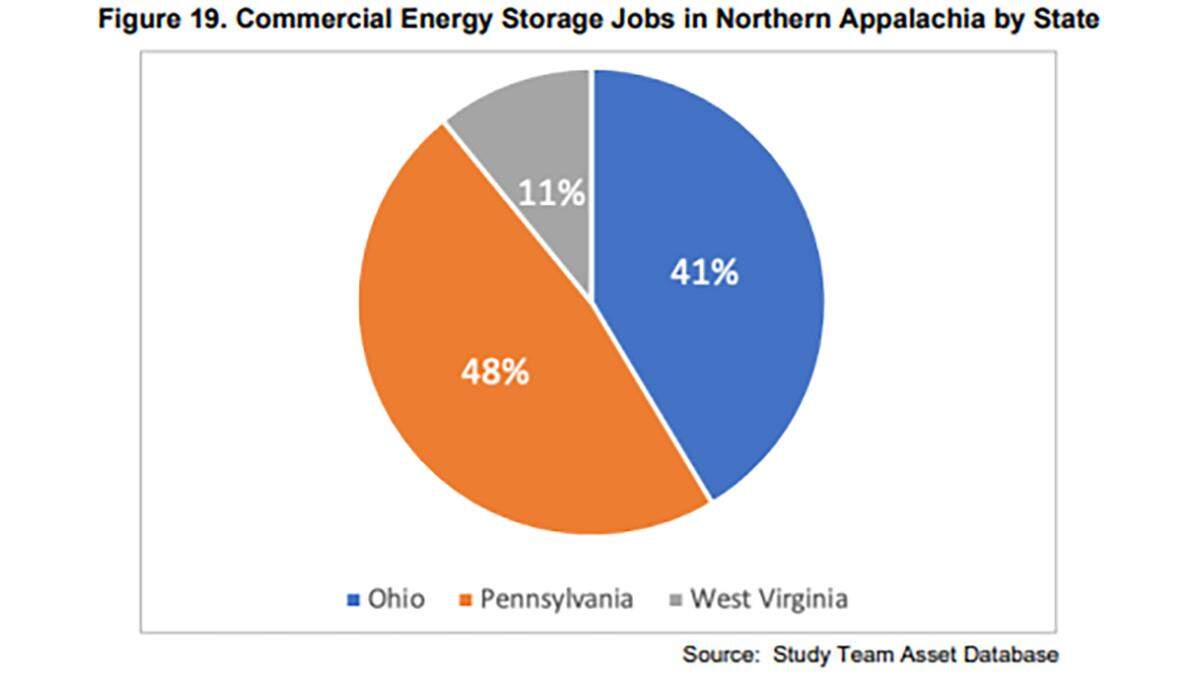
The Northern Appalachia region includes Mahoning, Trumbull, Columbiana and 29 other Ohio counties — where 17% of the state’s population lives — 52 Pennsylvania counties and all of West Virginia.
It’s home to more than 17,000 workers employed by more than 200 companies in energy storage or adjacent fields, according to the study. More than a dozen of those companies have a local footprint. The industry’s rapid local growth encouraged leaders to rebrand it as “Voltage Valley.”
In Trumbull County, Taiwanese manufacturer Foxconn intends to manufacture the all-electric Endurance pickup truck developed by Lordstown Motors Corp. at its newly acquired 6.2-million-square-foot Lordstown assembly plant, and it is partnering with Fisker Inc. on a smaller electric SUV that will also be built there.
A stone’s throw away, Ultium Cells, a $2.3 billion joint venture between General Motors and South Korea’s LG Energy Solutions, is ramping up to start producing the lithium-ion batteries to be used in GM’s upcoming electric lineup.
Lithium-ion recycler Li-Cycle is also setting up its largest facility to date at the Ultium plant.
In downtown Warren, BRITE assists energy technology startups as the state’s only energy incubator.
The study also identifies eight other adjacent enterprises in the Valley:
- Ajax TOCCO Magnethermic Corporation in Warren;
- Datco Manufacturing in Youngstown;
- General Extrusions Inc. in Youngstown;
- Graybar Electric Co., which has warehouse and sales locations in Youngstown;
- Kiraly Tool and Die Inc. in Youngstown;
- Novelis, which has a facility in Warren;
- PPG Industries, which operates near the Lordstown assembly plant;
- Zabrana Aluminum Extrusion in Columbiana.
Read the full study below: