
Housing insecurity is more likely if you’re queer — where are the services in the Valley?
LGBTQIA+ individuals are at a higher risk of homelessness and are less likely to be accepted by homeless shelters. Local advocates say there are few options for them here in the Mahoning Valley.
Full Spectrum Community Outreach Center, the Mahoning Valley’s only LGBTQIA+ center, said there is only one shelter in the Mahoning Valley that welcomes LGBTQIA+ youth — Youngstown’s Daybreak Youth Crisis Center, operated by COMPASS Family and Community Services — and none that are inclusive to LGBTQIA+ adults.
“We get, on average ... probably three to five calls a month of someone in the LGBTQIA+ community who’s in need of housing,” said Katie Salupo, the center’s housing director.
“The large adult shelters in our area either deny LGBTQ clients services or clients have reported that they were mistreated while there. We do have a couple very small [women-only] shelters, who will take LGBTQ women if they have space, but there is nowhere to recommend for adult males.”
Youngstown’s faith-based Rescue Mission of the Mahoning Valley emergency shelter last year provided more than 24,000 men, women and children with overnight stays, said President and CEO John Muckridge. He refutes claims that there are no queer-inclusive shelters in the area.
“We have folks that can come and stay at the Rescue Mission if they’re ... identifying as part of the LGBTQ,” Muckridge said. “Two weeks ago we had somebody stay over on our men’s side that would identify as a homosexual.”
The Rescue Mission’s shelter is separated by sex. Transgender individuals are placed based on “the way God made them”, rather than on their gender identity, said Muckridge.
“Because of the safety and security of that individual, as well as the other individuals in the house, we identify that God is the one who assigns gender,” Muckridge said.
Young queer adults are more than twice as likely to experience homelessness than non-queer adults, according to a 2018 study by Chapin Hall at the University of Chicago.
And emergency shelters are not always a welcoming or safe environment for queer people. According to The National Coalition for the Homeless: “Frequently, homeless LGBTQIA+ persons have great difficulty finding shelters that accept and respect them. LGBTQIA+ individuals experiencing homelessness are often at a heightened risk of violence, abuse and exploitation compared with their heterosexual peers.”
Sometimes their homes are stripped from them solely because of their sexual orientation.
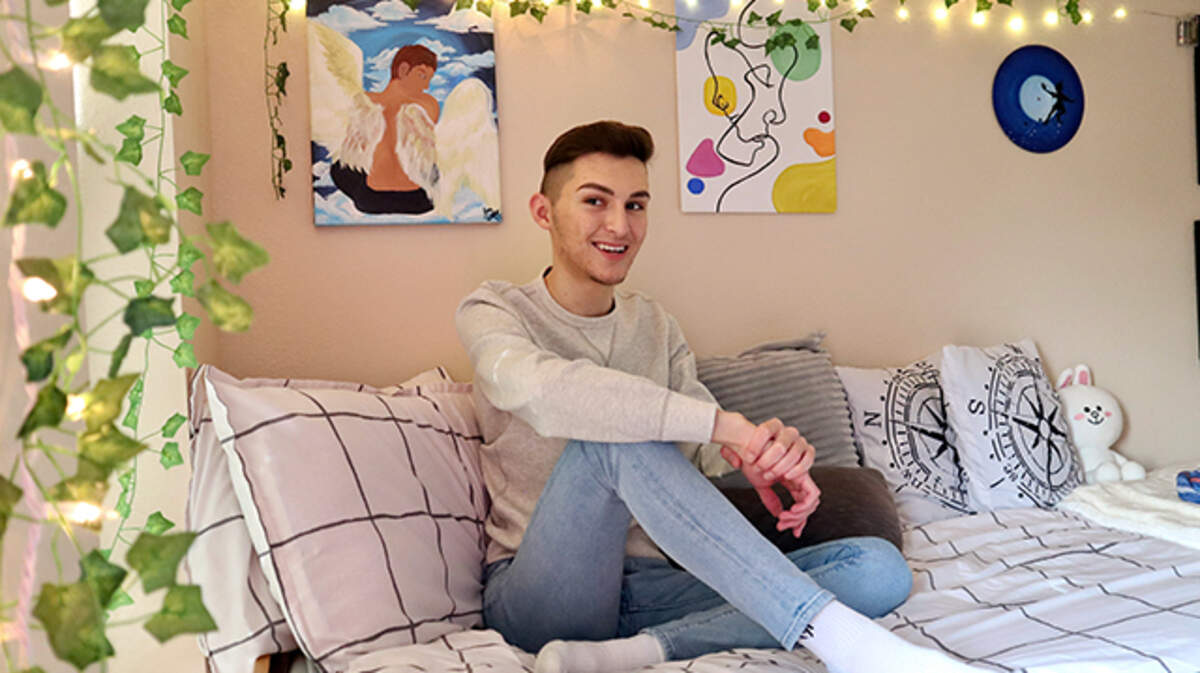
Trevor Walton of Kent was 16 when he came out as gay to his conservative mother. It was half-an-hour past midnight. Prom was right around the corner and he wanted to go with a guy. He knew his mother would not be supportive, but he said he couldn’t continue to conceal who he was.
“I can’t hide this anymore, I’m not going to be happy,” Walton thought.
So, he told her: “I’m gay.” After a domestic altercation with his mother a week later, police removed him from the home.
Walton moved in with his cousins, but that arrangement didn’t last. He was hospitalized during a mental health crisis and his cousins realized they weren’t prepared to foster him, he said.
The foster care system eventually placed Walton with his best friend’s family — the best scenario in a less-than-ideal situation.
Walton, now an adult, is a Kent State University student and lives in a dorm. The dorm gives him a place to stay during the fall and spring semesters, but not during the summer. As a legal adult, his former foster family has no legal obligation to provide him with housing, and they won’t let him return, he said.
Walton was able to get scholarships to cover his housing costs for last summer, but this summer he is not sure where he is going to stay or how he is going to pay for it.
“I don’t know what I’m going to do,” he said. “I want to study abroad in June and I’m going to get my own apartment next year. But, I don’t know how I’m going to pay for it because I’m already doing two jobs to cover tuition and it’s stretching me very, very thin.”
Trans individuals are at an even higher risk of homelessness. The National Center for Transgender Equality estimates that 20% of transgender individuals have experienced homelessness at some point in their lives, largely attributed to family rejection, discrimination and violence.
Salupo claims that some of the emergency shelters in the Mahoning Valley have denied trans people based on their gender identity.
“We have a couple of shelters in the area that are Christian-based that don’t allow really any transgender people at all,” Salupo said. “Just last week, we had a 21-year-old transgender girl turned away from one of our shelters just for being transgender.”
Lily Rice of Painesville, who came out to her family as transgender when she was a minor, and left home because she felt unsafe, questioned whether gender policies like the Rescue Mission’s are the safest option for trans people, but said she doesn’t think there are any “good” answers.
“Is that a good measure? No. Is just sticking anyone who identifies as a woman with women a good measure? I don’t think so either,” she told Mahoning Matters. “I think we’re at this point in human progression as a society that we haven’t, we haven’t found the good answers yet.”
Full Spectrum wants to bridge the gaps in services for at-risk LGBTQIA+ individuals — but it needs funding. The center proposed a new facility to provide safe housing for queer people, which could keep LGBTQIA+ individuals out of emergency shelters altogether, Salupo said.
The center has raised $25,000 through letter campaigning and donations to purchase a four- to five-bedroom house that would house both the center’s offices and four or five queer individuals in need of emergency shelter or transitional housing.
The center hopes to raise another $100,000, and has applied for COVID-19 relief grants through the city of Youngstown and Mahoning County, Salupo said. Donors can give to Full Spectrum through its PayPal account.
“If someone isn’t in a stable living environment, a clean living environment, one they could afford, something that’s safe, they’re not going to be able to be OK,” said Youngstown Health Commissioner Erin Bishop.
Currently, Full Spectrum Outreach sends queer individuals who are searching for safe emergency housing to Pittsburgh or Kent, but Salupo said that is not ideal.
Bishop agrees.
“Why do we have to send our … residents away from our city, because there isn’t a place where they feel welcome?” she said.
Full Spectrum’s housing project would keep queer individuals experiencing housing insecurity in the community that they know. It would provide an alternative to traditional emergency shelters that can put queer people in harm’s way, she said.
“People don’t want to leave the area that they’re used to that they know that they call home. But we literally have nowhere to send them here,” Salupo said.
This story was originally published November 30, 2021 at 9:55 PM with the headline "Housing insecurity is more likely if you’re queer — where are the services in the Valley?."