
Youngstown State confirms more faculty cuts; new notices issued Monday
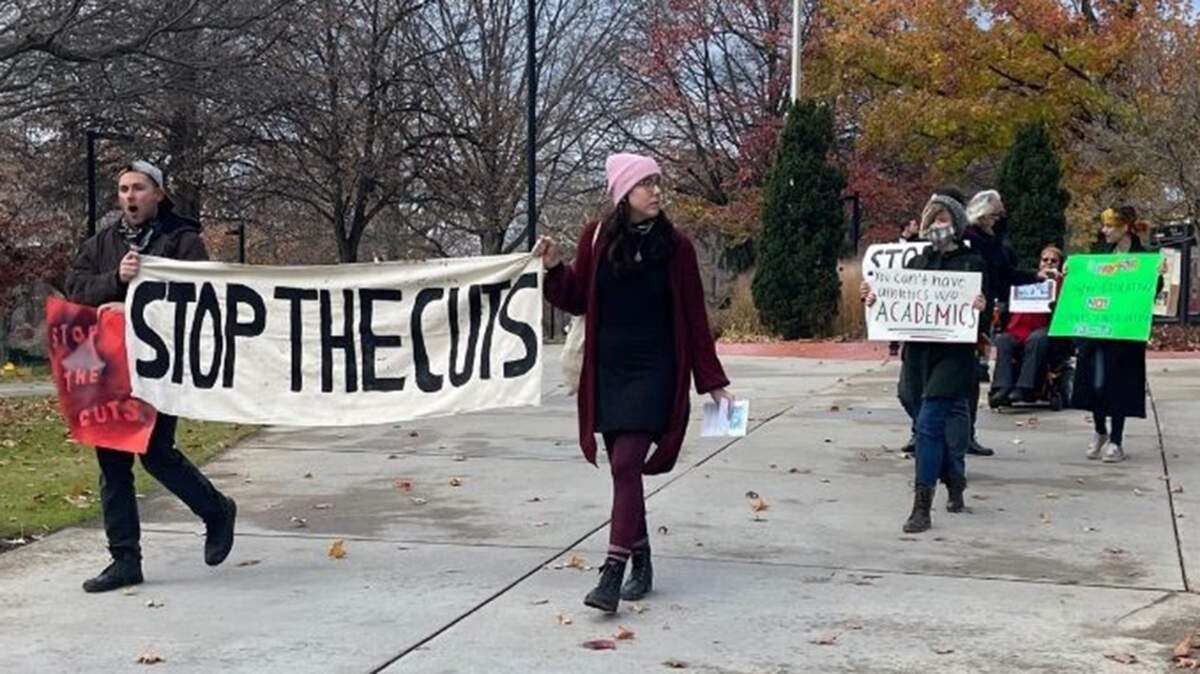
Seven Youngstown State University faculty members were told Monday their contracts won’t be renewed for the fall 2021 semester. Another nine faculty members received non-renewal notices late last year — part of a cost-cutting measure due to declining enrollment.
University spokesperson Ron Cole confirmed the notices were given to three lecturers from the Beeghly College of Liberal Arts, Social Sciences and Education, two from the College of Science, Technology, Engineering and Mathematics and two from the Bitonte College of Health and Human Services.
Neither school officials nor faculty union representatives could name all the affected faculty members Tuesday.
Cole said the seven non-tenured faculty members were employed for the 2021-22 academic year and faced the possibility of not being renewed at the end of that year, based on the needs of the university.
The two STEM lecturers were funded through a grant, which is expiring at the end of the academic year, Cole said, so the funding is no longer there to continue the contract.
“The reason for the other five non-renewal [notices] is mostly related to the academic program review process that continues across campus, all of which is focused on ensuring the efficient delivery of relevant quality academic programs,” he said.
Mark Vopat, spokesperson for YSU’s Ohio Education Association union membership, said the union plans to review the notices to ensure that each of the individuals were properly notified.
“We continue to be dismayed with the university’s decision to use full-time faculty as a cost-cutting measure,” he said, adding the jobs provide financial stability and benefits.
Cole said the deadline to notify lecturers of their non-renewal is March 1, and the university does not expect to send any additional non-renewal notices before then.
The faculty cuts are in response to the sunset of 26 academic programs with little to no enrollment — a cost-cutting measure intended to help the university invest in other programs with the potential for growth.
YSU reported a record-low student enrollment of 11,298 in the fall 2021 semester, a decline of 1,398 students from the prior fall.
If student enrollment continues to decline in the 2022-2023 school year, the university could face a revenue shortfall of at least $10 million, Neal McNally, vice president for Finance and Business Operations, told Mahoning Matters.
The university estimates a $5.6 million structural deficit and implemented cuts in response.
Cole said the university will save nearly $477,000 per year from the combined salary and fringe benefits for the seven lecturers whose contracts were not renewed.
“These are difficult actions that impact the lives of talented members of our YSU community, yet they are necessary to help ensure the university’s long-term academic vitality and to position us for continued success,” he said.
Vopat said the university has not addressed how cutting programs and faculty positions will help with the $10 million deficit.
“We’re not exactly clear on how they can be looking at reinvestment when these cuts are not going to come anywhere near to the amount of money they need,” he said.
Late last year the university announced nine faculty members had received notices of retrenchment or non-renewal. Along with the seven faculty members who were notified on Monday, a total of 16 faculty members have received retrenchment or non-renewal notices since last fall.
Administrators projected fewer than 20 faculty members would be let go this academic year.
Charles Howell, dean of the Beeghly College of Liberal Arts, Social Sciences & Education, told Mahoning Matters one Italian lecturer and two first-year composition lecturers received non-renewal notices Monday in response to the program cuts happening in the college.
“[The three lecturers] are all in areas which have declining enrollments, so the existing staff will be able to cover all of the courses that they would have taught,” he said.
A world language endowment
Alessia Mingrone, a visiting lecturer in the Beeghly College, was the Italian lecturer.
Mingrone said she started teaching Italian language and literature courses, English courses and a foreign film course at the beginning of the fall 2021 semester.
Her position was funded by the David and Helga Ives Distinguished Visiting Humanities Scholar, which was established in 2016 specifically for world language programs, Mingrone said, adding the university contributes little to her position.
“Lately there’s just been an overall panic sensation in the department, especially for people who have been working in the department for years,” she said. “We’re not really sure how exactly they’re going about making the decisions.”
Mingrone said her position seems like an easy target for the university to not renew since she was on a visiting contract.
“I’m not sure why there’s so much focus on cutting everything in terms of Italian because so many of the students are of Italian heritage. … That’s really why it’s such a bummer,” she said.
Mingrone said many of her students are “upset and complaining” about the impending loss of the Italian major.
Now that the endowed position will no longer be available, Mingrone said only one Italian professor will remain at the university. Mingrone said she is also considering moving out of the area.
“I’m not sure if anything else will be offered aside from just the language classes, with the minor being taken away,” she said. “I honestly don’t think much else will be offered in Italian.”
Looking to reinvest
Howell told Mahoning Matters he does not believe the layoffs will impact students enrolled in the college.
“We’re always sorry to have talented instructors leave, but on the other hand we do have declining enrollment,” he said. “We have ascertained that what they taught can be covered by other instructors very effectively.”
Howell reminded that as enrollment is expected to continue to decline through 2037, a substantial budget deficit is anticipated for next year.
“It is a challenging time, but we believe that we will be a smaller but very high quality institution at the end of this process,” he said. “This is all part of our resizing, to make sure that we can meet our budget and that we don’t have any fiscal shortfall.”
University officials have said they expect the cuts to non-growth academic areas will lead to reinvestment in areas with the potential for growth.
Vopat said the union continues to object the dismantling of cultural programs like the Center for Judaic and Holocaust Studies and Islamic Studies Centers at the university.
“They cost the university very little and have a great benefit. … I guess we wonder where the end is and when they’re going to look at other sources to make up for the shortfall.”
Of the 26 programs set to end next fall semester, 10 programs have no students and three have just one. Six other programs, however, have between seven and 12, according to the university: Manufacturing Engineering; Medical Laboratory Technology; Creative Writing; Gerontology; Electric Utility Technology; and Computer Information Systems.
This story was originally published February 23, 2022 at 5:00 AM.