Appeals court rules Mill Creek MetroParks ‘abused its discretion’ in eminent domain action
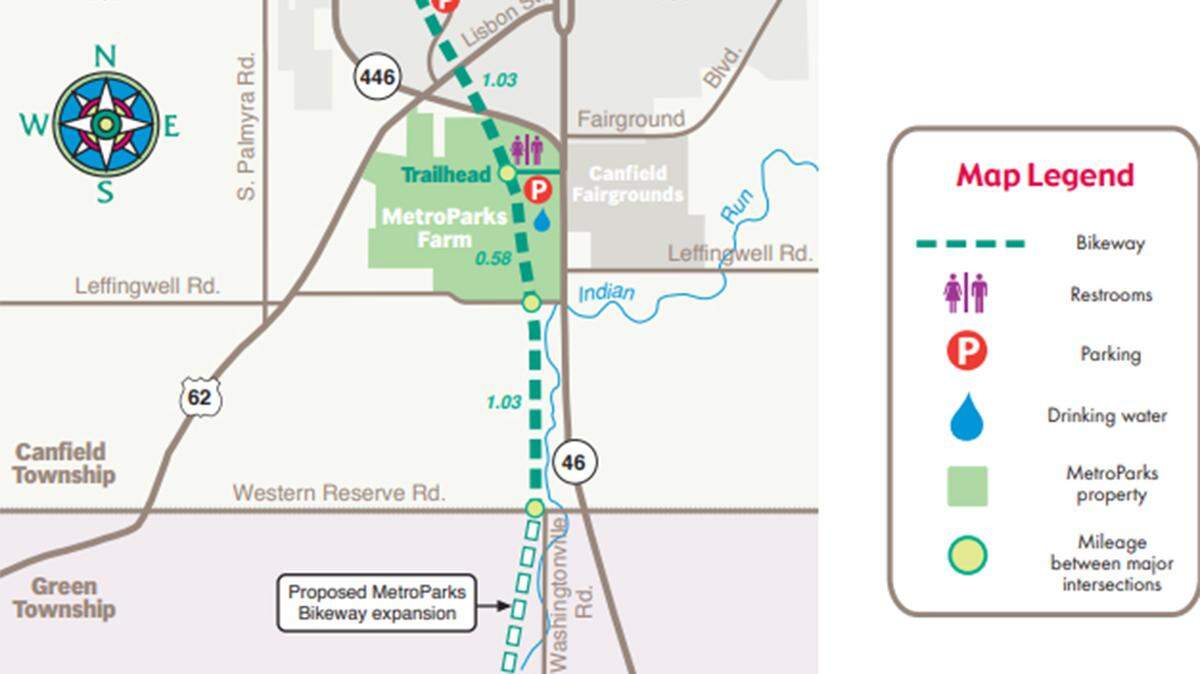
Ohio appellate judges on Thursday ruled in favor of private landowners in Green Township, from whom Mill Creek MetroParks is attempting to acquire land to complete a 100-mile, multicounty public bikeway that’s been long in the making.
Diane Less, a Green Township resident who is also the director of Angels for Animals in Canfield, is still fighting the MetroParks’ acquisition. Though a Mahoning County Common Pleas Court judge in June 2020 declined to rule in her favor in two related cases, the appeals court reversed both decisions on Thursday.
The court also determined the MetroParks “abused its discretion” in approving a resolution to acquire the property through eminent domain, since the land’s proposed use falls outside the scope of its authority.
The MetroParks has been in litigation for years with mostly private property owners to appropriate about 30 acres along a 6.4-mile span, where the proposed bikeway would run through Mahoning County, and connect to a 100-mile bike trail spanning Ashtabula to East Liverpool.
Most of the property sought is along abandoned rail lines, but in some cases, the proposed trail would run through or near private property.
Less released a statement Thursday saying the appellate court can now be added to the list of local and state officials who have pushed back against MetroParks’ plan.
State Rep. Al Cutrona of Canfield, R-59th, crafted a 2021 state budget bill amendment barring park districts from acquiring private property for recreational trails. His predecessor, former Rep. Don Manning, sponsored similar legislation before his death in March 2020.
“If [MetroParks officials] think it is OK to try and take our property, why don’t they give up some of their property?” Less wrote Thursday. “Doesn’t have to be for a bike trail, they can have a community swing set, playground, bird watching station or picnic table on their property if they think eminent domain is such a great idea. I bet they say no comment or more likely hide and won’t even answer.”
MetroParks officials received the appellate decision Thursday but declined to comment on it, as they had not yet conferred with attorneys, Executive Director Aaron Young told Mahoning Matters.
The parks’ proposal would have split 6 acres from Less’ South Range Road property in Green Township with a 65-foot wide swath for the proposed trail, she told The Vindicator in March 2019.
The MetroParks offered her $13,650 for the land, according to the opinion.
Less has long urged the MetroParks to consider an alternative route along public property in Washingtonville Road.
In Mahoning County Common Pleas Court, Less argued the MetroParks’ plans for the property and their reasons for acquiring it through eminent domain don’t align with state law. She asked the court to rule in her favor before bringing the cases to trial but was denied. She appealed to the Seventh District Court of Appeals in Youngstown in July 2020.
Fourth District appellate judges assigned to the case after local judges recused themselves reviewed decades of Ohio litigation — some of the cases were a century old — but found little precedent that properly fit the eminent domain situation in Green Township and the bikeway sought by the MetroParks, according to the opinion.
Under state statute, park districts can use eminent domain to acquire land for “conversion into forest reserves or or the conservation of natural resources,” so long as it’s for the general public welfare.
Fourth District appellate Judges Jason Smith and Peter Abele ruled though park districts have the authority to appropriate private land for the public good, statute suggests the Ohio Department of Natural Resources is the only agency able to acquire land specifically for recreational trails. They also considered whether a bikeway would satisfy the other requirements for appropriation — that it “supplies a human need” or contributes to the community’s well-being or “proper enjoyment of its property.”
“We do not agree with these principles, however, especially when applied to a rural area where it appears the public need is speculative at best and the harm to the private property owners is great,” the judges wrote.
“Many things provide for public recreation: movie theaters, shopping malls, bowling alleys, etc. However, just because those things provide recreation does not mean they constitute the conservation of natural resources. We believe the same may be said of a bikeway.”
Fourth District Judge Michael Hess gave a dissenting opinion, asserting that the appellate court lacked jurisdiction over the matter, since the Mahoning County Common Pleas Court did not issue a “final” order that could be appealed.
This story was originally published April 15, 2022 at 5:00 AM.