
Black coalition demands police reform; local chiefs engage
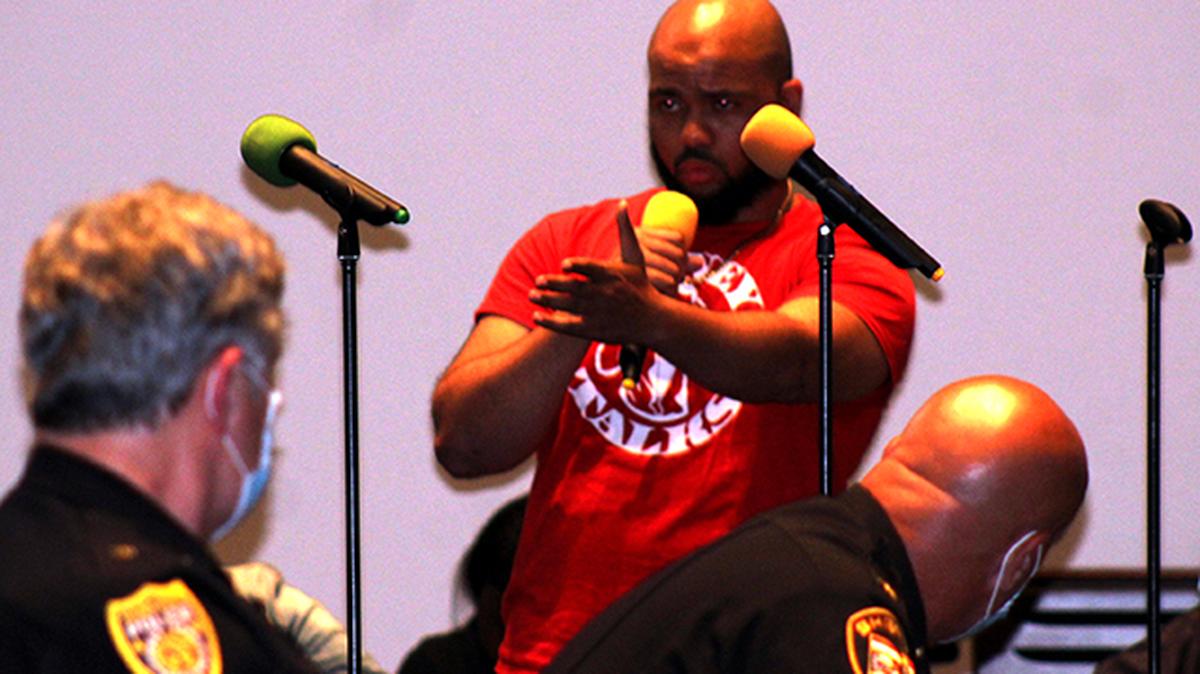
YOUNGSTOWN — Racial profiling is more than having your face "slammed" on the hood of a car while the engine's still hot; more than being choked by the knee of a police officer.
It's psychologically and economically damaging, said Keith Logan.
He and others moderating a Tuesday public forum on improving racial justice in Mahoning Valley police work posed direct questions on racial profiling, excessive force, the use of body cameras and citizen review boards to local law enforcement officials.
Tuesday's forum at New Bethel Baptist Church along Hillman Street was the first in a series of public town halls to tackle several demands for police reform called by the Next Steps Coalition, composed of Black community members of all ages.
Tei'asa Simms, who, like other Tuesday forum moderators, is affiliated with the Academy of Urban Scholars public school in Youngstown, made it clear to the local police chiefs gathered on the church stage that the coalition is "demanding" — not asking — for reform.
"If you're sitting on this stage and you don't feel there needs to be police reform, you need to turn in your badge and resign," Simms said at the outset of the two-hour forum, drawing applause from the crowd of nearly 100.
Though Warren, Campbell and Lowellville police departments were invited and expected to participate in the Tuesday forum, chiefs from those departments did not attend.
Jaladah Aslam, president of the Youngstown-Warren Black Caucus and one of the Tuesday forum's coordinators, said Monday invited departments were urged to send representatives if chiefs were unavailable.
Nearly a dozen chiefs did attend: Youngstown police Chief Robin Lees; Mahoning County Sheriff Jerry Greene; Boardman Township police Chief Todd Werth; Canfield police Chief Chuck Colucci; Austintown Township police Chief Bob Gavalier; Milton Township police Chief Chuck VanDyke; Hubbard Township police Chief Todd Coonce; Beaver Township police Chief Carl Frost; Girard police Chief John Norman; Mill Creek Metroparks police Jim Willock; and Ohio State Highway Patrol Canfield Post Lt. Brad Bucey.
When asked how citizens can become involved in reforming use-of-force policy, Mahoning Sheriff Jerry Greene said the issue is complicated by police unions and contracts. He again expressed support for recent state recommendations to establish a police misconduct database, which chiefs can use to inform their hiring decisions.
He also explained the contractual boundaries imposed on police discipline.
"One of the worst things we've seen in our line of work is when we have an officer who's absolutely horrible but they haven't done anything yet to where you can make a move and get rid of them," Greene said. "When you finally do fire them, they get picked up somewhere else.
"If you're a police officer who has to worry about what's on your record, you shouldn't be working — period," he said, to applause.
Moderator Lester Scott, whose questioning focused on the creation of independent police review boards comprised of citizens, said Tuesday he'd been pulled over by police while driving through — as they described it — a "high drug area."
Police told him he could avoid a ticket if he allowed them to search his vehicle.
"In my heart of hearts … [I know] I was pulled over because I was a young, Black man blasting rap music with my hat pulled to the back," Scott said. "In those situations, I felt violated. I felt frustrated. I felt I could never trust a police officer to police fairly in my community.
"Any citizen of this country should not have to live with this anxiety of, 'It's a possibility I could get pulled over because I'm Black,'" he continued. "We want more accountability. We want more engagement. We want more community-style policing, where you know this neighborhood; you've been here."
Canfield's Chief Colucci acknowledged racial profiling is still an issue in police work, but it's up to police administrators to ensure they're hiring the right people.
Austintown's Chief Gavalier, whose department regularly reviews traffic stops for racial disparities, said, "I'd be a fool to say it never happens. … But there are steps in place to try and stop that."
Though the state patrol's Lt. Bucey said the patrol's traffic stops include racial data — making it obvious when a trooper begins "stepping out of line" — Boardman's Chief Werth said it's not logged for local police departments, though he feels it should be. Responding officers are required to report it themselves, he said.
Werth said the department will begin reviewing the about 5,000 traffic stops Boardman police conducted last year for racial disparities. Of the department's nearly 2,000 arrests last year, officers used force in nearly 80, about a third of whom were Black, he said.
While local chiefs said Tuesday's forum offered perspective on the concerns of the Black community, forum moderators also appeared to learn more about police work and the public disclosure process on Tuesday.
Milton Township's Chief VanDyke asked whether Blacks who felt profiled or victimized by police filed formal complaints with the department.
"If we don't know [about] it, how are we going to fix it?" he said, drawing murmurs from the crowd.
Speaking on the implementation of citizen review boards, VanDyke — who teaches police supervision — explained police departments serve at the discretion of municipal leaders and recommended residents get more involved in the local policymaking process.
"I can't get my citizens to a township meeting. I can't get my citizens to get involved with the police," VanDyke said. "The first step is communication. We need to be able to communicate freely with our citizens. We need them to want to interact with us and engage with us and have those conversations. So, this kind of forum is a first step."
Aslam said Tuesday's forum was the first step in a series of local conversations on where race intersects with police work. Some of the other initiatives the Next Steps Coalition is seeking include: independent investigations and prosecutions of police misconduct, appropriate punishments for police misconduct and mandated diversity training.
Guy Burney, executive director of Youngstown's Community Initiative to Reduce Violence, said he felt Tuesday's forum was "necessary," but the discussion must continue in more venues.
"There's going to have to be some action steps," he said. "Some of the things they suggested today are going to need committees and processes in place to begin to work on them in our individual areas.
"I think it's going to be a lot of work in organizing now, to make sure these suggestions turn into policies and actions."
This story was originally published June 24, 2020 at 3:52 AM with the headline "Black coalition demands police reform; local chiefs engage."