
Youngstown’s human trafficking court struggles with low retention. Here’s how local attorneys can help
YOUNGSTOWN — A Youngstown woman facing a felony charge was recently diverted from the county courts because authorities said she was a victim of human trafficking.
With the help of Youngstown’s human trafficking court, she received a lesser charge of a misdemeanor, once she entered court. Youngstown Municipal Court Judge Renee DiSalvo said the victim was in jail, but moved to a residential facility for drug addiction.
A facility worker was on her way to pick the woman up from jail, and took a call they believed to be from a county jail worker. The man was wondering what time the victim would be picked up from jail.
Workers later verified the caller wasn’t from the jail — it was the woman’s trafficker ready to “snag the girl up,” said DiSalvo. The victim ran from court, and was never found.
DiSalvo said she believes the victim is back on the street.
This is just one issue the court is facing when trying to help human trafficking victims go through the program. Overall, few women enter the program, or seek out the treatment it offers. None have completed it thus far.
DiSalvo said she needs more people to be versed in identifying victims, so more people in the city’s judicial system are equipped to help.
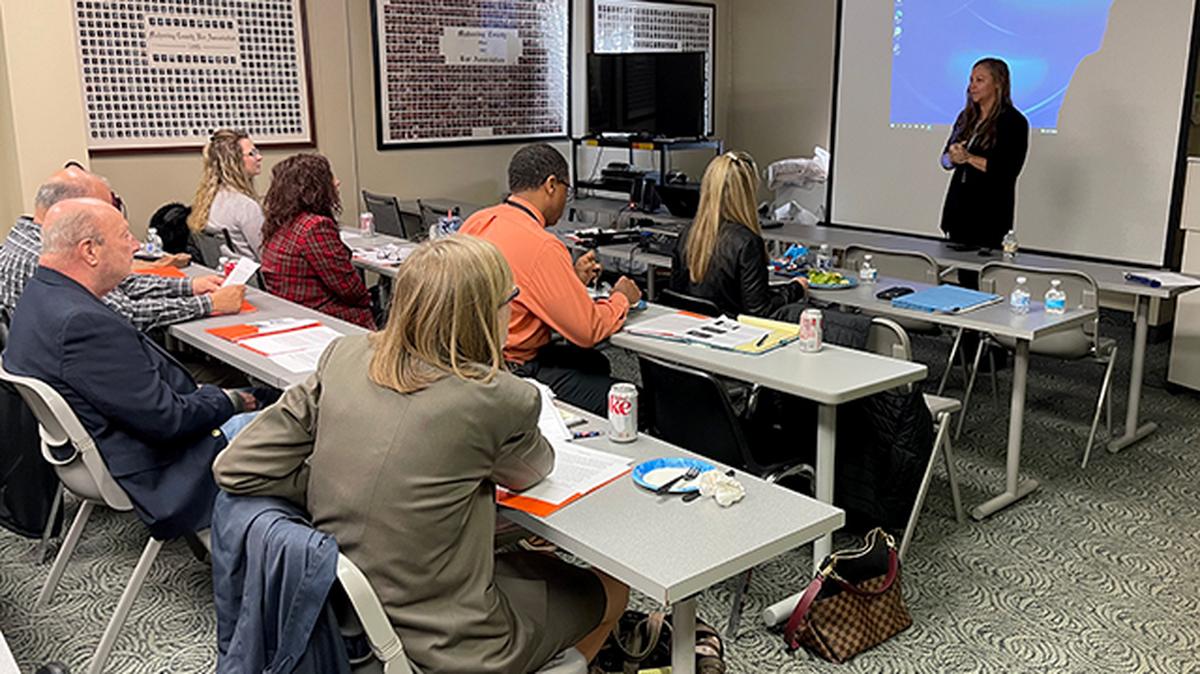
On Thursday, she coordinated a training seminar for defense attorneys to get a proper education on dealing with traumatized clients, and educating attorneys on widening the safety net with clients is one DiSalvo’s initiatives to see successful retention with human trafficking court victims.
The Mahoning County Bar Association held an educational seminar, “Human Trafficking & Holisitic Lawyering,” with the Mahoning Valley Human Trafficking Task Force, Meriden Thomas, a defense attorney who serves Franklin County, and a human-trafficker survivor Vanessa Perkins from Columbus.
Franklin County Municipal Court offers human trafficking victims a chance to enter the specialized docket human trafficking court — Changing Actions to Change Habits — also known as CATCH, to find treatments, and have a chance to regain normalcy.
Perkins escaped sex trafficking through the CATCH court after years of self-medication via drug and alcohol addictions, she said. Now, she works in the Franklin County court system as a bailiff for Franklin County Municipal Court.
Thomas handles low-level felony and drug possession charges, and also works with CATCH to help clients who are dealing with human trafficking trauma get into the program for recovery.
Thomas says as a defense attorney, the most powerful tool when building trust with her clients is to listen to their stories, and learn about any trauma they’ve experienced.
“You have to dig a little bit deeper, and get personal with your client, and meet them where they are,” she said. “You have to build that trust and respect with them so that they will start to listen to you.”
Many of Thomas' clients are trapped in the cycle because they're addicted to drugs supplied by traffickers, she said. Others go back to it because the lifestyle is all they know
Signs of mental health disorders are not noticeable until they’ve spent time away from the lifestyle, Thomas said.
Dozens of local defense and prosecuting attorneys attended the educational seminar to hear from DiSalvo and Thomas on new approaches to help those in need of treatment find their way to Youngstown’s human trafficking court.
Since most human trafficking court clientele have traumatic pasts, learning about trauma helps guide their treatment, DiSalvo said.
“We have a lady who has been in court for one year, and she is just now turning the corner,” DiSalvo said. “We have just now found out about a history of abuse we didn’t know about. If we had not been patient with her, she wouldn’t have turned the corner.”
Thomas said defense attorneys can learn to identify human trafficking victims through signs of physical abuse, scars, bruising and lack of cleanliness.
“[Other] signs are body language, if they make eye contact or are closed off,” she said. “It’s also important to respect that because if you push them [to open up], you’re not going to get anywhere.”
Of the four people who’ve entered the program, only one has “turned a corner,” DiSalvo said, since her start in the program a year ago.
“You enter into the field [after law school], and you are concentrating and focusing on your client and the best argument that you can make,” DiSalvo said. “When you’re talking about criminal defense, in particular, defense of the marginalized, this process is not enough.”