Canfield’s $107.8M building levy will skip August ballot; officials to revisit proposal
Canfield Local Schools’ $107.8 million levy proposal for a new pre-K to eighth-grade campus won’t appear again on the Aug. 2 special election ballot, board members decided Wednesday.
The 6.9-mill, 37-year bond levy was soundly defeated in the May 3 primary election, with 72% of voters opposed — and high turnout of more than 6,500 voters.
“Now the board’s gotta reconvene, have some good, hard, tough conversations about where we go from here,” district Superintendent Joe Knoll said during his State of Our Schools address on Wednesday.
Board President Nader Atway said he sees the rejection as “an opportunity to reassess, based on the margin of loss.”
Atway said the board previously planned to go back to voters at the next opportunity, during the August special election, and after more outreach — so long as that margin was small.
It wasn’t.
“What I’m seeing here is that there are different views, for different reasons that caused people to vote ‘No,’ and so for that reason, it’s clear we can come back and re-engage,” he said.
City and school officials in February announced the city would transfer 100 acres of the city’s long-undeveloped Red Gate Farm property at Leffingwell and South Palmyra roads for an about 200,000-square-foot new complex for students in pre-kindergarten through eighth grade, to replace the district’s 52- and 61-year-old elementary schools and its middle school, which will be 100 years old this year.
Unanswered questions
That land deal is contingent on passage of the bond levy, which drew waves of criticism in the run-up to the election — much of it on local Facebook groups.
For some, the nearly $108 million sum was galling.
“We believe our voters see the need and want new schools,” Knoll told Mahoning Matters last week in an email. “However, the burden of new construction falls mostly on our local taxpayers.”
For Canfield Local Schools, the state’s share of new construction costs comes to about 16%, or $10 million, Knoll said.
Taxpayers who spoke to board member Matt Campbell felt there wasn’t enough information about cost alternatives like full renovations of the aging facilities, as opposed to building new, he told Mahoning Matters on Wednesday.
Board member Dave Wilkeson, who regularly engaged with voters on social media ahead of the vote, said all the other scenarios the board considered would have cost more. The new campus “represents the most cost-effective and operationally efficient plan for our kids, teachers and community,” he wrote.
Others, including Cardinal Joint Fire District Chief Don Hutchison, drew attention to an ethane pipeline beneath the Red Gate Farm property, about 200 feet away from the proposed campus, as WFMJ reported in April. Were the pipe to leak or rupture, it could prompt an evacuation.
A property assessment conducted in March, shared on Facebook by board member Traci DeCapua, shows the land is “buildable,” she said.
But those who spoke to Campbell were less concerned with the pipeline and more concerned with its proposed location, outside city limits in the township.
“A lot of them were residents who felt like the school would be best-served if it remained in the city, like our traditional schools are,” he told Mahoning Matters on Wednesday. “They wanted to make sure we exhausted all the efforts to look at other areas where there is land — whether that’s enough land for the K-12 campus or just the K-8 campus.”
But, according to Wilkeson, there isn’t.
In his Facebook post, he said there isn’t a plot in the city large enough for a K-8 facility. He said both the district’s 61-year-old C.H. Campbell Elementary School and 100-year-old middle school “must come down” and that the district can’t rebuild there “for various reasons.”
“We talked to the landowners around Hilltop, they turned us down. We assessed space around [Mahoning County Technical and Career Center] with those landowners — again, they turned us down. We talked to other landowners around the high school. Same thing. [There’s] simply no place else with enough land for a complete facility to address our needs,” Wilkeson wrote.
Facebook arguments were pitched in the weeks ahead of the election. While voters who opposed the levy accused the administration of acting in secrecy, levy supporters chided the opposition for spreading misinformation.
One Facebook denizen even said — possibly in jest — that he heard the farm was atop an “old burial ground,” drawing parallels to campy horror flicks.
“Social media does cause challenges, especially during a [levy] campaign,” Knoll told Mahoning Matters. “Individuals can post their thoughts, but many times post facts that are not accurate. Not everyone will be happy with the plan, but arguing on social media is never a good idea.”
He noted the district’s levy committee maintained its own Facebook page and a nine-page FAQ on the district’s website.
What happens now?
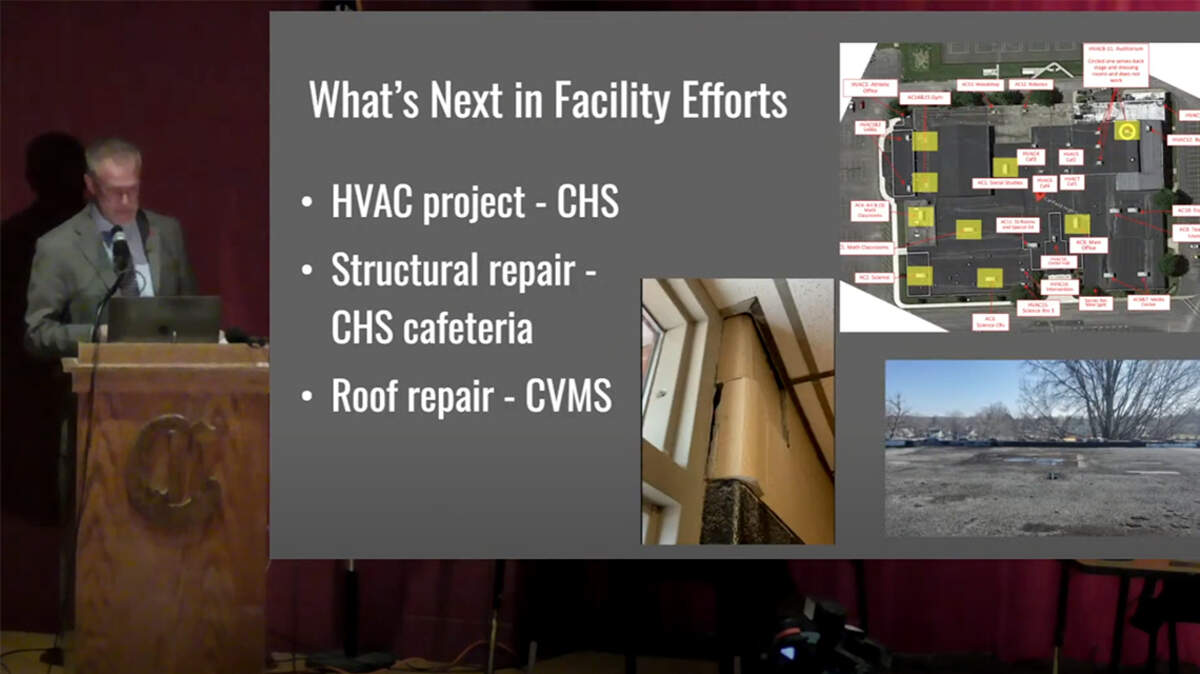
The district’s buildings aren’t getting any younger. Its chief infrastructure concerns now are needed repairs to HVAC systems, roofs, plumbing and electrical systems, site conditions and safety upgrades, Knoll told Mahoning Matters.
As summer sets in and temperatures rise, Campbell encourages district voters to take a tour of the Canfield Village Middle School, which doesn’t have air conditioning.
“I haven’t been on the board that long. From talking to some of the board members and even other community members, this has been a topic in Canfield Schools for a number of years now,” he said. “We need to make sure that we have a comfortable learning environment in those buildings — especially the ones that are having issues.”
Right now, the district is focused on the high school’s rough-top roof, as well as the middle school’s roof, and a portion of the high school cafeteria where a wall has separated from the roof, he said Wednesday.
“We have a permanent improvement levy that permits us to make needed repairs,” Knoll told Mahoning Matters via email. “We will need to triage the multiple problems to plan for how they will be addressed until we can pass a bond levy.”
School officials must file by Aug. 10 to get the issue on the Nov. 8 general election ballot — though they gave no indication Wednesday that they would.
If it’s defeated then, the district’s last chance to secure the building revenue would be in the May 2023 primary, per the city’s land agreement.