
WATCH | Youngstown officials say the Valley is a ‘hub’ for human trafficking, the second-largest criminal industry in the world
AUSTINTOWN — Six years ago, Taylor was lured online, groomed, manipulated and coerced into commercial sex trafficking, she said.
Eventually, her exploitation was uploaded online.
“It’s not always someone being kidnapped or held against their will… This can happen to your neighbors, your family members, your classmates,” Taylor said. “The more you know, the more you’re able to see signs and report it.”
Taylor, a Niles native and human trafficking survivor, traveled from Cleveland to the Mahoning Valley to share her story, bring awareness about human trafficking and educate the community.
Mahoning Matters has withheld Taylor’s full name to protect her identity, at her request.
In educating others on human trafficking signs, statistics and facts, Taylor said she’s found purpose in her pain.
If a person is being escorted, or is not able to do something by themselves, that could be one sign of human trafficking. During this time in Taylor’s life, she said no one was aware of the signs when she was being trafficked.
“This really is happening here. It’s not something that’s just happening in third-world countries. It happens in the neighborhoods of Youngstown and Cleveland,” she said. “Once you’re aware of these things, you can’t unknow them.”
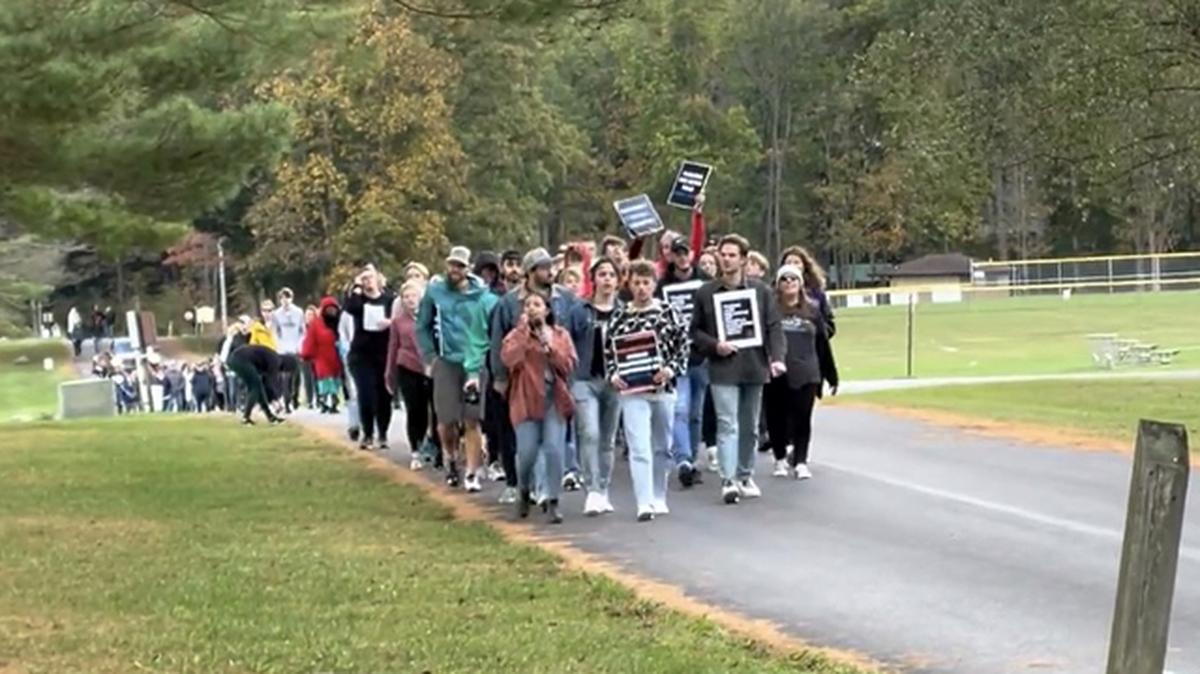
Youngstown’s first Walk For Freedom, hosted by the A21 organization — a national, faith-based nonprofit movement funded through individual donations — took place Oct. 16 at Austintown Park.
Walk participants sang in worship and heard from a panel of experts combating human trafficking in Mahoning and Trumbull counties.
Taylor said being able to free herself from her past human trafficking trauma has led to self-discovery with God, giving her a voice to raise awareness.
“Although social media and the internet destroyed my life, in a way, I use it now to raise awareness for human trafficking,” she said. “God has given me my voice back.”
Ohio ranked as the fifth-worst state for human trafficking in the nation in 2019, according to the National Human Trafficking Hotline.
The A21 organization works to make a global impact in ending “modern day slavery,” and to teach people how to identify human trafficking circles in their own communities.
A21 member Michala Sakotas, the organizer of Youngstown’s Walk For Freedom, and whose stepfather is Lordstown Police Department Capt. Chris Bordonaro, said her family has been working for three years to bring awareness to the severity of human trafficking in Youngstown.
“[Human trafficking] is an uncomfortable subject, so, no one really talks about it,” she said.
Sakotas said through her work with the A21 organization and with community leaders working in the field, she learned that people will travel from out of state to the Youngstown area just to abduct young women.
“It’s something I wasn’t even really aware of before meeting all of these people. … It makes you sick,” she said.
Youngstown’s first human trafficking court
Youngstown Municipal Court Judge Renee DiSalvo, one of the many Walk for Freedom speakers, said she is passionate to share her perspective on how the bad human trafficking situation is in our area.
Judge DiSalvo began her time on the bench in 2018, and one month into her service, the Mahoning Valley Human Trafficking Task Force approached her to see what could be done to help human trafficking victims escape from their traffickers, and find freedom.
Officials established a specialized court docket for human trafficking victims. Such programs take a therapeutic approach to trauma and crimes, offering the structure of court supervision and connecting people with appropriate treatments, according to the Supreme Court of Ohio. Other specialized docket programs in Ohio focus on drug offenders or offenders with mental health issues.
Judge DiSalvo said she’s now working to partner with the Youngstown Police Department to implement human trafficking training for police officers.
When young girls go through the human trafficking court, a team is assembled to help victims escape the human trafficking cycle.
“They’re not being targeted for conviction purposes, we want to get them out of what they’re doing,” Judge DiSalvo said. “We have a number of different treatments for [treating] psychological and mental health issues.”
“I know our [Youngstown] police force is very depleted as far as the workforce,” Judge DiSalvo said.
Because of the lack of police officers on the streets, many human trafficking victims are not able to receive law enforcement’s help to come into the human trafficking court for treatment, according to Judge DiSalvo.
Judge DiSalvo claims minority communities are impacted most frequently by human trafficking.
“Mostly in our area, human trafficking affects African-American communities, but they’re not the only ones because it affects everyone,” she said.
The court makes trauma-informed treatments a driving force of the court since human trafficking victims often have lasting psychological and mental health-related issues, she said.
“We have one girl [who is] going to do art therapy, and we’re thinking this might be another outlet for her,” Judge DiSalvo said.
The human trafficking court is a voluntary program, but it’s challenging for human trafficking victims to realize they are, in fact, the victims, according to DiSalvo. It’s also a “young” program, she said. It’s not 100 percent successful because many victims are still hooked on drugs supplied by their traffickers, she said.
Judge DiSalvo said the hardest part is getting victims to break away from their traffickers, and fully commit to what the human trafficking court offers.
“Most of them are in the position of thinking that since they’re addicted to drugs, they’re not in the position to be a victim,” she said. “Their drug dealers, also their pimps, are the ones keeping them from getting help.”
Youngstown Police Officer Kelly Jankowski, a Mahoning Valley Human Trafficking Task Force agent, said she received a tip about a woman being held against her will.
She and her team drove to a house on Youngstown's South Side to investigate.
“We ended up coming across her and finding her, and she had a warrant out of Columbiana County,” Jankowski said. “We went to the jail, spoke with her there and told her we wanted to get her help.”
Jankowski waited for two hours outside of the Columbiana County jail to get her to a shelter.
“We set that up to where an advocate came, and she was placed in a shelter,” Jankowski said. “A movement called the Harriet Tubman Movement [in Geauga County] will come and help the women find housing, and will get them the supplies that they need.”
Jankowski said more drug dealers are starting to become human traffickers, realizing that a female can make 100% profit compared to selling drugs on the street.
“With drugs, you have to buy them and cut them, then you can make a profit,” she said. “With people, you can just sell them over and over again and that’s 100% profit.”
Parents should monitor their child’s online activities
Jankowski said she expects as many as 1 in 8 advertisements for escorts in Youngstown in 2020 were for “juveniles being sold.”
Jankowski said she considers Mahoning and Trumbull counties to be human trafficking “hubs” for traffickers traveling from other states.
“Mahoning and Trumbull counties can count as the ‘hub’ for human trafficking because Austintown, for example, is a pivotal point for truckers and all of the truck stops out there,” she said.
Online security is more important now than ever before, with more opportunities for human traffickers to reach new victims, she said.
“What happened with the coronavirus pandemic was that online presence grew, and now there are ways to go online and traffickers can promote themselves to get clients,” Judge DiSalvo said.
Jankowski said parents should be consistently monitoring their child’s phone and social media activity.
“Parents are saying, ‘My child will never do that,’ but parents have to realize, these kids are so tech-savvy and smart,” she said. “They will find ways to hide things.”
There were more than 365,000 missing children reported in the country in 2020, according to the National Crime Information Center.
Human trafficking is the second-largest criminal industry in the world, Jankowski said.
Sgt. Jessica Shields with the Youngstown Police Department’s Family Services Investigative Unit said a lot of children are being reached by adults through gaming and social media platforms.
“Almost every day, I see some type of report just through the police station through parents finding out that their kids are talking on Snapchat to grown adults [who] are promising them clothes, shoes and money. … A way out from their parents [who] are too strict,” she said.
A human trafficking awareness forum will be at 6 p.m. Nov. 23 at Metro Assembly of God, 2530 South Ave., Youngstown, to get human trafficking prevention efforts off the ground in the Valley.