
The Earnheardts | The concept of time during a pandemic
When my students are getting ready to graduate and they start looking at how they'll be compensated, we always chat about three things: money, time and contentment.
Most measures of employment focus on the first one. Money is something we need to survive and I don't discount it. But I also know that it's not the only factor in determining whether or not someone is happy. Salary or hourly wages aren't the only forms of "money" either. Aside from good health care, there's retirement to think about, even though it's usually the last thing on the minds of traditionally-aged, newly-minted college grads.
In his book, "Running Down a Dream," author and podcaster Tim Grahl lays out what he identifies as three primary values that drive our work: Are you pursuing fortune, fame or freedom?
I know what some of you are thinking: "Why can't we have all three?" Well, those values can certainly be interlaced, and we can claim to have more than one value, but determining what drives us helps us make better choices about our lives.
This concept reminded me of the talks I have with my students.
Fortune? That one's easy. It's all about money. That line from The O'Jays' For The Love Of Money, "Money, money, money…" plays in my mind when I think about fortune as a value. In case you needed an earworm for the day, this song is a good one to have in your head.
Fame is a person's desire to be seen and heard. People who are driven by this are interested in being known and talked about. In their dream scenario, the paparazzi would be waiting outside a Starbucks to snap a picture of them drinking a mochaccino. More importantly, though, fame is about a need some people have to be a participant in the conversation and to express ideas that matter to others.
Freedom is about time. More specifically, it's about controlling your own time. But during the pandemic, "control" and "time" have been odd concepts to define.
Before the pandemic, I would have easily chosen freedom as my biggest value. I know for a fact I'm not motivated by fortune. I couldn't even tell you my current salary; I'd need to look it up.
Fame? I suppose fame is a little bit of an influence in my value set. I work as a teacher-scholar, spending a large amount of time reading and processing ideas. Then I get to share those ideas with the students I teach. So, following Grahl's definition of "fame," I'm participating in the conversation, but I don't really crave a large audience.
As an introvert, I realize there would be a hefty price to pay if I gained true fame. Payments would likely be extracted in the form of personal freedom. But I don't engage in ideas because I want fame, I do so because I'm curious and my brain is hungry. It feels more like an introspective pursuit than this definition of fame would indicate.
This leaves freedom. As I noted earlier, freedom is such a strange value to quantify right now. Time as a form of freedom has lost some of its meaning during the pandemic. Days used to be structured and the freedom of teaching and research was that I didn't have to account for each minute. It's one of the main reasons I spent 10 years on my education. Having a flexible schedule is important to me.
Freedom. I loved this. I owned this. I valued this. I controlled this. Well, OK, I mostly controlled this. Still, the freedom of time was one of the few concepts over which I felt I still had a modicum of control. Even during the pandemic, I haven't given this up.
I'm not alone. Now, more than ever, other people are feeling freer because they're working remotely. But while we have more freedom, time has become an elusive concept. To compare it to money, it would be like eliminating cash and moving to the barter system.
The new reality of time is old fashioned, or futuristic, or just somehow off. How do you measure the value of something that seems to have lost it's constant?
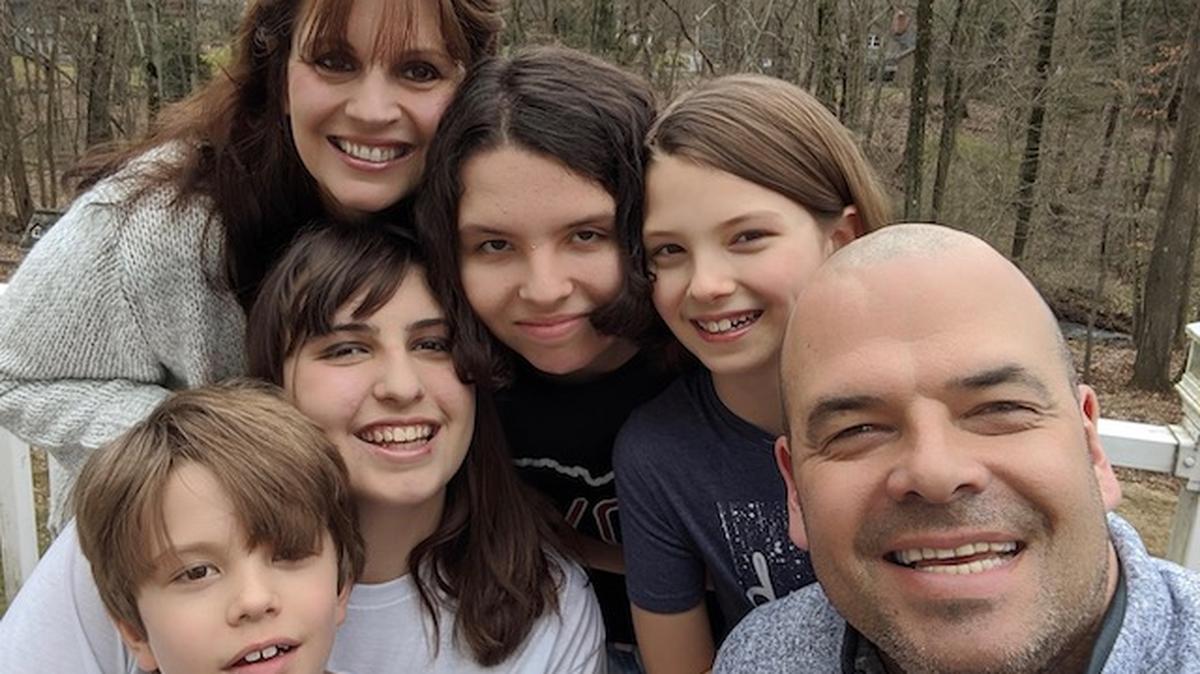
What this has to do with The Earnheardts — with my husband and our children— is directly connected to those conversations I have with my students about the values of work while maintaining a healthy work-life balance (which I understand is different for everyone).
Our four children, although separated in ages by eight years, are very familiar with the concepts of fortune and fame. They think they know what a lot of money is, which is a weird byproduct of their concept of fame — YouTube stardom.
"YouTube stars are rich!" they tell us. Not sure they've ever offered much proof beyond a few oddball screen names (e.g. Is PewDiePie a YouTube star? I forget). So, of course, Adam and I use this as an opportunity to explain how the workforce functions as part of society and also to urge our children to think about what they value.
Freedom, I fear, is one we'll struggle with for years to come — both during the pandemic and in the time that follows. This is because, like the rest of us, our children have had the concept of freedom and time turned upside down.
You look on social media and see jokes about the concept of time, about February 2020 lasting for 36 hours and March lasting for 534 days. Funny, but it really felt that way. There are memes where people make up months like Octebuary. It's fun to joke, but like all humor, we laugh because we relate to it's real and sometimes painful truth.
Depending on what you decide to do, days can be over before you know it or you can look at the clock thinking it's 10 p.m., but it's only 5 o'clock p.m. (or is it a.m.?). The Coronavirus lockdown has messed up our internal clocks and calendars. And, as someone who values time, I don't know how to adapt let alone teach my children about it.
In the early days, we held on to the daily rituals that created structure, but when it became apparent we were going to be isolated for the long haul, we started to relax. That's when time really started to get weird.
We don't force our kids to wake up at a certain time every morning or tell them when to go to bed every night. Their little internal alarm clocks do this for them. They awake and go to sleep at almost the same time each day anyway. Much like our ancient ancestors, we're letting a more natural state of being determine our routines.
It makes me wonder how we'll all react, what we'll keep and what we'll ditch, when life returns to normal, when we really have to start paying attention to clocks again. Will the kids value freedom because they've had more of a chance to live as they want? Or, is having a set schedule better for all of us as individuals? As a family? Hell, as a society?
I don't know the answers yet, but I may have an idea somewhere around 700:00 a.m. on the 449th day of Janember.
— Mary Beth Earnheardt is director of the Anderson Program in Journalism at Youngstown State University. You can follow her on Twitter at @mbexoxo.
This story was originally published July 6, 2020 at 4:35 AM with the headline "The Earnheardts | The concept of time during a pandemic."