
Advanced occupational therapy treatment helps former police officer regain mobility after stroke
She later became a lieutenant in the department and the first-ranked woman in township history.
Then, Polak’s life changed when she had a major stroke in September of 2021 in the middle of the night, leaving the left side of her body paralyzed.
After beginning treatment with Mercy Health occupational therapists at St. Elizabeth in Youngstown, Polak was motivated to return to uniform and regain independence.
Determination
“In our family, quitting is not an option,” Polak said. “My brother had been in an accident when he was 14; he had a traumatic brain injury and was paralyzed on the left side. He had some of the personality changes and things that were associated with that, but he fought back from that, and he had two children and then got his CDL. I started thinking about whether all these people can do that. I can do, you know, at least that much and more in my therapy.”
Now, Polak has regained almost all of her mobility thanks to her tenacity and a new treatment style utilizing the help of the InMotion robotic arm.
She was dedicated to getting better, coming in for occupational therapy to regain movement and agility, and logging hours of muscle training on the machine and later at the swimming pool.
“Those exercises were very helpful and instrumental in getting dexterity back,” she said. “Fast forward a year later, we’re going to the pool three times a week, and I’m doing a class and swimming laps, and the laps looked like someone who knows how to swim. They don’t look like my first laps were like I could get my arm up, and it looked like a duck thrown this wing.”
She could go from having virtually no movement in her arm and fingers to having 95% movement of her arm and 60% movement in her hand.
Being a self-advocate
Her work helped her be able to take care of personal tasks, like doing her hair.
“Oh, this is one of the things I did one day. It’s crooked. But I got a ponytail,” she showed her therapists, who were all excited.
Polak could go back to work for a while but chose to resign because it was taxing her mental health and taking time away from healing, redefining her life.
“I didn’t get back in uniform, but I did get back to work 40 hours a week,” Polak said. “But that was too much for me; it was taxing on my mental capacity. I did not have time for therapy, and I wasn’t taking time for therapy.”
She enters her German shepherd into AKC obedience competitions. She trains her dog and uses signals for obedience and commands during trained walking patterns. It is all done on her left side, which, not long ago, she couldn’t move. She’s now focusing on continuing her outpatient therapy, swimming in the pool, or being outside with family.
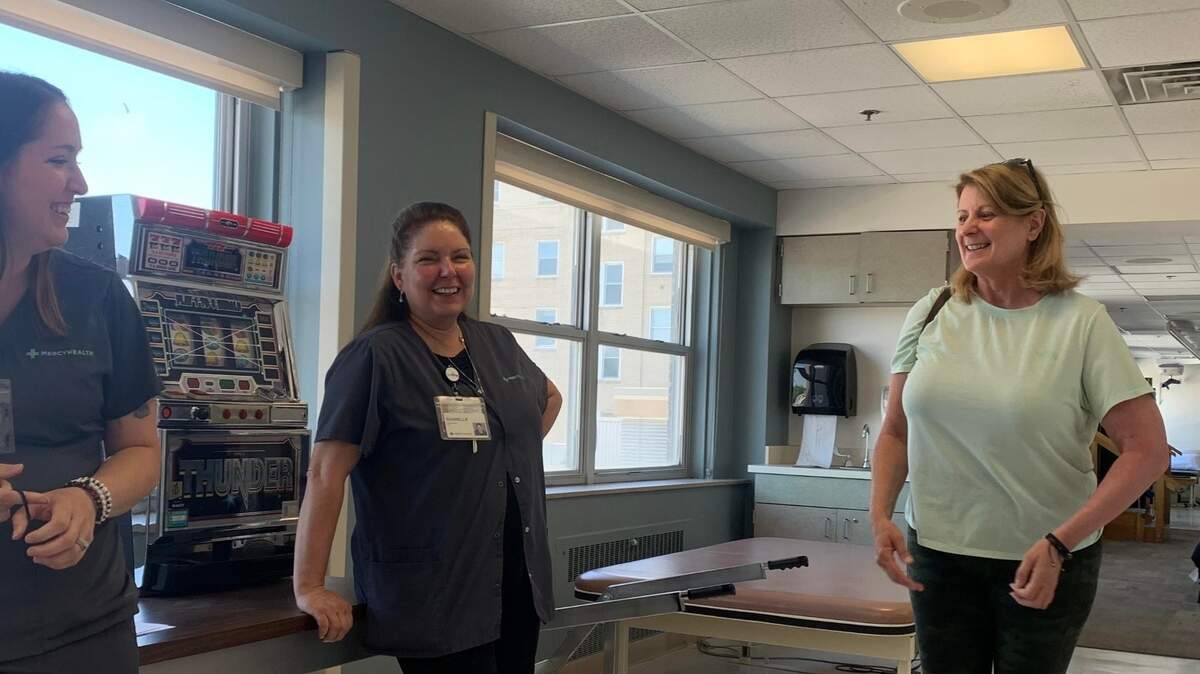
“You connect with a patient like you can appreciate her tenacity and think, ‘What if that were you? Because it could’ve been, it could be any one of us,” said Renee Swavel, an occupational therapist at St. Elizabeth in Boardman who worked continuously with Polak after her stroke. “It’s a privilege to say all of us had a hand in helping her, a small part, but she was the biggest part.”
Tracy’s message for other stroke survivors on their journey
“Some days are better than others,” Polak said. “Some days, you’ll get out of bed and wake up, then want to go back to bed. But you can’t do that. You must focus on building on your (skills) daily, and you advocate for yourself. Do something every day you didn’t do yesterday, or at least try it and surround yourself with the best therapists you can find, which I was so fortunate to lock into.”
What is the InMotion robotic arm?
Swivel explained what happens physically and mentally when someone has a stroke.
“Once a person has a stroke in a certain area, some brain cells die. So if your stroke is on the right side of the brain, that controls your left arm. Sometimes people have no movement at all and, you know, they get frustrated, depressed, they don’t want to try to use the left arm,” said Swivel.
.jpg "charts (1).jpg")
Patients will use the InMotion robotic arm to calculate current mobility and guide them toward regaining more movement, keeping track of their progress as they continue practicing with the robotic arm. It’s one of two machines currently treating patients in Ohio.
“Where we think this helps them, the robot will help them until they get some movement, then it will back off, so the person sees the arm moving and makes that connection,” said Swivel.
“Every time they try practical use with that arm, two things can happen: they can actually make new connections, or there’s a kind of a structural thing that happens, where other parts of the brain start to take over. Maybe parts of the brain they didn’t use before, just because there are using the right hand. But if they don’t try to use it, they’re not going to get better ... but during the treatment, the machine itself senses what they can and can’t do. And what they can’t complete, it’ll guide her to the movement that allows them to perform as much as they can.”
Swivel and fellow occupational therapists Stacy DeSarro and Danielle Meyer explained that the technology records tangible data at the end of each set, giving patients and therapists numbers to gauge their performance and strive for improvements.
“There’s no correlation between someone’s disability and function,” said Meyer. “Tracy was the perfect candidate because of her tenacity and dedication to getting better a little bit every day. When she had her moments, I think her family was always there to help pick her up, her husband and her sister and other loved ones, friends and fellow officers.”
Polak thanked all of her Mercy Health physicians and therapists, including occupational therapists from DeSarro, Meyer, and Swivel, as well as Adam Schrock, Michael Strugiss, and Mindy Rubesa.
To learn more about National Stroke Awareness Month, visit the CDC’s website.
----------------------------------------------------------------------------------------
(EDITOR’S NOTE: Get the latest Mahoning Valley news in your email inbox weekday mornings. Sign up here for our free daily newsletter.)
-----------------------------------------------------------------------------------------
Here’s how you can support Mahoning Matters.
-----------------------------------------------------------------------------------------
Follow Mahoning Matters on Facebook, Twitter and LinkedIn.