
New research shows benefits of strength training for cardiovascular health
New research suggests a link between a patient’s leg muscle strength and better recovery after a heart attack with a much smaller risk of heart failure during recovery.
Findings “highlight the importance of regular exercise and maintaining muscle strength in older age, as muscle mass can diminish with age, possibly affecting cardiovascular health,” wrote Jacqueline Howard for CNN Health.
Howard, Kensuke Ueno, and Dr. Kentaro Kamiya, researchers in the Department of Rehabilitation at Kitasato University School of Allied Health Sciences in Japan, are the authors of the new research.
Their findings suggest that patients in cardiac rehabilitation after a heart attack who have high levels of quadriceps strength are less likely to experience heart failure while recovering from a heart attack.
Understanding the research
But Dr. Hans Kirr wants patients to know it’s not just about leg muscles. It’s about overall wellness and strengthening bodies to prevent damage in the first place.
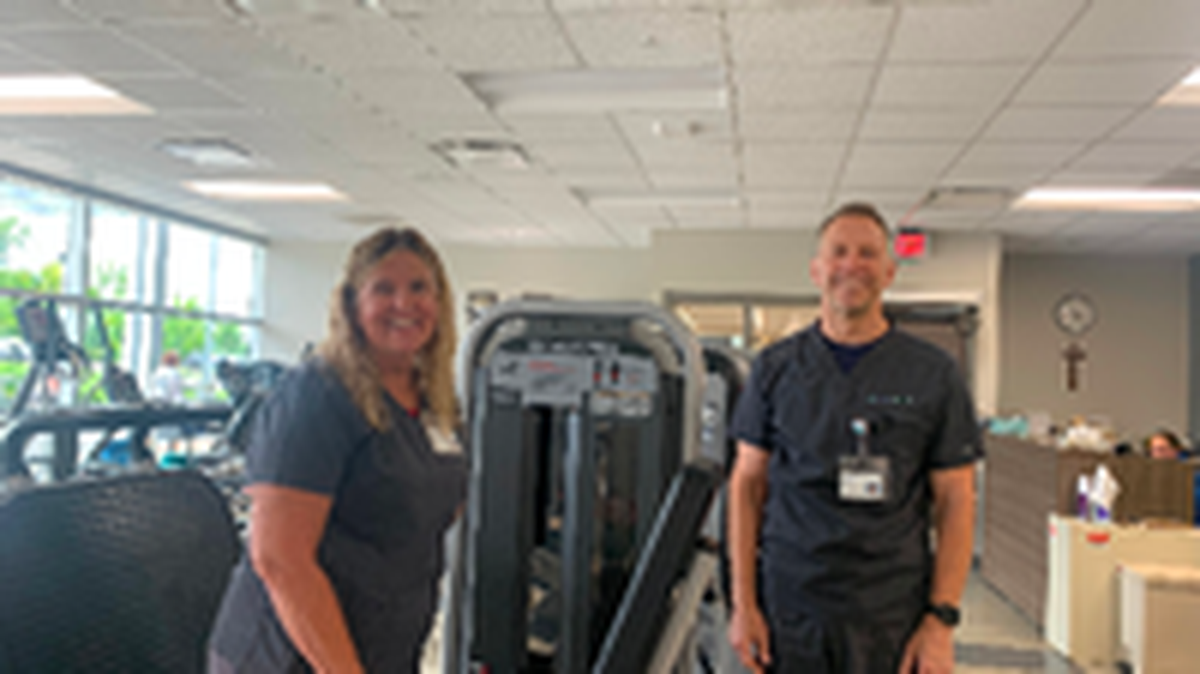
He manages Howland Medical Center and St. Joseph Warren Hospital physical therapy.
He’s worked in the Mercy Health system for 30 years. Teams provide professional guidance both through the physical therapy and cardiac rehabilitation programs at Mercy Health after a patient has a heart attack.
“Quadriceps strength is probably just a proxy for your fitness,” said Dr. Kirr. “If you have a heart attack and have strong quadriceps afterwards, you’re gonna be more apt to move, more apt to take steps. You’re probably a little more fit to begin with. You’re probably feeling a little bit better, you’re probably doing these things that come along with it.”
Dr. Kirr said the crucial part of the study to understand is to start strength training and build overall muscle strength.
“My fear is people are gonna go out, get on any extension machine and just work out their leg muscles thinking just doing this will cut down risk of heart failure. Probably not,” Dr. Kirr continued. “[Effective] strength training overall cuts your risk by half. Your risk is double for heart failure if you have low muscle strength. Your risk is under half actually of heart failure just by being strong and being fit. It’s not really quadricep strength. It’s just being fit exercising.”
After a patient has a heart attack and comes to physical therapy, Dr. Kirr explains how they’re encouraged to start strength training.
“There’s a thing sarcopenia which is a natural muscle loss as you’re getting older,” he said. “The thing that kills us is frailty. We don’t move as much as we age. We fall, we break something and can die. So being strong is huge..”
Patients with a heart attack are approved for 12 weeks of cardiac rehabilitation, broken into three phases. The first two phases are monitored in the hospital and cardiac rehabilitation centers.
“We think of what we do as all-around primary care physical therapy,” he said. “As you do this exercise, you also get better coordination, better balance. There’s a hormonal response to strengthening that we don’t even talk about that’s huge...especially with the older patients, what we want to do is sit to stand, just starting by measuring that sit-to-stand test while looking at the norms and where the patient’s at. Sometimes we can start adding weight. It’s going to build your quadriceps, it’s going to build your cardiac output, because that’s a hard thing to do.”
Benefits of strengthening muscles
While walking and running are recommended, Dr. Kirr said he wishes more medical practitioners discussed the benefits of strength training.
“Most people don’t find out their osteoporosis until they have a fall, break their shoulder break their wrist, or they just bend over and pick something up and get a spinal compression fracture,” he said. “It’s probably the one thing we’ve not done a good job of talking about strengthening talking about walking. I get a lot of patients who say I exercise at walk, but you have to be strong.”
He recommends contacting a physical trainer to show you the ropes and starting small but staying consistent with strength training. Think of doing sit-ups, push-ups, squats, and HIIT workouts to begin.
CONNECT WITH US
WEB SITE ► https://www.mahoningmatters.com
DAILY NEWS EMAIL ► https://www.mahoningmatters.com/customer-service/newsletter-signup/
FACEBOOK ► https://www.facebook.com/mahoningmatters
TWITTER ► https://twitter.com/mahoningmatters
YOUTUBE ► https://www.youtube.com/@mahoningmatters2814
INSTAGRAM ► https://www.instagram.com/mahoningmatters
SUPPORT US ► https://givebutter.com/vNfzEW