
Doctors protest St. Elizabeth Hospital’s use of live animals during human medical training
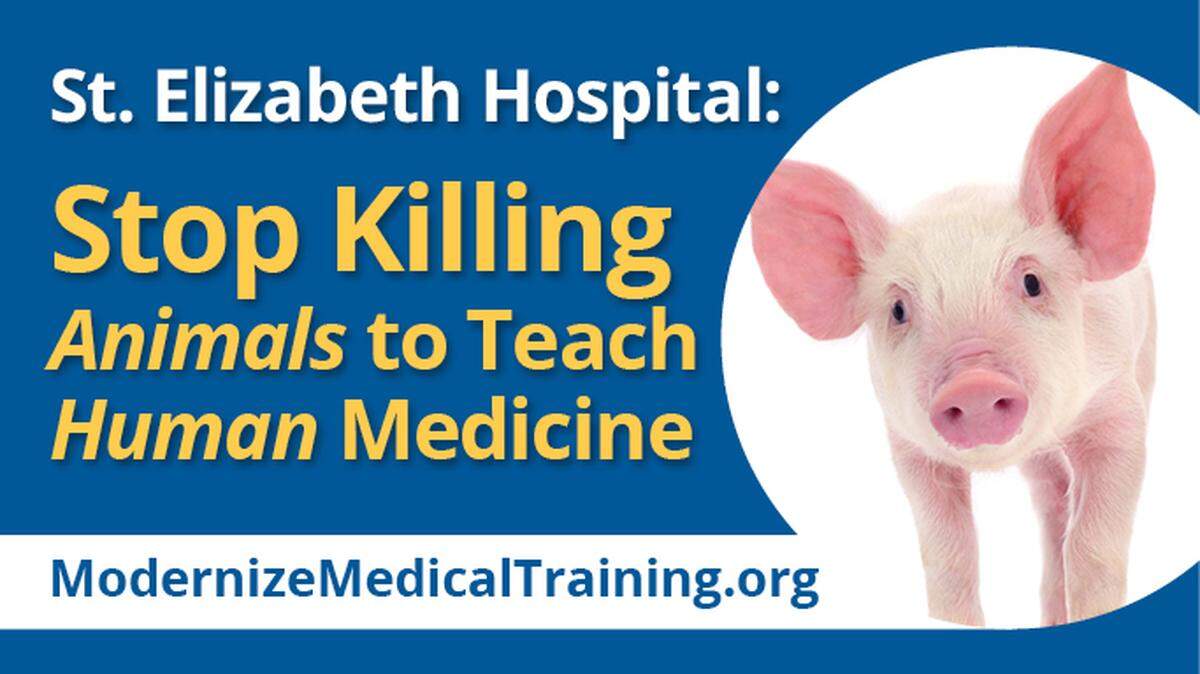
An animal rights advocacy group calls on leaders at St. Elizabeth Youngstown Hospital to cease training practices for surgical residents on animals.
What is the Physicians Committee for Responsible Medicine?
The Physicians Committee for Responsible Medicine mainly focused on promoting alternatives to harmful animal research in medicine, cosmetics and science.
Founded in 1985, the Washington D.C. nonprofit advocacy group comprises over 17,000 doctors.
Claims against St. Elizabeth in Youngstown
Today, they protested St. Elizabeth Youngstown Hospital, part of Mercy Health, and the training practices at Northeast Ohio Medical University (NEOMED) in Rootstown.
According to the Physicians Committee for Responsible Medicine, surgery residents or doctors at St. Elizabeth Youngstown Hospital use live pigs during medical surgery training.
During the laboratory class hosted at NEOMED called “Surgical Training and Experimental Surgery,” the pigs undergo 29 painful procedures to their internal organs before being euthanized.
They’re campaigning with billboards that read: “St. Elizabeth Hospital: Stop Killing Animals to Teach Human Medicine.”
What are other programs using?
According to the committee, using live animals as a practice isn’t common anymore or necessary to learn all the invasive procedures taught during the residency lab using pigs.
“Eighty percent of surveyed U.S. surgery residencies (210 of 264) do not use animals,” as most facilities have incorporated simulators, including Cleveland Clinic and Case Western Reserve.
“Hundreds of surgery residencies have never used animals or have replaced them with simulation and human cadavers,” says Jacob Dijkstra, MD, of Cleveland. “When the best surgery programs in the country train using human-relevant methods, St. Elizabeth and NEOMED should take heed.”
Other NEOMED surgery programs at Akron General Hospital and Summa Health use these inorganic simulators that mimic human skin and anatomy.
Response from Mercy Health, NEOMED
Here’s the official response from Mercy Health:
The Mercy Health – St. Elizabeth Youngstown general surgery residency program fully complies with all laws, regulations, guidelines and ethical standards for treating animals in its medical education program. In addition, our surgical training methods follow strict protocols set by our graduate medical education faculty. These techniques are designed to train our highly skilled surgeons in advanced, complex surgical procedures to prepare them for real-world surgical cases. The animals receive constant care and monitoring to prevent pain and suffering, including using anesthesia. The Accreditation Council for Graduate Medical Education fully accredits our training program. Also, it incorporates laparoscopic and robotic surgical simulators, donated cadavers and partial task trainers.
CONNECT WITH US
WEB SITE ► https://www.mahoningmatters.com
DAILY NEWS EMAIL ► https://www.mahoningmatters.com/customer-service/newsletter-signup/
FACEBOOK ► https://www.facebook.com/mahoningmatters
TWITTER ► https://twitter.com/mahoningmatters
YOUTUBE ► https://www.youtube.com/@mahoningmatters2814
INSTAGRAM ► https://www.instagram.com/mahoningmatters
SUPPORT US ► https://givebutter.com/vNfzEW
This story was originally published August 10, 2023 at 2:59 PM with the headline "Doctors protest St. Elizabeth Hospital’s use of live animals during human medical training."