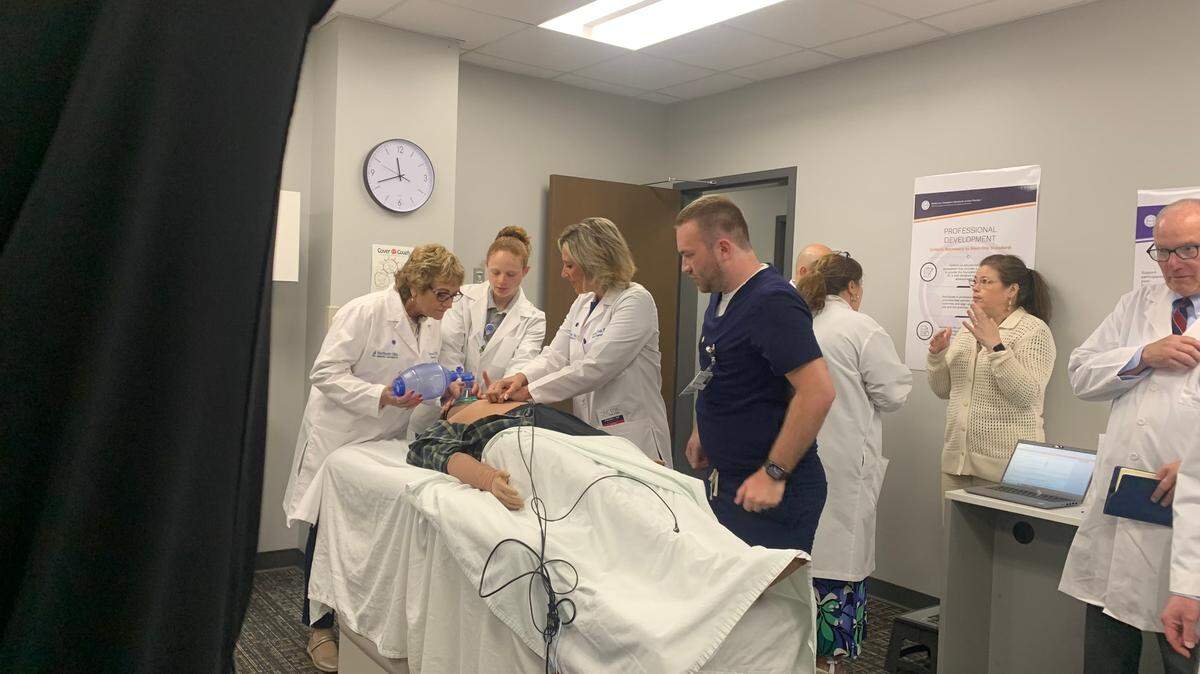
Trumbull County’s Sen. Sandra O’Brien and Columbiana County’s Rep. Monica Robb Blasdel helped do chest compression and resuscitate the patient during a simulation at NEOMED.
Kelcey Norris
Legislators representing Mahoning, Trumbull and Columbiana counties participated in Doctor for a Day at Northeast Ohio Medical University in Rootstown, from classrooms to simulated patient care.
Fellow representatives Joseph Miller and Jon Cross, as well as Summit County Executive Ilene Shapiro, rounded out the rest of the Doctor for a Day group.
White coat ceremony
John Langell, president of Northeast Ohio Medical University (NEOMED), welcomed all seven members of the Doctor for a Day class of 2024 at the 9:30 a.m. white coat ceremony.
First, each legislator donned a white coat embroidered with their name and the NEOMED logo. The coat is carried by medical professionals from medical school to residency and practice, according to Langell.
“We hope you get a good flavor out of what it’s like to be a student at NEOMED and the trials and tribulations of match day and what it’s like. One out of every thirteen doctors practicing in Ohio have graduated from NEOMED,” said Langell.
Peer instruction
Representatives Al Cutrona and Joseph Miller learning how NEOMED students participate in class through multiple-choice questions and peer instruction. Kelcey Norris Mahoning Matters
After the welcoming ceremony, the legislators attended their first class on social health determinants with Kristine Baughman and Emmie Wagner.
“Place matters,” said Baughman.
Physicians consider patients’ home conditions, like mold and lead levels and other social factors as indicators for their health and wellness in life.
The legislators learned how NEOMED students participate in class through multiple-choice questions and peer instruction.
Using clickers, everyone picks an answer and if less than 80% of the class gets the answer correct, classmates will break into small pairs and discuss what they think is the right answer.
If more than 80% of the class answers right, instructors like Baughman randomly call on a student to explain their answer.
“With 180 medical students in a room, it gets loud,” she said.
For their first of a handful of questions, 67% of the Doctor for a Day class got the right answer.
Anatomy lab and research
Next, legislators moved to the gross anatomy lab to learn from NEOMED Distinguished University Professor and paleontologist J.G.M. ‘Hans’ Thewissen.
Dr. Erin Franks also helped legislators navigate the gross anatomy lab at NEOMED, where students learn about anatomy with the help of body donors.
“Body donors are people that have donated their bodies themselves while they were alive; we only accept the bodies of people who donated themselves,” Thewissen said. “[The] motivation of those [donors] is that they think it’s important for physicians to learn from actual bodies for the benefit of healthcare in general.”
The only thing NEOMED students know about the body donors is their age, occupation and cause of death, everything else is undisclosed.
At the end of the semester, the bodies are cremated.
The students run a memorial and burial day for family members of the body donors to participate in to honor their loved ones.
“We teach students that they need to show respect for these people who are actually dead,” Thewissen said. “Somebody’s parents, somebody’s brother. To further make that point, at the end of the year, we have a memorial service, where all the students come in white coats and we invite [body donors’] families. We honor these donors, and that happens to be today, this afternoon, in the front of the building. You’ll see many young people wearing white coats and you see many families who are sad.”
Cutrona held a heart and helped weigh them with Thewissen and Shapiro.
Legislators learned about the process of embalming, asked questions about rigormortis and body donors.
Thewissen showed legislators a body donor, who was a 90-year-old florist.
Not all the legislators were comfortable holding the embalmed body parts; instructors helped them understand processes.
(left to right) Columbiana County’s State Rep. Monica Robb Blasdel; Mahoning County’s State Rep. Al Cutrona; Trumbull County’s Nick Santucci and Sen. Sandra O’Brien during dental care simulation. Kelcey Norris
Next, the representatives and senators participated in simulations of patient care in the Wasson Center Interprofessional Learning at NEOMED.
During the simulations, there’s a two-way mirror separating the professors and students, who are interacting with patients.
The patients are played by actors who are given outlines for what they’re supposed to do.
Instructors watch, but they aren’t in the room.
At first, legislators were learning about dental disease caused by substance abuse disorder with suboxone.
The simulation started with a teeth-cleaning demonstration, but it turned to a simulated emergency. The patient coded, and legislators had to adapt to the day.
The simulation then went from calm to chaos. Robb Blasdel had to start doing compressions and everyone was taken away with a doctor to help with something like taking patient information and medicine
Robb Blasdel and O’Brien helped do chest compression and resuscitate the patient during the emergency simulation.
The legislators rounded out their day by having lunch with students, participating in match day and celebrating a commencement ceremony.