
‘Dangerous moment.’ Nuclear experts weigh in on possible risk of escalation in Ukraine
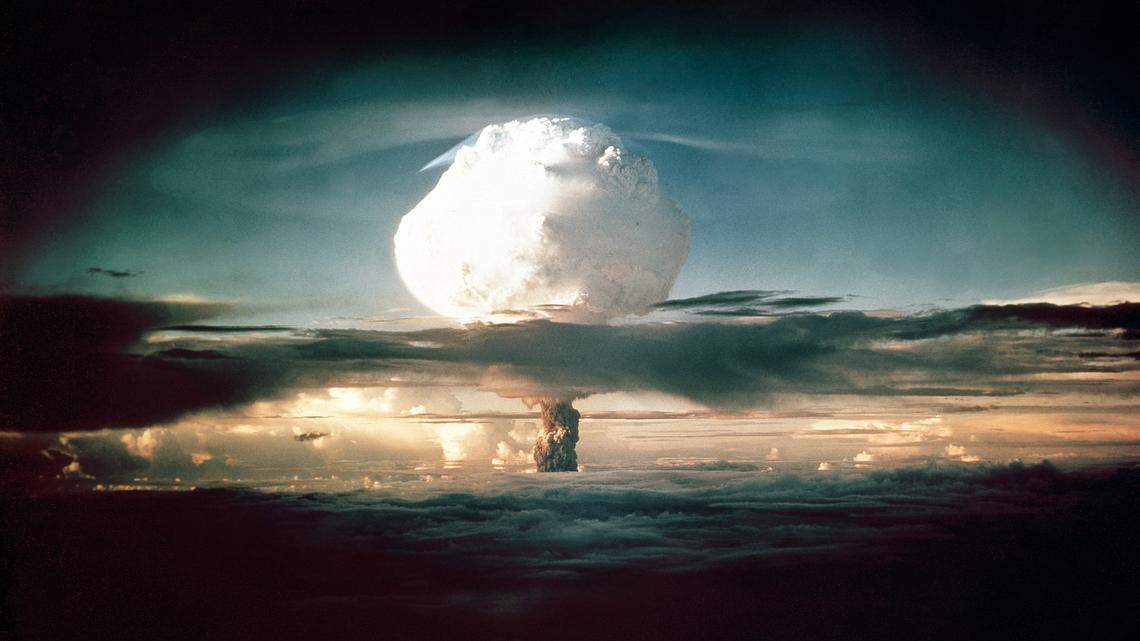
As the war in Ukraine enters into its ninth month, some nuclear arms experts across the United States and Europe are in agreement that the risk of nuclear war, though difficult to quantify, is at its highest level since the 1960s. Though disagreement remains over just how dire the current situation is.
“I don’t think nuclear war is likely, but I do think the risks are higher than they’ve been since the Cuban Missile Crisis and in some ways maybe even higher,” Steven Fetter, a former assistant director for national security and international affairs at the White House, told McClatchy News. “So I would say the risks are unacceptably high.”
Fetter noted that during the Cuban Missile Crisis, Nikita Khrushchev, the Russian premier, was restrained, in some ways, by the politburo. With President Vladimir Putin, there don’t appear to be the same controls on his authority, Fetter said.
Michael Mazarr, a senior political scientist at the RAND Corporation, a think tank, told McClatchy News the war in Ukraine is on “the road to being more worrisome,” but added “Russia has a lot of escalatory steps that it can take before it contemplates even the single use of a nuclear weapon. And even at that point, it is not clear that NATO would decide to become directly involved.”
Launching large scale salvos of remaining cruise missiles and other intermediate range weapons and employing the Russian air force to a greater extent are both steps Russia could take, Mazarr said. Using chemical weapons and cyber attacks are additional options, he added.
The decision to use even a single nuclear weapon in battle is “such a profound thing” that it “risks losing the sympathy of the countries that have been fence-sitters in this war,” Mazarr said, adding that it would also risk drawing NATO in or at least redoubling the west’s commitment to supporting Ukraine.
Beyond warning of “catastrophic consequences,” U.S. and NATO officials have refrained from laying out a specific response that would follow a nuclear strike in Ukraine.
“This conflict is entering into a very difficult place,” Francesca Giovannini, executive director of the Project on Managing the Atom at the Harvard Kennedy School, told McClatchy News. “As you endure what some of the conflict analysts call a hurting stalemate, a protracted conflict where both sides lose, but they don’t lose enough to have to back down, at that point, one of the parties needs to further escalate.”
Giovannini added that a broader nuclear war would not necessarily begin after the first use of a tactical nuclear weapon in Ukraine. Rather, the use would more likely result in a conventional conflict between NATO and Russia, which could then devolve into a global nuclear war.
Other experts, namely those at institutions dedicated to the eradication of nuclear weapons, provided a more pointed assessment of the current situation.
“I think it’s an incredibly dangerous moment right now,” Beatrice Fihn, executive director of the International Campaign to Abolish Nuclear Weapons (ICAN), told McClatchy News. “We’re seeing a cornered Putin and we basically just have to trust that he will make the right decision, which feels like it’s not a great strategy to rely on.”
During times of crisis, the situation can easily and quickly escalate from bad to worse, Fihn added. Uncertainty, coupled with things like cyber attacks, false information, miscommunication or accidents may set the scene for disaster.
There have been dozens of nuclear weapons accidents, sometimes called “broken arrows,” over the years, according to the Pentagon.
“[T]he risk is much higher than anyone should be comfortable with,” Derek Johnson, managing partner of Global Zero, an organization dedicated to eliminating nuclear weapons, told McClatchy News. “When the consequences are so astronomical as to include the end of life on Earth as we know it, even a very low probability can translate into an uncomfortable level of risk. And that’s on a comparatively peaceful day, never mind in the middle of a crisis.”
What would a large-scale nuclear exchange mean?
Should a large-scale nuclear exchange occur, experts warn that the devastation would be unprecedented.
A public service announcement released by New York City officials this summer provided guidance on what to do in the event of a nuclear attack.
“Get inside, stay inside, stay tuned,” was the advice. However, experts said that might not be enough.
“Unfortunately nuclear weapons are so destructive that there really is no effective civil defense,” Fetter said in response to the PSA, while Fihn added, “There aren’t enough radiation beds in the whole world to manage the impact of a detonation in a heavily populated area.”
Within the first few hours of a nuclear exchange between the United States and Russia, 91 million people could die, according to ICAN.
“While I would say the immediate risk is not so large that people should be heading out to the countryside, we could have a major nuclear war happen tomorrow if we’re unlucky. And you can’t really say that about any other major threat,” Seth Baum, executive director of the Global Catastrophic Risk Institute, a think tank, told McClatchy News. “This stands out as being I think by far the most immediate, urgent threat to global civilization.”
This story was originally published November 15, 2022 at 6:56 PM with the headline "‘Dangerous moment.’ Nuclear experts weigh in on possible risk of escalation in Ukraine."