
UPDATE | Judge declines to block U.S. House results on plea from Youngstown Black voters
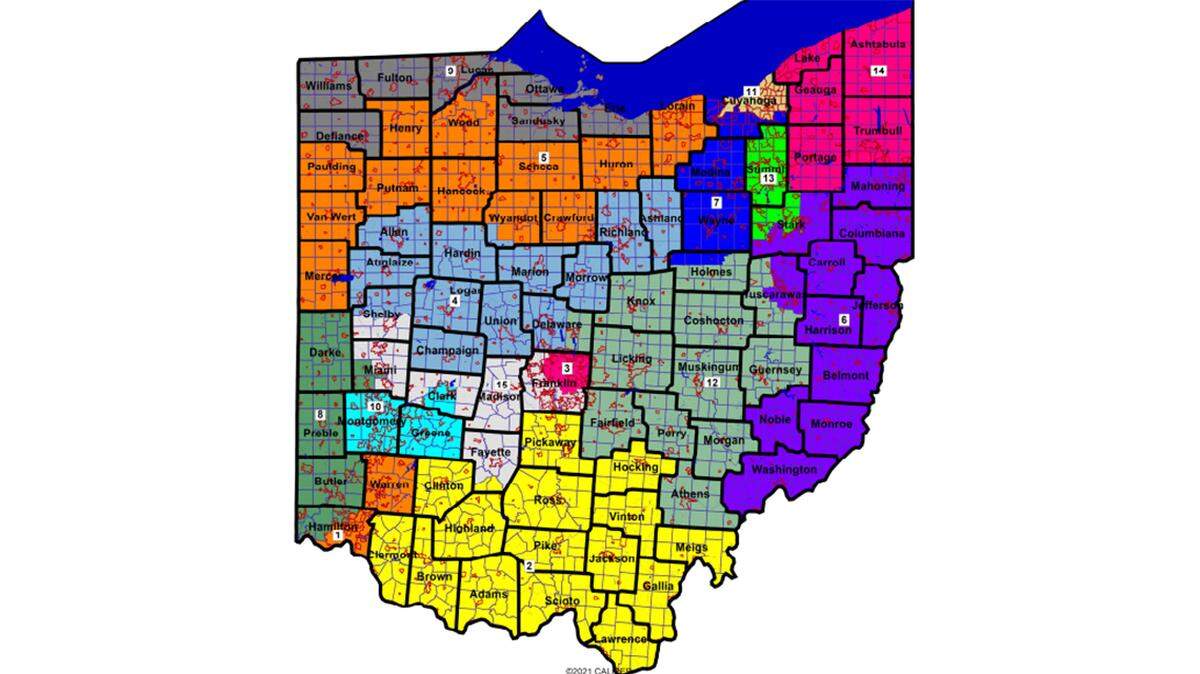
A federal judge in Ohio’s Southern District federal court on Tuesday morning declined to issue an injunction blocking certification of Ohio’s U.S. House primary election winners amid voter discrimination challenges against the state’s new congressional district map.
Youngstown-area Black voters, including the Rev. Kenneth Simon, Helen Youngblood and the Rev. Lewis Macklin, had intervened in a federal lawsuit regarding state legislative redistricting. They argued that the proposed maps violate anti-discrimination provisions of the Voting Rights Act and other legal precedent protecting against racial gerrymandering of legislative districts in the Mahoning Valley that could dilute Black voting power.
However, Judge Algenon Marbley on Tuesday ruled the Southern District case did not concern congressional redistricting, and suggested the voters bring their claims in a separate lawsuit.
Though those voters, represented by attorney Percy Squire, in December filed a separate lawsuit against the Republican majority members of the Ohio Redistricting Commission in the state’s Northern District court, they withdrew the case last month, following a lengthy stay issued by that court.
They still reserve the right to re-file that case later.
“The Court is receptive to the [intervenors’] desire to be heard on the merits and to their difficulty thus far in finding a receptive ear,” Judge Marbley wrote. “Nonetheless, their best course at this point is to file a new federal case in the Northern District specific to congressional redistricting and to move for a [temporary restraining order] as they see fit.”
Read the original report below:
___
A federal judicial panel in Ohio said it will decide by noon today whether to temporarily block the results of U.S. House races in Ohio that have gone forward under an unresolved congressional map.
A three-judge panel of the U.S. District Court for the Southern District of Ohio announced the timeline during a hearing Monday.
Side parties in a federal lawsuit over the state’s unresolved maps of legislative districts have raised issues with Black representation under the congressional map that was used to formulate May 3 ballots. They hope to stop the results of those races from being certified while court challenges at the state and federal levels proceed.
‘Pure racial gerrymandering’
Percy Squire, attorney for those intervenors — including Youngstown voters the Rev. Kenneth Simon, Helen Youngblood and the Rev. Lewis Macklin — on Monday argued Ohio election officials should not recognize the state’s congressional primary winners on May 3, since the congressional map that is being used discriminates against Black voters there, Cleveland.com reported.
Squire, who spoke to Mahoning Matters last month about a separate case Simon and others filed in federal court against the Ohio Redistricting Commission’s Republican majority in December — and later withdrew — said the commission’s map doesn’t take racial demographics into account, which is a violation of the Voting Rights Act.
“These maps are flawed at the very fundamental level, from the dilution of Black voting power in the Mahoning Valley and really throughout the state of Ohio,” he said. “It’s pure racial gerrymandering.”
Squire’s argument in that case also referenced his 1991 federal court case Ezell Armour et. al. v. State of Ohio, in which the court concluded that Ohio’s 1988 redistricting process intentionally discriminated against Black voters in Mahoning County. Ohio mapmakers now must refrain from racial gerrymandering when drawing legislative districts for the county, Squire said.
“There’s only one area in the state where a federal court has determined that the state of Ohio intentionally engaged in redistricting on a racially discriminatory basis. That’s the Mahoning Valley, and that finding is something that [the commission] should have been cognizant of right at the outset,” Squire told Mahoning Matters.
The Voting Rights Act requires mapmakers engage in an “intensely local appraisal of indigenous political reality,” said Squire. Essentially, mapmakers must consider the conditions on the ground in a newly drawn district. These conditions include racial demographics, population and historical voting patterns.
In Squire’s December lawsuit, he argued the commission “adopted a specific policy to totally disregard the impact of racial bloc voting.” But Mahoning County has a history of “persistent racial bloc voting,” according to the lawsuit.
Voters in Youngstown and Warren — whose populations are 41% and 27% Black or African American, respectively — are currently part of the 13th Congressional District, represented by Rep. Tim Ryan of Howland.
But under the map approved March 2 by the commission, Warren voters would join the rest of Trumbull County in the 14th district, which would also include Ashtabula, Lake, Geauga and Portage counties. Youngstown voters would go to the 6th, which would include the rest of Mahoning, as well as Columbiana, Carroll, Jefferson, Harrison, Belmont, Monroe, Noble and Washington counties, and parts of Stark and Tuscarawas counties.
A redistricting outlook
Republican Secretary of State Frank LaRose last month ordered county election boards to use districts indicated on the map most recently approved by the commission to create spring primary ballots. His position was that the map remained valid until a court determined otherwise.
The map is the second U.S. House plan okayed by the commission. Its first proposal was invalidated as an unconstitutional gerrymander unduly favoring Republicans.
The Ohio Supreme Court has pushed the briefing schedule in the legal challenge to the commission’s second congressional map well past the primary, effectively leaving questions of the 2022 election to the federal court.
Candidates for U.S. representative in the 6th and 14th congressional districts appear on Mahoning Valley voters’ May 3 primary ballots.
In the 6th Congressional District, which includes Columbiana and Mahoning counties, Republican incumbent Rep. Bill Johnson faces primary challenges from John Anderson of Enon, Michael S. Morgenstern of Poland and Gregory M. Zelenitz of Belmont. Democratic candidates include Martin Alexander of Boardman, Eric S. Jones of Austintown, Louis G. Lyras of Campbell and Shawna Roberts of Belmont.
In the 14th Congressional District, which includes Trumbull County, Republican incumbent Rep. Dave Joyce of Chagrin Falls is up against Patrick Gene Awtrey of Parma Heights and Bevin Cormack of Chesterland. Running unopposed for the Democratic nomination is Matt Kilboy of Deerfield.
These spring ballots do not include Ohio House and Ohio Senate races, because those maps are still in limbo.
___
The Associated Press and Mahoning Matters correspondent Aspen Pflughoeft contributed to this report.
[Editor’s note: The Rev. Lewis Macklin is a regular contributor to Mahoning Matters.]
This story was originally published April 12, 2022 at 5:00 AM.