
Food pantries on Ohio college campuses help students experiencing food insecurity
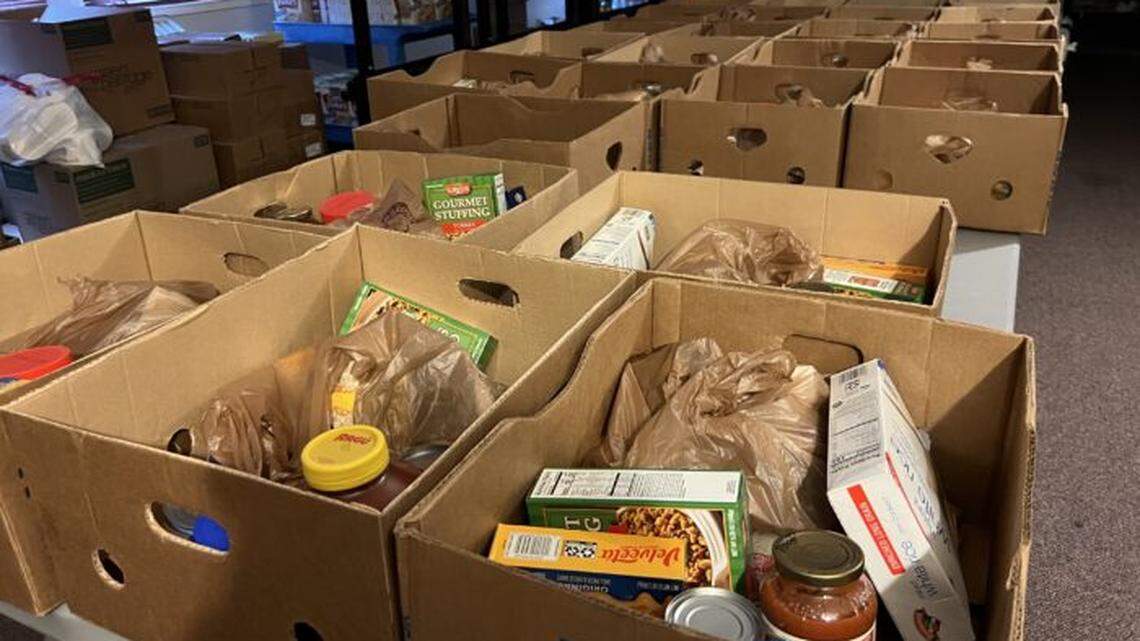
Food insecurity is one of the biggest issues on college campuses, yet is often invisible, according to experts.
Almost every college campus in Ohio has a food pantry, but each one is different and a new bipartisan bill would create a hunger-free campus program.
“The hope at the end of the day is that every college and university in Ohio, private and public, would have a robust program,” said Ohio state Rep. Sean Brennan, D-Parma.
“Hungry students don’t do as well academically.”
Brennan and state Rep. Jim Hoops, R-Napoleon, introduced Ohio House Bill 157 which would require the Chancellor of Higher Education to create the Hunger-Free Campus Grant Program.
The bill would appropriate $625,000 for fiscal year 2026 and 2027 for the program.
The bill has had three hearings so far in the Ohio House Workforce and Higher Education Committee.
“It would create a hunger-free designation that colleges and universities could get from the Department of Higher Ed to show prospective students that when you come to our campus, we’re going to help take care of you,” Brennan said.
“We’ve got programs to assist you, whether you need it right off the bat, or if you run into hard times.”
Brennan graduated from University of Dayton in 1992 and remembers being able to buy mac and cheese boxes for $1 and three tacos at Taco Bell for $1.
“Although you were struggling, you could make ends meet,” he said. “But nowadays it’s much tougher. Food prices have skyrocketed.”
Food insecurity is when someone does not know where their next meal is coming from, they are skipping meals, or rationing food.
“It comes up like ‘Oh, college students just live on ramen … it’s kind of like a rite of passage.’ But when you really look at that, if a student can only afford to eat ramen, they’re likely food insecure. That is not a nutritional food source for every meal,” said Stephanie Dodd, executive director at Community Campus Coalition.
About 40% of college students reported experiencing food insecurity, according to the Hope Center Student Basic Needs Survey, a 2025 report that surveyed 74,350 students from 91 colleges in 16 states.
“No student should have to choose between food and their future,” Swipe out Hunger’s Director of Advocacy Zoe Duffield said in an email.
“Yet, for many college students, that is the daily reality. … Since other costs of higher education are fixed – like rent/housing, tuition, textbooks, etc. – food is seen as a flexible, sometimes optional cost for students. That variability makes the issue invisible to many campus admins and even among peers.”
Food insecurity can affect academic performance.
“Too often we find students who are struggling academically, not because they aren’t academically capable, but because they are struggling with non-academic barriers that are getting in the way of them being successful,” Dodd said.
Falcon Food Pantry
Bowling Green State University’s Falcon Food Pantry serves on average about 1,300 students every month, said Shannon Orr, director of the pantry.
The pantry, which opened in March 2022, offers shelf stable and frozen meals.
Their most popular items are ramen, peanut butter, pasta, tomato soup, and rice.
“We were not doing everything we needed to do to address student hunger on our campus (before the pantry opened), which is the hidden epidemic,” Orr said.
“The food pantry provides a really critical need (and) can really help to alleviate some of the burden.”
The pantry receives 5,000 pounds of food each week from local banks and students can fill up a bag of food at the pantry once a week. They also provide hygiene and feminine hygiene products.
Emergency food bags are kept in residence halls and at the campus library.
The pantry even manages a 10-bed community garden on campus where students can pick fresh produce during the summer.
“Not everybody has a parent that they can comfortably tell that they’ve run out of money,” Orr said. “We already have students who are living in the dorms, who are coming and telling us that their only source of food is a pantry.”
The pantry has received many messages from students saying how they were on the verge of dropping out.
“Being able to see the impact that we have on students is huge,” Orr said.
A student told Orr that the pantry helped her leave an abusive relationship and ultimately graduate.
“She had been in an abusive relationship and was living with the guy, and the only way that she was able to leave him was because a friend said that she could sleep on her couch, and then she came to the pantry every week to get food,” Orr said.
The financial support through the Ohio bill would help campuses support their students, Orr said.
“One of the things that we really don’t want is for students to come to university and to drop out because of food insecurity and financial challenges, and all they have is debt and no degree to show for it,” she said.
Cuyahoga Community College
Cuyahoga Community College students can shop for up to 15 pounds of products once a week at the on-campus pantry.
“It’s a great service that we feel really lucky to be able to provide,” said Leslie Brown, a food pantry liaison for one of the food pantries at Tri-C.
“We love that the students are able to choose what they want, instead of just getting a set bag of products.”
There is a food pantry on each of Tri-C’s four campuses and more than 200 students use the pantry Brown works at per week.
“Some are taking the food home to feed their parents,” Brown said. “(Some) live in multi-generational homes, so we know the food is being used by a wide variety of people.”
The food for the pantry comes from the Greater Cleveland Food Bank.
Fruits, vegetables, and frozen proteins are some of their most popular items, Brown said.
“Almost all of our students also work — whether a full-time job or a part-time job or managing families,” Brown said. “It feels especially important, not just even from a financial aspect, but even just from a time aspect.”
Nearly three-fourths of college students have at least one nontraditional characteristic, according to the National Center for Education Statistics.
A nontraditional characteristic could be a student who is older than 24, working full-time, raising a child, a military veteran, an immigrant, or a first-generation college student.
Brennan said his bill could be especially helpful for nontraditional students.
“We’re investing in young people and working-class folks to help them move ahead and contribute to Ohio’s economy, and that’ll pay big dividends in the end,” Brennan said.
This story was originally published April 22, 2026 at 10:00 AM.