
Ohio State University investigation finds former president misused position for personal associate
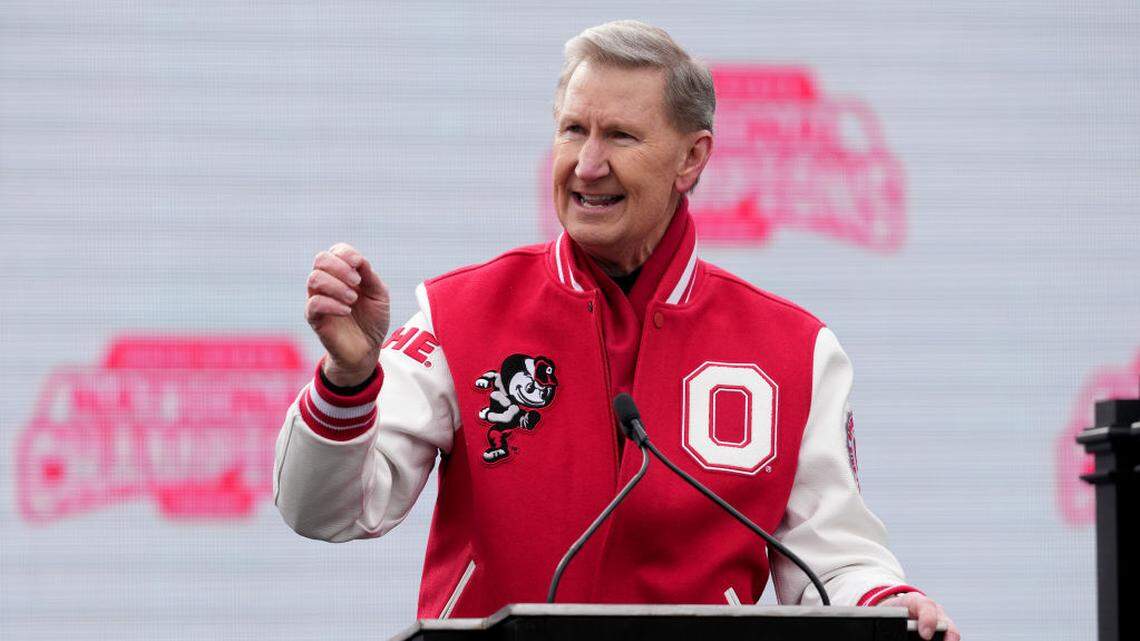
Former Ohio State University President Ted Carter misused his role to try to get resources to help Krisanthe Vlachos — the woman he was having an “inappropriate relationship with” — according to a new report.
Ohio State this week released the 47-page report, which details the investigation into the circumstances that led to Carter’s abrupt resignation last month. The university has also released thousands of documents as part of the investigation.
“Carter intentionally put his own interests before Ohio State’s interests when he used the authority and influence of his university position to secure benefits for Vlachos,” according to the report. “Carter’s actions betrayed Ohio State’s Shared Values and violated university policy.”
The report has been shared with the Ohio Inspector General, Ohio Ethics Commission, Ohio Auditor of State and Ohio Attorney General, said university spokesperson Ben Johnson.
“Sufficient evidence exists that Carter should have seen that Vlachos’ efforts both internal and external to the university implicated this reporting requirement because her efforts, if successful, would have resulted in misuse or misappropriation of public funds,” according to the report.
The report states Carter implicated Ohio Ethics law through his continued actions, citing the Ohio Ethics Commission’s definition of conflict of interest, which “prohibits public officials or employees from participating in actions or decisions that definitely and directly affect themselves, their family members or their business associates.”
Under Ohio Revised Code 102.03, public officials are prohibited to “use or authorize the use of the authority or influence of office or employment to secure anything of value or the promise or offer of anything of value that is of such a character as to manifest a substantial and improper influence upon the public official or employee with respect to that person’s duties.”
The report notes that Carter’s actions “may warrant further consideration” by state agencies. As of Thursday, no action by other state agencies had been announced, and Carter had not been charged with a crime related to the university’s investigation.
Carter tried to help Vlachos get a job at the university, space on campus, staff and technical support for her podcast, help with her app idea, and university investment in her business proposals, according to the report. The investigation found that at least 14 university employees received requests from Carter to help Vlachos.
According to the report, Carter connected Vlachos with JobsOhio, Anduril Industries, the Ohio National Guard, the Ohio Department of Veterans Services, OH.io, Student Veterans of America and Vet Mentor AI. Anduril Industries is the autonomous weapons manufacturer building a facility in Pickaway County.
“Carter’s efforts on behalf of Vlachos therefore potentially jeopardized the university’s relationships and credibility with these external parties,” the report states.
“Carter sought resources and assistance for Vlachos despite there being no clear nexus to a viable service or product that she could deliver that would serve Ohio State’s interests. The pervasiveness of his efforts, and the inappropriate nature of Carter’s relationship with Vlachos, were not apparent when they occurred because he typically made such efforts in serial fashion, and the full extent of those efforts was not apparent to individual employees,” according to the report.
Vlachos took at least five trips with Carter and had at least 24 meetings with him in the just over two years he was Ohio State’s president, according to the report. Carter took over as Ohio State president in January 2024 and was earning $1,189,732 when he resigned in March.
“Carter actively concealed the true nature of his actions involving Vlachos through the use of his personal email, personal meetings on his calendar, and other means,” according to the report.
The investigation concluded that university processes and decisions by Ohio State employees thwarted Carter’s attempts to help Vlachos from succeeding within the university. Vlachos was never hired as an Ohio State employee and she did not receive university funding.
The investigation
Ohio State University Board of Trustees Chair John W. Zeiger requested an investigation on March 8, the day after Carter resigned. The investigation was conducted by the Office of University Compliance and Integrity and the Department of Internal Audit.
“Its findings regarding our former president are deeply disappointing, but it is gratifying the university’s systems and processes – and the people charged with implementing them – prevented misuse of Ohio State’s resources,” Zeiger said in a news release.
Investigators examined emails, text messages, calendars, Carter’s two university laptops, social media accounts, contracts, payments, travel expenditures and BuckID records.
They also conducted 60 interviews, including 12 with people not affiliated with Ohio State.
Carter declined to be interviewed for the investigation through his attorney, and Vlachos did not respond to an interview request for the investigation.
The report made five recommendations:
*Maintain the processes of the President’s Office and the independence of the Board Office in reviewing travel and expenditure requests submitted by the president, as well as transparent scheduling processes for the president. *Units should review their practices on leadership requests for assistance. *Consider revisions to ethics and insider threat training for senior leaders. *Reinforce the importance of culture and shared values at the senior leadership level. *Continue to respond as appropriate to any state and federal agency inquiries.
Vlachos met Carter in 2023
Vlachos and Carter met at a Veterans in Energy forum in Washington, D.C. in March 2023, according to the report. At that time, Carter was president of the University of Nebraska.
It was there that Vlachos asked Carter to cohost her podcast and mentor her son who was joining the Navy.
Her son emailed Carter’s personal email in February 2024 and asked for a recommendation for the Seaman to Admiral Commissioning program. Carter asked his chief of staff to help write a letter of reference.
Carter graduated with a bachelor’s degree from the United States Naval Academy in 1981 and served in the United States Navy. He was the superintendent of the United States Naval Academy from 2014-2019, and was the president of the United States Naval War College.
In July 2024, Carter forwarded Vlachos’ resume to Katie Hall, Ohio State’s senior vice president for talent, culture and human resources.
“She is planning to move to Columbus immediately (from St. Louis) and is looking for a full time position,” Carter said in his email to Hall. “She tells me she is open to any opportunity that fits her skill set. Think she would be a good fit for anyone’s team.”
Vlachos applied to five positions related to advancement, but it does not seem that she was ever formally interviewed and was not hired by Ohio State, according to the report.
In October 2024, Carter asked Ohio State Senior Vice President for Marketing and Communications Elizabeth Parkinson to help Vlachos produce her podcast and Parkinson’s team helped twice.
Vlachos said in a December 2024 email that Carter was in her “most inner circle.”
“Ted’s been the unrelenting cheerleader who has understood my vision energizing me to realize my own power & potential,” Vlachos wrote in the email. “He’s also been an incredible resource of knowledge, important relationships & OSU’s support in total of the podcast’s mission!”
Many witnesses interviewed for the investigation described Vlachos as “persistent” and “unsophisticated,” according to the report.
“Vlachos was described as ‘weird’ because she did not follow typical professional courtesies. She was very demanding and made unusual requests or comments, like asking to house-sit professors’ homes or saying she was living out of her car,” according to the report. “She made employees uncomfortable, and many witnesses described avoiding or ignoring her contacts.”
Vlachos was seen with Carter on several occasions and the pair were seen walking outside of a Philadelphia hotel in the morning at the Association of Public and Land-grant Universities annual meeting in November 2025, according to the report.
“No inappropriate interactions were observed,” according to the report.
‘The Callout’ podcast
Vlachos had a $93,716 contract with WOSU, home to Ohio State’s public radio and TV station, for 50 episodes of “The Callout” podcast she hosted, according to the report. The podcast was a veteran-focused program that had about a dozen episodes posted on YouTube, but they have all been removed.
“WOSU offered Vlachos the university rates charged to nonprofits because they considered her podcast to be a nonprofit,” according to the report. “WOSU personnel did not feel pressured by anyone and saw the contract as in line with the type of engagement WOSU was seeking to increase revenue.”
Vlachos had a desk on the third floor of WOSU, email records show.
WOSU took care of filming and production. Three episodes were recorded at WOSU in 2025 — the first on Aug. 6 for $2,410, the second on Aug. 27 for $1,982, and the third on Dec. 10 for $2,196.
“Vlachos’ Callout Podcast appeared to narrowly focus on connecting veterans with utility industry jobs that did not require a college degree,” according to the report.
Carter participated in at least five of the 19 episodes of “The Callout” podcast.
“Vlachos’ podcast appears to have never obtained many subscribers or significant viewership and did not evidence substantial marketing capabilities,” according to the report. “A witness who participated in the podcast described it as unprofessional and unengaging.”
Carter helped connect Vlachos with JobsOhio, the state’s privatized economic development agency, at the Memorial Tournament in Dublin in 2025 and JobsOhio agreed to a $60,000 contract for four podcast episodes.
JobsOhio Chief of Staff Phil Greenberg said they had been considering doing podcasts and viewed this as an opportunity to partner with Ohio State, but their goal was to expand the podcast beyond the utilities industry, according to the report.
Ohio Department of Veterans Service Director John C. Harris Jr., was on the Dec. 10 podcast episode and he “described Vlachos’ interview style as amateurish and the podcast experience as difficult,” according to the report.
Carter sought university businesses expenditures related to Vlachos
The report highlighted various instances of business expenditures requested by Carter from May 2025 to January 2026, all of which were related to Vlachos.
His first trip with Vlachos was highlighted by the report. Carter was invited to an annual Gaff-n-Go Lineworker Rodeo as a guest speaker in February 2025. The event was hosted by the Virginia, Maryland & Delaware Association of Electric Cooperatives, whose president and CEO, Brian Moiser, cited Vlachos in his email invitation to Carter.
At the event, Carter and Vlachos met with executives from Vet Mentor AI, who introduced them to the company’s CEO, Paul Hylenski.
The trip’s cost totaled $1,706.34, including travel and business dinners. Lodging was paid for by the Rodeo, according to the report.
Carter traveled to Las Vegas, Nevada in January 2026 to speak at a conference on behalf of JobsOhio. The total cost of the trip including airfare and lodging was $4,320.17.
The university’s investigation revealed Carter requested Vlachos to join the delegation and conference, which was approved by JobsOhio, even though none of the documentation submitted to the university listed Vlachos as a guest, according to the report.
Vlachos did not submit any expenses to JobsOhio for the trip.
While business documentation reflected that no university funds were used to pay Vlachos or subsidize her expenses, the report found at least one instance of Carter fabricating a business expense in order to travel with Vlachos on the university’s dime.
Carter planned to travel to Orlando, Florida on a personal trip in September 2025, and he asked his wife, Lynda Carter, to book travel through their Southwest Airline points. He later changed the nature of the travel to business, listing the purpose as “Veterans and executive engagements scheduled by President Carter,” according to the report, and requested to be reimbursed for the use of his airline points. He was scheduled to meet with University of Central Florida President Alexander Cartwright, as well as multiple Disney executives.
During the trip, Carter visited the International Lineman’s Museum, according to photographs posted on social media that show him there with Vlachos. Carter did not mention the visit to his staff or submit documentation regarding event attendance or Vlachos’ presence, according to the report.
A witness confirmed that Vlachos visited the museum with Carter. He dropped her off and left to attend a meeting, later returning for an hour-long meeting with Vlachos to discuss her “app idea,” according to the report.
“This trip, and perhaps others, do not represent a responsible use of university funds, as required by the Expenditure Policy, because they were connected to Vlachos,” according to the report. “Therefore, sufficient evidence exists that Carter violated the Expenditures Policy.”
Ohio State’s Expenditures Policy states for every trip, there must be a written statement explaining the justification of the expense, and must include details of who, what and why something was purchased, and how it benefits the institution.
University employees are required to document expenses approved by an authorized employee. Notably, the president’s expenses are solely approved by the secretary of the Board of Trustees.
“While university employees satisfied their policy obligations, they trusted that Carter’s requests were made appropriately and in good faith,” according to the report. “In contrast, Carter’s actions suggest that he did not follow the spirit of the policy by incurring business travel and requesting expenditures connected to Vlachos, an individual seeking public resources to support her personal business.”
Within Carter’s local business expenditures, the report noted one instance of Carter fabricating a business expense to cover costs associated with Vlachos.
On Nov. 17, 2025, the university paid for a $2,124.12 meal at a Student Veterans of America dinner attended by university, Google, and SVA executives at Carter’s specific request. The dinner was at Butcher & Rose in downtown Columbus.
Carter, a member of the SVA Board of Directors, was invited to the 11-person dinner, where he requested to include Vlachos as a guest.
After reviewing the documentation, Carter’s chief of staff asked him if Carter had authorized the payment. Carter denied doing so and asked for the expense to be stricken from the record, according to the report.
The report revealed Carter had a history of trying to fold Vlachos into SVA.
Carter invited Vlachos to the organization’s national conference in Colorado Springs, Colorado, this past January where he requested she introduce him in his 10-minute address, and proceeded to introduce her to attendees.
He also nominated Vlachos to join the organization’s board of directors. She did not move forward in the election process because she was deemed unqualified in comparison with other sitting board members.
“Notably, SVA’s Directors individually are extraordinarily qualified, and Vlachos’ experience and expertise does not objectively compare to those of existing Directors,” according to the report.
Carter’s efforts to launch Vlachos’ military app
Vlachos was trying to to launch an app — Operation Forward — centered on assisting veterans in pursuing higher education and obtaining jobs.
Carter used university and external partners to aid Vlachos in her pitch. He leveraged his position to connect her with dozens of university staff members across departments in order to further her goals.
Vlachos first connected with Carter to pitch the idea to the university on Aug. 18, 2025. Carter orchestrated a virtual meeting with Vlachos, Carter’s Chief of Staff JR Blackburn, and Chris Kabourek — former senior vice president of administration and planning, and senior advisor to the president.
Kabourek stepped down from his position April 13, without elaboration on the reason for his departure. According to the report, Kabourek made “substantive efforts” to support Carter’s will on behalf of Vlachos, including serving as Carter’s university point of contact for Vlachos.
“No other employee other than Carter communicated so extensively with Vlachos, and no other employee had the same level of awareness of or involvement in Vlachos’ activities both inside and outside the university,” according to the report.
After Vlachos’ initial pitch to the university, Carter and Kabourek continued to facilitate meetings on her behalf despite internal pushback. University employees collectively decided over months that the idea was not feasible.
“Employees noted Vlachos did not appear to understand the obvious technical challenges, and they concluded that Vlachos did not present a viable solution to those challenges or even a thoughtful plan to begin to address them,” according to the report. “Further, employees consistently concluded that they saw no benefits to the university in assisting Vlachos or pursuing her App idea.”
Employees who worked under Kabourek raised concerns about Carter’s relationship with Vlachos. According to the report, Kabourek told them to raise their concerns directly with Carter, even though they were Kabourek’s subordinates.
“This refusal or unwillingness to respond appropriately to such concerns, and in fact to direct them to go themselves to the person about whom the concern relates, is a dereliction of duty for a senior leader and does not demonstrate the behavior expected by the university of its leaders,” according to the report.
Kabourek facilitated a meeting between Vlachos and Vet Mentor AI, which she attempted to partner with to build her app.
According to the report, during a meeting with JobsOhio and Anduril in July 2025, Zach Mears, Anduril’s senior vice president of strategy, said there was a blurred line between Vlachos’ podcast and potential app, lacking organization in her ideas.
Mears said Vlachos never made a formal request for partnership between herself and Anduril, but would frequently attempt to communicate with him regarding the idea. According to the report, Mears ignored her communication as he saw no value in the relationship.
While Mears said he never felt pressured by Carter to work with Vlachos, he questioned Carter’s judgement in advocating for her ideas.
“Mears also noted that the time spent by Carter and others on Vlachos’ idea felt discordant in comparison with Anduril’s substantial ongoing business with the university,” according to the report.
Carter also attempted to engage university donors to support the app. In September 2025, Vet Mentor AI CEO Hylenski said he had conversations with Vlachos about funding in which she claimed Carter could introduce the pair to billionaire Les Wexner.
In a text message included in the report, Vlachos told Hylenski that Carter told her he’d spoken to Wexner about the app in an attempt to facilitate a meeting between the parties.
“Notably, Wexner’s attorney was contacted as part of the investigation process and confirmed that at no time did Wexner ever discuss or meet with anyone, including Carter, regarding Vlachos or her App idea, and therefore he never agreed to purchase or invest in any technology associated with it,” according to the report.
Carter used his personal Gmail account to contact Vlachos and Hylsenski to discuss the app and funding, promising to highlight their efforts in his presentation on AI Fluency to the I/ITSEC conference in December 2025.
In documents shared in the report about the follow up of the conference, Carter discussed “a significant philanthropic contribution from a donor,” with a plan that “involves leveraging this funding with JobsOhio’s support to attract veterans to Ohio, with Ohio State providing educational support.”
“According to several witnesses, Carter stated that he had obtained or would obtain donations for or interest in Vlachos’ business ventures from university donors,” the report states. “We confirmed that Carter had not, in fact, done so. This misrepresentation of the engagement of university donors by Carter is a notable misuse of influence by a university president.”
Hylenski told investigators Carter coached the group on how to obtain financial support for the app.
Carter’s search for external support for Vlachos culminated in a Dec. 10, 2025 meeting between JobsOhio, Vet Mentor AI, the department of veterans services, and Ohio State executives. The report states that Carter and Kabourek went to “extraordinary efforts” to attend the meeting.
Kabourek skipped a luncheon honoring his employees due to Carter’s request to attend the meeting, and Carter — the keynote speaker for the luncheon — left only 15 minutes into the event to support Vlachos’ meeting.
According to the report, Hylenski described Carter entering the meeting “like the Godfather,” and proceeding to make authoritative statements about the app, even saying he would put his and the university’s name on the app.
Greenberg said the JobsOhio technology staff was unimpressed, and would not go forward in supporting the technology.
Carter, however, continued to push for efforts to support Vlachos’ app, including helping to name and structure the venture.
“Hylenski stated that Carter had discussed being named to an advisory board of the Operation Forward venture, which Hylenski noted might come with some form of equity or compensation,” according to the report.
Carter and Vlachos ultimately cut ties with Vet Mentor AI over business disagreements.
Disagreements arose when Vlachos demanded 25% equity of the venture and demanded to be CEO, according to the report. Hylenski said the organization and Vlachos had never come to an official business agreement, and declined her request as she did not own any of the technology associated with the app.
Vlachos told Hylenski that if these requests were not met, the company would “lose Ohio,” according to the report.