
Bipartisan former Ohio AGs urge U.S. Supreme Court to keep immigration protections for Haitians
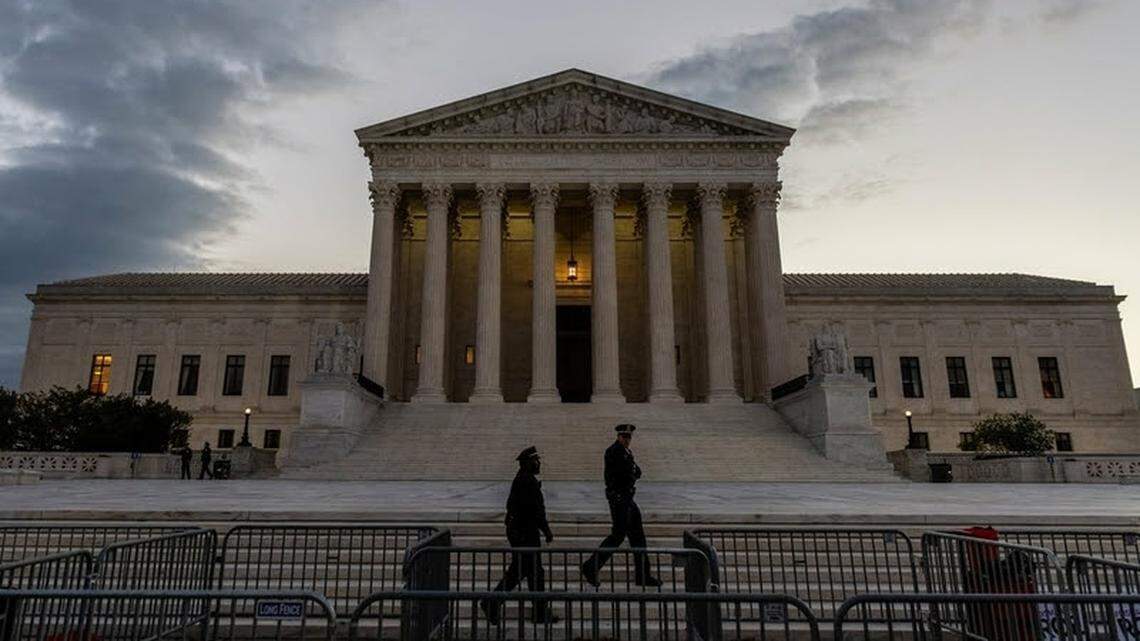
Next week, the U.S. Supreme Court will consider the immigration status of thousands around the country, including Haitian immigrants in cities like Springfield, Ohio.
The oral arguments bring together two cases dealing with the temporary protected status (TPS) granted to Syrian and Haitian immigrants.
In an amicus brief, a bipartisan group of former Ohio attorneys general urge the court to reject the Trump administration’s bid to terminate TPS protections.
“Fully revoking TPS — which would uproot more than 14,000 people across Ohio — would irreparably harm the state and wipe out economic gains that have spread throughout the community,” they wrote.
The court hears the case as Congress considers a three-year extension of TPS protections for Haitian immigrants. Several GOP U.S. House members signed on to a discharge petition which forced a vote on the measure. Last week, the U.S. House approved the bill and advanced it to the U.S. Senate.
How we got here
Last year, then-Secretary for the Department of Homeland Security Kristi Noem attempted to terminate immigration protections and work authorizations for immigrants from several countries including Somalia, Nepal, Burma, Honduras, Nicaragua, Ethiopia, South Sudan and Venezuela.
Last June, when she rescinded those protections for Haitian immigrants, a DHS spokesperson said the decision “restores integrity in our immigration system and ensures that Temporary Protective Status is actually temporary.”
Noem’s actions would affect the more than 330,000 Haitians nationwide who have received immigration protections.
Civil rights attorneys quickly sued the Trump administration and the Washington D.C. District Court halted Noem’s orders. In March, the U.S. Supreme Court agreed to hear the case and set oral arguments for April 29.
Amici’s arguments
Former Ohio attorneys general Jim Petro, Marc Dann, Nancy Rogers, and Richard Cordray all signed on to an amicus brief – a legal brief filed by individuals or groups who aren’t parties in the lawsuit – urging the court to maintain protections for Haitian TPS recipients.
They argue Noem overstepped her authority by failing to consider the economic impact Haitian workers have on communities like Springfield and making spurious claims that TPS recipients are involved in crime.
“Neither the Constitution nor the TPS-enabling statute permit the executive to terminate TPS by executive fiat,” they wrote, “let alone do so with threadbare process and absent any meaningful evidence supporting its decision.”
Still, their argument focuses not so much on what the government did as how the government did it. The former AGs contend Noem violated the Administrative Procedures Act, which requires agencies to consider the economic fallout of their actions, and justify their changes.
The legal brief cites reports that roughly 14,000 Haitians with TPS status call Ohio home, and they contribute $160 million to the state’s economy.
“More than 3,000 children born to Haitian TPS holders in Franklin and Clark counties since 2020 are U.S. citizens,” they added.
Zeroing in on Springfield, the brief contends that Haitian workers have been a boon to the local economy. While Springfield has blossomed, they argued, the counties that house similarly sized cities, like Warren and Mansfield, have not.
“In 2022, one year after Haiti was redesignated for TPS protection, Clark County (where Springfield sits) saw its GDP grow by 1.6%,” the brief stated, “while Trumbull County (where Warren sits) saw its GDP grow by only 0.4%, and Richland County (where Mansfield sits) actually saw its GDP contract by 0.4%.”
Removing several thousand workers from the local economy would hamper that growth, and present challenges to the businesses who’ve come to rely on them as employees and customers. Because Noem’s order didn’t consider those impacts, the attorneys general argue, it shouldn’t be allowed to go forward.
“Ohioans significantly benefit from, and rely on, Haitian TPS holders’ contributions to the Ohio economy,” they wrote, “and the secretary was required to take these benefits and economic considerations into account.”
As for the justifications Noem did offer, the AGs contend they’re no justification at all. Far from being prone to criminal behavior, they noted, Haitian immigrants nationwide have an incarceration rate 26% lower than all other legal immigrants and 81% lower than American citizens.
“Because its public-safety theory is unsubstantiated—and, indeed, contrary to the evidence — the government has offered no reasoned explanation at all,” the attorneys general wrote.
In addition to violating the broader Administrative Procedures Act, the attorneys general contend Noem’s order violates the process laid out in the TPS enacting statute.
Since the country’s founding, the brief explained, Congress has set the terms for immigration policy, and so the secretary’s actions are bound by federal law.
The TPS statute directs the DHS secretary to weigh whether conditions in country like Haiti still justify TPS status “after consultation with appropriate agencies of the government.”
To Noem, that gives cabinet officials broad discretion to determine what constitutes “consultation.”
But the Ohio AGs note the typical process includes a thorough review from the U.S. State Department followed by an official report recommendation to DHS.
“Reading the phrase ‘after consultation with appropriate agencies’ to mean whatever minimal process the secretary chooses to call consultation does not respect the statute’s limits,” the attorneys general wrote. “It erases them.”