
Ohio lawmakers consider joining other states to test psychedelic-assisted treatments
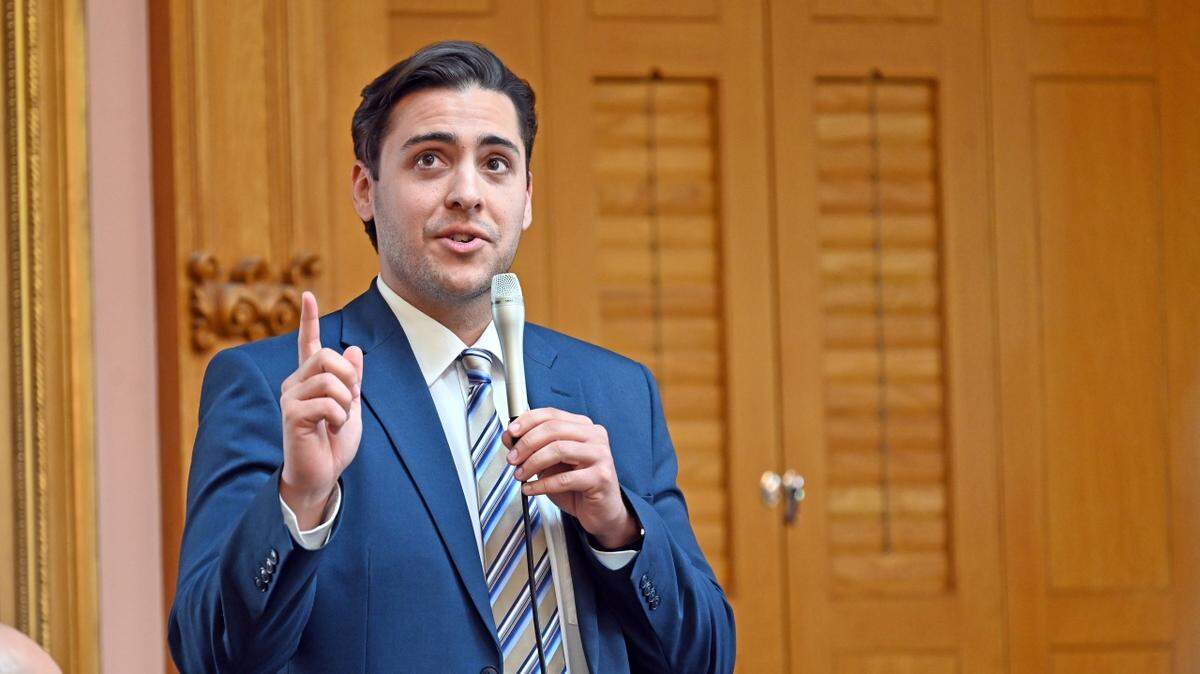
In Ohio and several other states around the country, lawmakers are weighing the potential benefits of a little-known psychedelic drug called ibogaine.
Prompted in large part by veterans seeking psychedelic-assisted treatment abroad, Republican lawmakers are looking to research its efficacy in treating post-traumatic stress and opioid addiction.
It’s an almost inconceivable turnaround for a party that spent decades aggressively pursuing the war on drugs.
“I think that, looking at the effect it has on veterans,” Ohio state Rep. Justin Pizzulli, R-Scioto County, said, “and just hearing people talk about how it helped them — it stopped them from committing suicide — I think that’s a message that Republicans are very passionate about.”
Pizzulli chairs the Ibogaine Treatment Study Committee and lobbied for its creation as part of last year’s budget.
Pizzulli represents Portsmouth which he described as “ground zero” for the opioid crisis in Ohio.
“It was the greatest crisis to ever happen to my community in our lifetime, and we’re still paying and recovering for it,” Pizzulli said.
“I made a promise to my constituency to be sure to find alternative methods to help fix and to research things that I think could potentially be helpful.”
Supporters of ibogaine treatment insist their effort is limited to clinical therapies in a controlled setting rather than opening the door to recreational use. And they point to initial studies that show promising results for the treatment.
Right now, a handful of states are pooling funds and working together to develop a treatment that could pass muster with the FDA.
The White House has blessed the effort and kicked in $50 million. Supporters who spoke Wednesday encouraged Ohio to participate.
Still, even some lawmakers who seem open to the approach remain skeptical about the state’s role in funding the effort.
Committee testimony
Initial studies suggest ibogaine rewires neural pathways in the brain and promotes regeneration. Researchers have already seen some effectiveness in treating opioid addiction and PTSD with ibogaine, but they think it might also have applications in the treatment of neurodegenerative diseases like multiple sclerosis and Parkinson’s disease.
Geoffrey Lawrence from the libertarian think tank Reason Foundation emphasized its potential in treating opioid use disorder.
He noted current medication-assisted treatments, like methadone and buprenorphine, have low success rates in part because they require regular dosing.
The average person winds up going through treatment for opioid addiction several times before achieving long-term remission.
“Ibogaine works differently,” Lawrence said. “It physically repairs the brain’s architecture and balance of neurotransmitters within a matter of days. As a result, patients are able to move beyond the symptoms of physical withdrawal and get a new lease on life.”
Logan Davidson serves as legislative director for Veterans Exploring Treatment Solutions. The group funds grants for veterans traveling abroad for ibogaine treatment. He stressed the conservative case for expanding access to the drug.
“The legislation we have advanced does not legalize, decriminalize or expand recreational use of any substance,” he said.
“It funds rigorous scientific research in controlled clinical settings, preserves FDA and DEA authority, demands accountability for every public dollar invested, and reflects a fundamental commitment to those who served.”
With roughly 17 veterans on average committing suicide each day, Davidson said any work at the state level to advance treatment is important.
“If there is an opportunity to accelerate an effective treatment through that process,” he said, “you can count the lives saves by the days shaved off that timeline.”
Who pays?
To that end, Lawrence explained Texas recently approved an ibogaine research program with the goal of developing a treatment that could make it through clinical trials.
And although Texas put forward $100 million split evenly between private and state dollars, that’s nowhere near enough.
And would you look at that — Ohio is set to receive about $2 billion in opioid settlement funds.
Lawrence said several states are already considering proposals to earmark some of those settlement dollars for the effort. Mississippi, for instance, committed $5 million in March.
“Using this money to create access to a drug that works effectively and immediately to help people turn their lives around could be the most impactful legacy of those funds,” Lawrence said.
But Ohio state Sen. Steve Huffman, R-Tipp City, pushed back.
“Is it the state’s job to do that?” he asked.
He noted Ohio put $5 million toward pediatric cancer research in the most recent budget, but it’s not common for state lawmakers to do so.
“Is it not the federal government’s job to financially do that to benefit all citizens?”
Huffman also asked why private industry isn’t leading the charge.
Americans for Ibogaine CEO Bryan Hubbard explained ibogaine isn’t patentable.
“There’s not the opportunity to create 6, 7, 800% rates of return on a medication that can essentially be replicated and produced by anyone,” he said. “The lack of patentability is a significant disincentive to the conventional Big Pharma model.”
He added that the current system of medication-assisted treatment for opioid abuse is often billed through Medicaid. That system serves some companies’ interests just fine, Hubbard said.
“We would be foolish to not recognize that there is a business model at work that is rooted in the daily administration of pharmacology,” he said.
If ibogaine treatment proves as successful as its supporters hope, Hubbard added, it could disrupt that approach to treatment.
Hubbard successfully lobbied the Trump administration to issue an executive order encouraging research into psychedelic-assisted treatments.
As part of that order, the president directed the Department of Health and Human Services to put at least $50 million toward state research efforts like the one Texas announced.
Hubbard encouraged state lawmakers to get on board.
“I hope that stalwart Ohio, part of the blue-collar backbone of America, will be among the states which turn the fulcrum of history to emancipate the mind, body and soul of very person who lives at the end of hope,” he said. “Ibogaine heals.”