
Top Husted aide lobbied for Ohio utility that profited from corrupt law
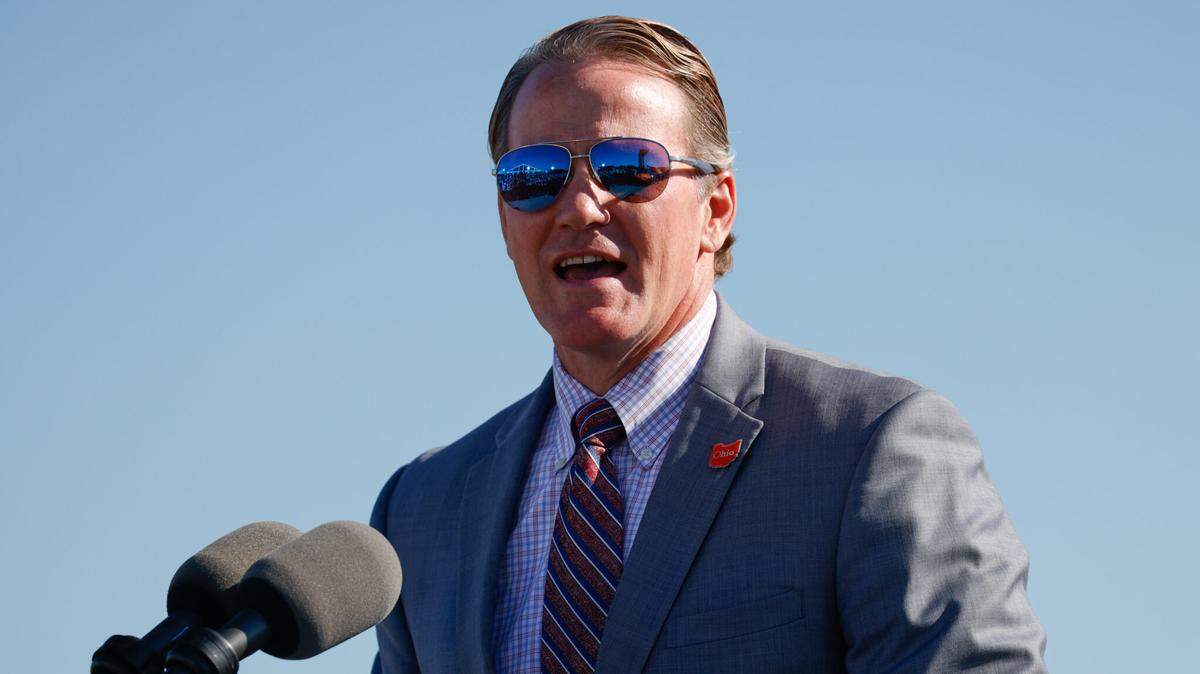
When then-Lt. Gov. Jon Husted was appointed to the U.S. Senate at the start of 2025, he was coming from an administration with numerous high-ranking officials connected to the utility lobby. In 2020, that administration was rocked by the biggest bribery and money laundering scandal in Ohio history — all of it related to utilities.
When Husted reached the Senate five years later, one of his first moves was to hire as a top advisor a longtime utility lobbyist.
The lobbyist’s client made millions off the scheme at the heart of the 2020 utility scandal. The same lobbyist had also represented a massive drug wholesaler that had paid out millions to settle claims that it had negligently distributed vast amounts of opioids in addiction-ravaged Ohio.
Ohioans’ utility bills are spiking amid a tax-subsidized data-center boom and lavish executive pay. The Trump administration has also threatened billions in federal funding for addiction treatment.
Husted’s decision to hire the lobbyist, Sean Dunn, has some questioning whether average Ohioans’ welfare is Husted’s top priority.
“It’s tone deaf because he’s an elected official who doesn’t see how cozy relationships can compromise his decision making,” said Catherine Turcer, executive director of Common Cause Ohio, which advocates for accountable government. “Or he sees a benefit to these very cozy relationships.”
‘Public servant’
Husted’s office didn’t respond to questions for this story. But less than a month after he took office in 2025, Husted announced that Dunn would be his senior advisor and counsel.
“Dunn brings decades of experience as a lawyer and public servant focused on technology, public utility, workforce and a variety of legislative issues,” Husted’s office said in a written statement. “He has held roles with the Office of Chief Legal Counsel to the Ohio Governor, the Ohio Senate Judiciary Committee, the Ohio Department of Administrative Services and the Ohio Senate Majority Caucus.”
What the statement didn’t say was that Dunn had been a lobbyist for Virginia-based AES, which has 527,000 customers in the Ohio region that includes Dayton.
According to disclosures filed with the Ohio Lobbying Activity Center, Dunn began lobbying for AES in 2009 and did so until February 2025.
During that time, Dunn lobbied the state legislature and the executive branch on numerous measures relating to Ohio House Bill 6, the 2019 law that was the product of what one federal prosecutor said was “likely the largest bribery and money-laundering scheme ever in the state of Ohio.”
Akron-based FirstEnergy was the major utility player in the scandal, in which putting $61 million in bribes won a $1.3 billion bailout financed by customers.
It was passed by the legislature and immediately signed by Gov. Mike DeWine, in whose administration Husted was No. 2.
Former Ohio House Speaker Larry Householder, R-Glenford, is now serving a 20-year sentence in federal prison for his involvement in the scheme. A state trial of former FirstEnergy executives ended in a hung jury earlier this year.
$77 million to subsidize a wealthy utility
In addition to FirstEnergy, other Ohio utilities also richly benefitted from the scandal-ridden H.B. 6 law.
The law claimed to promote clean energy because it bailed out two nuclear plants owned by FirstEnergy. But it gutted Ohio’s energy efficiency standards and it created a separate bailout for two aging coal-fired generators owned by a consortium of Ohio’s other utilities — including Columbus-based AEP and AES, for whom Dunn lobbied.
The group was called the Ohio Valley Electric Corporation and one of its 71-year-old coal plants isn’t even in Ohio, it’s in Indiana.
Subsidies from the corrupt bailout law stopped flowing to FirstEnergy after the FBI started making arrests in early 2020. But money continued to flow to the other utilities for years as the utilities — and apparently Dunn as a lobbyist — fought their repeal.
It wasn’t until May of 2025 that DeWine finally signed a law ending the subsidies.
By then, AES’s share of them was $77 million, according to a subsidy scorecard kept by the Office of the Ohio Consumers’ Counsel. That’s part of $670 million in subsidies paid by customers that had gone to the consortium since 2017.
As AES’s representative, Dunn registered to lobby on H.B. 6 — presumably in support of it — disclosures show. And he lobbied on numerous bills that would have repealed the coal subsidies, after the scandal broke. AES executives testified against them.
While AES pleaded poverty to justify its share of the customer-financed subsidies, the company found a way to pay CEO Andrés Gluski $9 million last year.
The bribery and bailout scandal
Husted had exposure of his own in the massive bribes-for-bailout scandal.
Emails have come to light indicating that shortly after he agreed to be DeWine’s running mate in 2017, he lobbied DeWine to support the massive utility bailout.
And in 2024, Husted declined to say whether he knew that FirstEnergy was the source of a $1 million dark money contribution to a group supporting him back when he was still vying with DeWine for the Republican governor nomination.
There was also a meeting that raised a lot of questions.
On Dec. 18, 2018, FirstEnergy CEO Chuck Jones and VP Michael Dowling met with Gov.-elect DeWine and Lt. Gov.-elect Husted at the Columbus Athletic Club.
They discussed whether the executives wanted Sam Randazzo, a former FirstEnergy consultant, to be the top utility regulator in Ohio.
Jones and Dowling then drove a mile to Randazzo’s condo and negotiated what FirstEnergy later said was a $4.3 million bribe. DeWine nominated Randazzo to be chairman of the Public Utilities Commission six weeks later.
Even though he was supposed to be policing utilities on behalf of consumers, Randazzo helped write the corrupt bailout legislation. In 2024, facing state and federal indictments, Randazzo took his own life by hanging.
Others with close connections to FirstEnergy also played prominent roles in the DeWine-Husted administration.
Legislative Affairs Director Dan McCarthy was a FirstEnergy lobbyist when he set up one of the main dark money groups through which FirstEnergy would funnel millions in bribes. He joined the DeWine-Husted administration shortly thereafter.
And DeWine’s chief of staff, Laurel Dawson, was married to a former FirstEnergy lobbyist whom a state indictment said had gotten a $10,000 loan from Randazzo a few years before DeWine took office.
Dawson, the administration said, knew about the massive FirstEnergy payment to Randazzo, but didn’t tell DeWine about it for nearly two years. As of late last year, she still worked for DeWine.
Other lobbying
In addition to Dunn’s ties to AES, he also lobbied on behalf of Dublin-based Cardinal Health, one of the three largest prescription-drug wholesalers in the United States. Dunn’s engagement with the company ran from 2009 to 2019.
Federal enforcement actions and government lawsuits against the drug wholesaler alleged that Cardinal frequently ignored “blatantly suspicious orders” as it shipped billions of opioid pills into Ohio and other U.S. states.
In 2021, Cardinal and two other giant wholesalers agreed to pay $808 million to settle state allegations that the companies’ negligence fueled Ohio’s raging addiction crisis.
Disclosures also show that Dunn made $895,000 in the 15 months before he joined Husted’s team and was owed between $1 million and $5 million by his old firm.
Ohioans
Median household income in Ohio is $72,000 a year and many say they’re getting crushed by the cost of utilities, prescription drugs, gasoline, healthcare and groceries.
Husted’s office was asked what the senator was doing to relieve the affordability crisis, and to explain his decision to hire as a top advisor someone who’d grown wealthy lobbying on behalf of some of the industries driving the crisis.
It didn’t answer.
Turcer of Common Cause said Dunn’s hiring and the lack of a response may be a consequence of gerrymandering and longtime, one-party rule in Ohio.
“When power is really entrenched, (leaders) are not asking themselves the kinds of questions that voters would ask them,” she said. “They’re just not challenging themselves to do better for voters because they think they’re anointed rather than elected.”
In the November election, Husted faces former Ohio Democratic U.S. Sen. Sherrod Brown. The Cook Political Report rates the race a tossup.