
Mike Trout Is Good Again. The Angels Should Trade Him, Stat.
(Commentary)
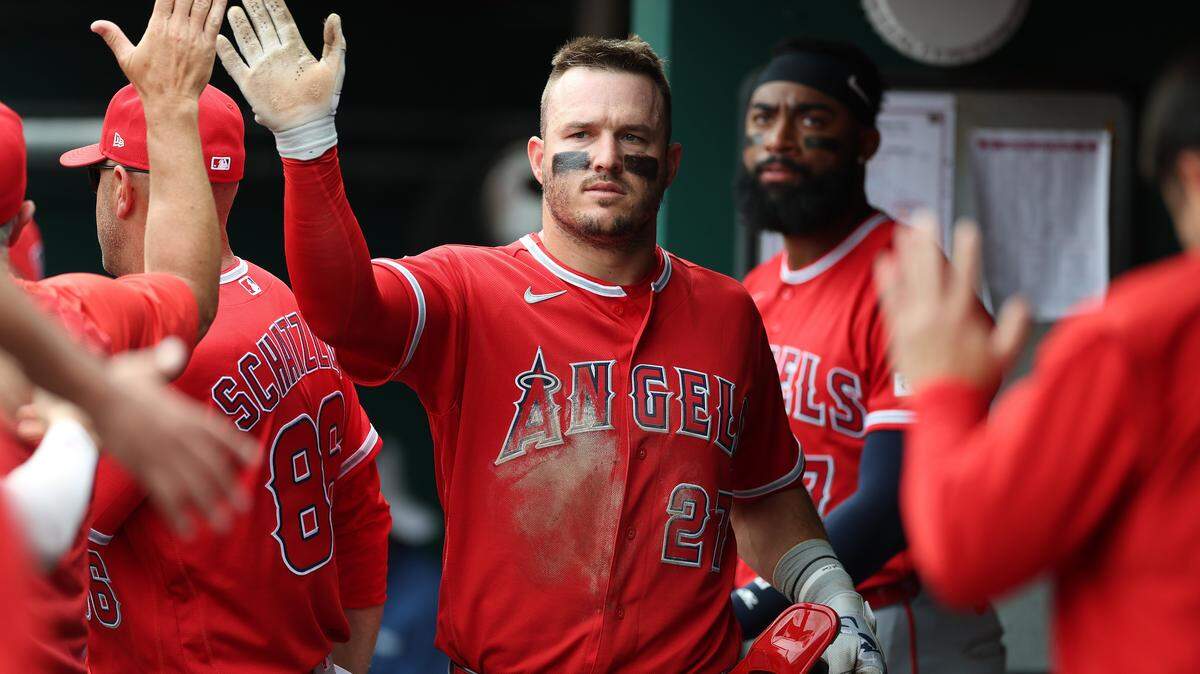
Mike Trout is having his best MLB season since 2022. He is healthy and producing like a star at the plate again, with power and patience and high batting averages. He has more plate appearances than he did in 2021 and 2024, and more wins above replacement than he produced in all but two seasons since 2019.
The Los Angeles Angels need to look into trading him now, as his value will never be higher, and his contract is still a major risk for them. (Trout has a no-trade clause and has the right to veto any trade.)
Trout's contract has about $178 million remaining over four-plus years, a deal that, as recently as last fall, looked as if it was going to be underwater for its duration. The Angels locked up the best player in franchise history multiple times to deals in which he probably left some money on the table, but they have not built a contender around him, even when they had perhaps the two best players in baseball at the same time, Trout and Shohei Ohtani.
They are even further from contention now than they were when Trout signed his most recent extension, and their farm system was ranked as the worst in baseball in January, with no prospects in my top 100 and few position player prospects who offered even the ceiling of an average everyday player.
It is bleak.
What Trout is doing, however, makes it seem as if he has discovered the fountain of youth. His hard-hit rate of 50% after a month was his highest since 2023, his barrel percent and barrel per plate appearance rates were the highest of his career and he was whiffing less on fastballs and breaking balls than he had in several years.
Statcast's bat speed data goes back three seasons, but it indicates that in 2026, he is swinging as fast as ever.
That's one reason trading Trout, if there's a decent market for him, is the only logical move for the Angels.
They are not likely to contend during his contract and they could use the trade to try to add some prospects while also shedding some of the salary commitment. The Angels could swing a trade that just dumps the salary, but that is not going to set the team in the right direction; they are not going to be able to spend their way to 90-plus wins just by using whatever they save from moving his contract.
They need to get one or two real prospects back, even if that means paying down some of the sunk cost promised to Trout.
If Trout keeps producing and stays healthy, as he has in the first month-plus of 2026, then the contract itself is not an issue -- his production will justify the salary. The problem is that Trout is 34 and has not played a full, healthy season since 2022, nor has he been a two-win player since 2023. His own recent history and the general track record of players in their mid-30s indicate that he is probably going to get hurt again.
Once that happens, the opportunity to trade him vanishes.
To a contender, especially a team sitting on the bubble of a playoff spot, a two-win player is not worth $37 million -- well, unless he's replacing a negative two-win player, I guess -- but a four-win player would be. If this revenant Trout is going to stick around for a year or two, and you had some reason to believe he'd stay off the injured list, you could take on most of the contract and probably be satisfied with the return, as long as you're not giving up any prospects.
The problem for the Angels is that they really need the prospects, or young big leaguers, more than they need the cost savings. And the team's owner, Arte Moreno, has been willing to spend money.
If the Angels do this, they need to pay a large chunk of what Trout is still owed so they get players back. Paying a third of the remaining money, about $60 million, makes Trout a $25 million a year expense, and that gives the acquiring team a chance to get surplus value for as long as Trout keeps hitting.
It's rare, but we have seen players with huge contracts traded for returns that included real prospects or young big leaguers, including most recently in the Rafael Devers trade.
Devers brought back four players, including a former first-rounder who has since become a top 100 prospect in James Tibbs III and a former top 25 prospect who had not had big league success yet in Kyle Harrison. Devers was still owed over $270 million at that point, with the Boston Red Sox paying just the salary for Jordan Hicks (about $25 million), who came back as part of the return. (This deal does not look so hot for the San Francisco Giants right now.)
The most obvious trade partner is the Philadelphia Phillies, who need help in the outfield corners and would get an immediate bump from bringing home a star. (Trout is from Millville, New Jersey.) Their general manager, Dave Dombrowski, has loved acquiring big-name players, and isn't afraid to trade prospects to try to boost the major league team. The Phillies just fired manager Rob Thomson, which signals they are in win-now mode. And they can probably take on a good portion of Trout's contract.
Philadelphia's prospect capital for trades is thin, with Aidan Miller hurt and Andrew Painter a critical part of the major league rotation, but I could see the Phillies parting with an outfielder like Justin Crawford or Dante Nori, along with some prospects from their low minors, perhaps even right-hander Gage Wood.
The Texas Rangers seem like a great fit. They could make Trout their primary designated hitter, as he is a below-average defender in a corner now, and their DH situation is abysmal.
The Giants showed last year they were not afraid to take on a big contract when they sent four players to the Red Sox for Devers, who is now part of their DH problem. They have gotten some production from Casey Schmitt, a good defensive third baseman who has power but does not walk and chases too often. It does seem like throwing good money after bad to acquire another big-contract DH, though.
The New York Yankees could get creative here with some of their own big contracts and perhaps slot Trout in as their DH. They still owe Giancarlo Stanton, who is their DH in his interludes between injured list stints, about $40 million through the end of 2027, including the buyout on his 2028 team option. They could send Stanton to the Angels to offset some of Trout's remaining contract, and have enough second-tier prospects after George Lombard Jr. and Dax Kilby to put together a compelling package.
(I've long been a skeptic about Spencer Jones' hit tool, but the Angels are the sort of team that can hand him 500 plate appearances and see what happens.)
I considered the New York Mets, but they do not seem like a great fit. Rookie Carson Benge has not hit so far this year, although his future is still promising; they really need a first baseman, which Trout has not played, and putting him at DH does not necessarily improve their offense enough right now and potentially blocks that spot for Juan Soto for several years.
The same goes for the Detroit Tigers, who have seen Kerry Carpenter get off to an alarming start with a 36.5% whiff rate after a decline in his overall production last year; Trout would be an improvement, but if we assume Carpenter has not gone over the cliff at age 28, it would be an incremental one.
The San Diego Padres could find a place for his bat, but they do not have the prospects the Angels should be demanding, and I'm not sure their new owners want to take on yet another long-term contract.
It's quite possible that Trout will get hurt again, as he has in almost every year since the pandemic season, and obviate any discussion of his trade value. It's quite probable that Moreno will not allow general manager Perry Minasian to entertain trade offers. And there's certainly a chance, albeit small, that Trout's rally to start 2026 is a mirage -- maybe just fluky, maybe a rare time when he's in such good physical condition that he can remind us of the player he once was, and some minor ailment will bring him back to earth.
The Angels' future is bleak with or without him, however. Sometimes trading the best player in franchise history is the right move for the franchise's future.
This article originally appeared in The New York Times.
Copyright 2026 The New York Times Company