
As Ohio’s COVID-19 orders sunset, DeWine makes $1M vaccination lottery
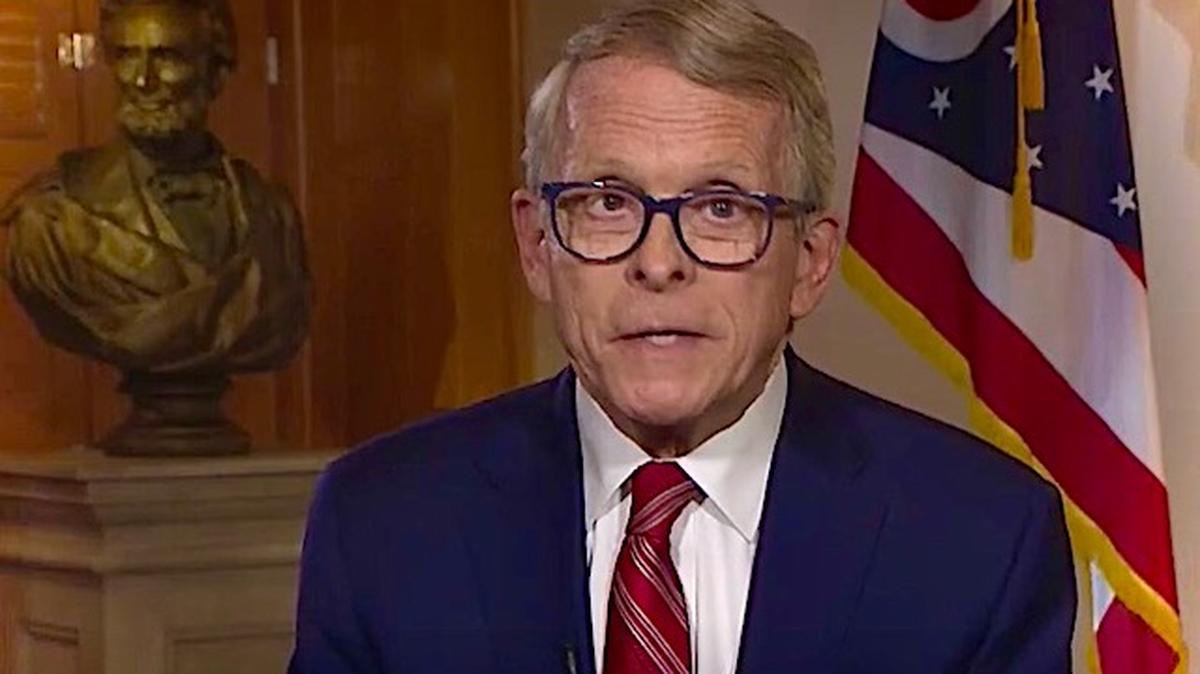
COLUMBUS — After 14 months of disrupting Ohioans' lives and livelihoods to survive a once-in-a-lifetime global pandemic, "it's time to end the health orders," Gov. Mike DeWine said.
In a 20-minute public address delivered Wednesday evening, the governor announced the state's COVID-19 pandemic health orders are set to end June 2, except for in Ohio's nursing homes and assisted-living facilities, which must still comply with federal safety protocols.
Among the state orders that will end in three weeks are mandates on mask-wearing, social distancing and capacity restrictions for indoor and outdoor events.
"It's been a year. You've followed the protocols. You've done what we've asked. You've bravely fought this virus," DeWine said. "And now, our cases are down, and we have a tested and proven weapon with the vaccine that all Ohioans 12 and over can utilize."
Soon-lifted venue capacity restrictions have stymied the entertainment industry and imperiled live venues large and small.
Mere hours before DeWine's stunning reversal on health orders, Mahoning Matters Editor Mark Sweetwood hosted a panel with Eric Ryan, CEO of local venue operator JAC Management Group, and other Valley business leaders about life after the pandemic.
Ryan said the company's "drop dead date" for booking Canfield Fair acts is about six to eight weeks before Labor Day — about mid-July.
And with DeWine's announcement shortly after, events like the Canfield Fair suddenly gained a green light to pack the stands.
Following DeWine's address, Ryan said the group expected to be working late Wednesday night, phoning live acts to book for mid- to late summer, which is now effectively back on the calendar.
"I think it's amazing. We're extremely excited ... to be back in business," Ryan said. "My fear was that when he announced it, [DeWine] was going to give us very little lead time, and that's what they did.
"We've gotta let people make their own decisions, and we're getting to work booking shows immediately."
Youngstown's Covelli Centre and Warren's Packard Music Hall are already booked through fall, Ryan said.
Get vaccinated for $1 million
DeWine also announced a ploy to incentivize the coronavirus vaccine that even he admitted sounds "crazy."
Every vaccine-eligible Ohioan will be entered into a series of prize drawings for up to $1 million or a full, four-year scholarship to one of Ohio's state colleges and universities, the governor said.
Vaccine-eligible Ohioans under 18 years old will be eligible for the scholarship, which includes tuition, room and board and books. Those 18 and older will be entered to win cash prizes of up to $1 million.
The Ohio Department of Health will hold five drawings each Wednesday, starting May 26, with assistance from the Ohio Lottery Commission. Eligible winners must have received at least one dose of the coronavirus vaccine by the date of the drawing.
Winnings will be paid from unspent federal pandemic relief funds, DeWine said.
"I know that some may say, 'DeWine, you're crazy! This million-dollar drawing idea of yours is a waste of money,'" the governor said. "But truly, the real waste at this point in the pandemic — when the vaccine is readily available to anyone who wants it — is a life lost to COVID-19."
An end to Ohio's yearlong emergency?
Notably, the governor during his Wednesday address did not chart an end to Ohio's state of emergency, in place since March 9, 2020. State lawmakers may be the ones to end it.
Senate Bill 22, set to take effect in late June, limits emergency declarations in the state to 90 days and would have allowed a committee of legislators to begin dismantling state health orders themselves. The bill survived DeWine's executive veto in March.
DeWine had previously promised to lift state health orders once the state reaches a rate of 50 new cases per 100,000 people over two weeks.
On Tuesday, the state reported 123 new cases per 100,000 people and "lately, this number has been dropping about two to three points per day," the governor said. That's down from more than 800 new cases in December and 200 new cases four weeks ago, he said.
"For a year, Ohioans have made sacrifices to save lives and keep our state moving forward. What you have done has really worked. And now, we have a powerful weapon that is almost 100 percent effective in beating the virus," DeWine said. "Simply put, the vaccine is stronger and better than medical experts ever imagined. And now, everyone 12 and over can use it to protect themselves — to put an invisible shield of protection around themselves. Everyone can now control their own health — their own destiny."
Pfizer offered to 12 and older today
DeWine also announced Ohioans age 12 and older can begin receiving the two-shot Pfizer coronavirus vaccine today, following federal approval of the vaccine for that age group earlier this week.
More than one-fifth of all new COVID cases nationwide in the last week of April were children, according to the National Children's Hospital Association.
Children's hospitals and pediatricians in the state have already begun working with local groups to make the vaccine available, DeWine said.
"The risk of this vaccine — of an adverse side effect — is so minimal compared to the benefit of preventing a potentially serious and/or life-threatening disease," Dr. Sherman Alter, a pediatrician at Dayton Children's hospital, told the Dayton Daily News. "To me, the vaccine always wins out."
Ohioans younger than 18 who are not emancipated must have parental consent to receive the vaccine, according to DeWine's office. Parents or legal guardians should also accompany them to the clinic, unless it's at a physician's office or associated with their school.
The Ohio Department of Health released a list of frequently asked questions about vaccinating youth age 12 to 17.
Vaccine refusals
Following reports earlier this month that the U.S. may never reach herd immunity from coronavirus — at least, as it was initially prescribed — DeWine said Ohioans who refuse the coronavirus vaccine are making a "high-risk gamble."
Fewer Ohioans are currently hospitalized for COVID-19 than before a vaccine was available — a 75 percent drop, DeWine added. On Jan. 10, more than 4,200 Ohioans were hospitalized for the disease. That's now down to 964.
But unvaccinated people accounted for nearly all of Cleveland Clinic's COVID-19 hospitalizations between Jan. 1 and April 13 — 99.75 percent, DeWine said. That's evidence that "vaccinations do, in fact, save lives," the governor said.
"While we have this great weapon, the danger of remaining unvaccinated is crystal clear. The virus is still here. Our cases are down, but that's only because 42 percent of our entire population has now been vaccinated and can no longer get it and can no longer spread it," DeWine said.
Medical experts, however, say a small percentage of vaccinated people may still contract COVID-19, in what's called a "breakthrough infection."
Despite that, "the vaccinated among us feel liberated," DeWine said. "They can hug their grandkids, go out to eat, go to a ball game — live their life — all without fear.
"But for those who are not vaccinated, the virus is just as dangerous as ever. In fact, because the new variant is more contagious, the virus is really more dangerous than ever for those who are not vaccinated."
Now that most Ohioans have access to the vaccine, "it is up to each Ohio citizen whether to use it or not," the governor said.
"There comes a time when individual responsibility simply must take over."
The 'new normal'?
DeWine said Wednesday lifting the health orders won't stop businesses from imposing their own pandemic safety requirements. "In fact, based upon the experiences of other states, we expect that many stores or businesses may require social distancing and masking," he said.
It's something Ryan said JAC will have to review.
"We're gonna still try and do things as safely as we can. It's one thing to have restrictions. It's another thing to have them be enforceable," he said. "We're in the mass gathering business."
For many, there are still questions about what "normal" will look like.
In the health care sector, the pandemic required quick, innovative responses, some of which are likely here to stay, Missy Russo, COO of Mercy Health Physicians, told Mahoning Matters during the Wednesday live panel discussion.
Local primary care practices started offering more robust telehealth services when, at the height of the pandemic, patients were unable to leave the house for doctor appointments, she said.
The increased emphasis on telehealth will likely be permanent, Russo said.
"Patients appreciate that they don't have to leave their homes and can meet providers and receive care when needed," she said.
COVID-19 care, such as testing and vaccinations, will become part of primary care practices, like strep tests and flu shots, she added.
But the shift to remote working leaves questions unanswered for the business community. For example: Where will remote workers pay income tax?
Cities like Youngstown stand to lose income tax revenue, since more city employees — some of whom live outside city limits — now work from home.
Guy Coviello, president and CEO of the Youngstown/Warren Regional Chamber, said the organization is lobbying for state legislation that shifts the burden of determining where income tax goes from employers.
"We are very focused on protecting businesses as they re-emerge," he said. "We don't want the burden of tracking [income tax] to fall on employers."
When it comes to determining which cities will benefit from income tax of remote workers, Coviello hopes cities can collaborate with townships, which cannot collect income tax but will be required to provide municipal services for remote workers who live in their communities.
Looking back at the last 14 months, though many businesses have been sacked with lemons by the pandemic, it's possible some have made lemonade, Coviello said.
He said he doesn't think the economic slowdown caused by the pandemic compounded Youngstown's existing economic recovery issues. Given the average payroll in the community, "we probably benefited," he said, since a large proportion of Valley residents likely received stimulus payments.
On a granular level, it provided a business slowdown for entrepreneurs like Serdar Dede, who owns Cafe 422, to make necessary renovations at his businesses.
"So I look back, and that's a positive I can tell you about," Dede said. "We did renovate our restaurants during that slow time."
But, "We just want to go back to normal."
State-level business groups uniformly praised DeWine's decision to end health orders, the Associated Press reported.
The news "is the logical next step in fully reopening our state for Ohio's businesses and families," said John Barker, president and CEO of the Ohio Restaurant Association.
"Removing these barriers comes at the right time and will assist the efforts of Ohio's business community to restore Ohio's economy," said Andrew Doehrel, Ohio Chamber of Commerce CEO and president.
Dr. Lisa Egbert, president of the Ohio State Medical Association, said the organization supported the announcement but urged all eligible Ohioans to be vaccinated as soon as possible.
Other news
• According to the latest figures Wednesday from the Ohio Department of Health, the state is reporting 1,087,182 confirmed or suspected cases of the coronavirus. There have been 21,666 confirmed or suspected cases in Mahoning County; 16,103 in Trumbull County; and 8,830 in Columbiana County.
• Statewide, the new adjusted COVID-19 death total is 19,441, including 588 in Mahoning County; 468 in Trumbull; and 229 in Columbiana. Mahoning County's 588 reported COVID-19 deaths was eighth among Ohio's 88 counties; Cuyahoga County had the most with 2,120. [DEATH DATA WAS NOT UPDATED WEDNESDAY.]
• In nearby counties: Stark, 32,459 cases and 907 deaths; Portage, 12,905 cases and 203 deaths; and Ashtabula, 6,844 cases and 170 deaths. [DEATH DATA WAS NOT UPDATED WEDNESDAY.]
• Trumbull County Combined Health District will host COVID-19 vaccination clinics at Eastwood Mall. The clinics will be located in the former Lane Bryant space near Center Court, next to Pandora. The clinics are set for today, as well as May 18, and May 20. You can register in advance at gettheshot.coronavirus.ohio.gov or walk in. For more information, go to TCCHD.org.
• A majority of Americans who haven't gotten vaccinated said in a new poll that they won't get a COVID shot. In The Associated Press-NORC Center for Public Affairs Research poll, 64 percent of respondents said they have gotten a COVID-19 vaccine and 35 percent said they haven't. Of the respondents who haven't gotten a shot, 61 percent said they wouldn't get a COVID vaccine; 34 percent said they would "definitely" not get a shot.
• According to the Pennsylvania Department of Health on Wednesday, there were 1,179,251 COVID-19 cases in the state that have led to 26,659 deaths. There have been 9,360 confirmed or suspected cases in Mercer County and 255 deaths; 7,403 cases in Lawrence County and 207 deaths. In Mercer County, 35,380 people have been completely vaccinated; in Lawrence County, 25,471 have been completely vaccinated.
• Though Pennsylvania senators want answers about the data security breach that impacted 72,000 residents who participated in the state's contact tracing efforts, those questions remain unanswered. The state Department of Health dropped out of a recent committee hearing on the matter at the last minute, citing a pending class action lawsuit filed in federal court. A former employee said contact tracers collected personal identifying information about residents in unsecured Google spreadsheets.
This story was originally published May 13, 2021 at 3:52 AM with the headline "As Ohio’s COVID-19 orders sunset, DeWine makes $1M vaccination lottery."