
DeWine draws attention to testing, tracing in Ohioans’ future
COLUMBUS — It only took two days for Ohio Health Director Dr. Amy Acton's absence to turn a daily briefing into a game of virtual televised Pictionary.
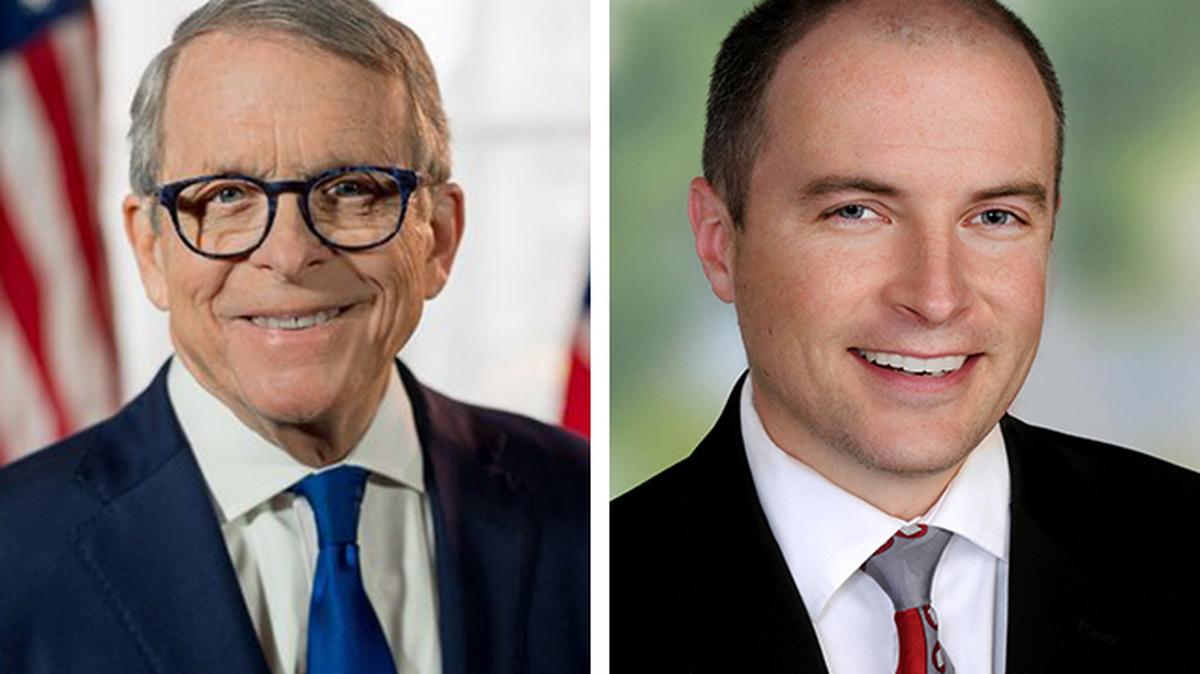
During Friday's briefing, Gov. Mike DeWine trotted out his trusty whiteboard to explain contact tracing with the help of Dr. Mark Hurst, Medical Director at the Ohio Department of Health.
Robust contact tracing, along with a ramped-up testing plan, will help ease Ohio into the state's next phase of managing the pandemic, the details of which will be announced Monday, he said.
Whatever the plan entails, DeWine has made clear he trusts Ohioans to make decisions that protect themselves and others — from relegating bleach to the laundry room to washing their hands.
Testing
About 3,700 people are being tested for coronavirus each day in Ohio; by the end of May, DeWine intends to increase that number to 22,000.
Testing has been limited in Ohio due to shortages of necessary swabs and what's known as reagent — a mixture used to analyze if someone has the coronavirus.
After getting the green light from the FDA earlier this week, Thermo Fisher will produce a new reagent. ROE Dental Lab in Cleveland will manufacture up to 1 million swabs.
Starting April 29, the state will be able to test 7,200 Ohioans per week, increasing incrementally to 22,000 per day by the end of May.
The strategy is the product of a task force headed by two former Ohio governors: Richard Celeste and Bob Taft.
Dr. James Kravec, chief clinical officer for Mercy Health, told Mahoning Matters Friday though it isn't clear if or how the newly approved reagent will help local testing efforts, any testing expansion is good news.
Some who have contracted the virus don't show symptoms, Kravec said. As medical professionals are able to positively identify more people who have, they're more able to properly isolate them for the recommended 14 day-period or urge them away from public settings, and those patients have medical grounds to avoid the workplace.
An increase in testing will mean an increase in positive cases, though Kravec cautioned that wouldn't imply a new surge of infections — "in reality, we're just finding more of what's out there currently," he said.
It will likely also cause a decrease in the area's mortality rate, he said, but that's more of an artificial deflation. The more virus cases confirmed, the more accurate the number of people dying from its complications becomes, he said.
"We don't really know that number [of deaths over cases] because we're not testing everybody, because we don't have enough tests," Kravec said. "That's a very important fact."
As of Friday, the state's current closure and stay-at-home orders are still expected to lapse on May 1, though DeWine has suggested additional rules would accompany a gradual re-opening of the state's economy. Kravec said he's confident local medical workers will still be able to test groups that receive priority testing — the sickest or most vulnerable patients, first responders and medical workers — with the amount of testing currently on-hand.
"As we slowly open up, I think we'll be in a better position to [test] if we continue practicing social distancing," he said. "With a gradual re-opening, we'll probably be in a good place."
Contact tracing
Contact tracing is the process by which someone with coronavirus lists the people they may have infected; those people are then expected to isolate themselves for 14 days.
In Ohio, a community health care worker will assist that person in determining whom they may have infected starting from two days before developing symptoms. In a comprehensive interview, which can last up to 45 minutes, the health care worker assesses the level of contact the infected person had with others.
"We know people shed the virus for us to 48 hours before they first become ill," said Hurst.
Contacts are told to quarantine for 14 days after their last exposure to the person.
The state has put in place a new contact tracing team of 1,750 people who will assist local health departments in this process.
Election
Tuesday is Ohio's long-awaited primary election. As you may recall, the March 17 primary was postponed hours before the polls were set to open.
If you've already completed and sent in an absentee ballot or voted early at your local elections board, your vote's locked in, state officials have assured.
Everyone else is expected to vote by mail. Today is the deadline for requesting an absentee ballot. Ballots must be postmarked by Monday.
Once your ballot's submitted, you can track it here. As of Tuesday, there were nearly 700,000 ballots that have not been returned.
In a letter to the Ohio Congressional Delegation sent Thursday, Secretary of State Frank LaRose alerted politicians to mail delays that could affect ballots and asked them to intervene.
"We are finding that the delivery of the mail is taking far longer than what is published bt the United States Postal Service as expected delivery times ... As you can imagine, these delays mean it is very possible that many Ohioans who have requested a ballot may not receive it in time," LaRose wrote.
In response to a question about the general election in November, DeWine said, "We really can't predict what November's going to bring."
But Lt. Gov. Jon Husted reminded Ohioans that the state already has vote-by-mail. Everyone in the state will receive an absentee ballot request about Labor Day.
"No one will have to go to a physical location to cast a ballot," said Husted.
Other coronavirus news
• According to the latest figures Friday from the Ohio Department of Health, the state is reporting 14,581 confirmed cases of the coronavirus. There have been 688 confirmed cases in Mahoning County; 278 in Trumbull County; and 214 in Columbiana County.
• Statewide, there have been 649 confirmed deaths, including 65 in Mahoning County; 23 in Trumbull; and 18 in Columbiana. Mahoning County's 65 reported COVID-19 deaths on Friday was the second-highest among all Ohio's 88 counties; Cuyahoga County reported 91 deaths.
• Giant Eagle is reserving curbside pickup slots for front-line health care workers at key Valley locations. Health care workers will be able to place their grocery orders online for pickup using a link provided by their employer.
• According to the Pennsylvania Department of Health on Thursday, there are 38,652 COVID-19 cases in the state which have led to 1,492 deaths. There are 61 cases in Lawrence County with 5 deaths; 64 cases in Mercer County with 1 death.
• The Ohio Department of Health's list of COVID-19 cases at state long-term care facilities now includes 200 cases at Mahoning Valley facilities. The state's report on COVID-19 cases at these facilities is expected to be updated every Wednesday.
• The John J. McDonough Museum of Art on the campus of Youngstown State University will offer views of the Spring 2020 Graduating BFA Virtual Exhibition at 5 p.m. today with a sneak preview of the exhibition on its Facebook page.
• Youngstown State University's 22nd annual Summer Festival of the Arts, originally scheduled for July 11 and 12, has been canceled due to the ongoing COVID-19 health crisis.
• QUICKmed Urgent Care and Rite-Aid have announced new locations, dates and times for drive-up COVID-19 testing clinics in the area, including in Columbiana, Canfield and Girard. See the full list at MahoningMatters.com.
This story was originally published April 25, 2020 at 6:38 AM with the headline "DeWine draws attention to testing, tracing in Ohioans’ future."