
JAMAEL TITO BROWN PROFILE | ‘I don’t want us to come out and just survive. I want us to thrive’
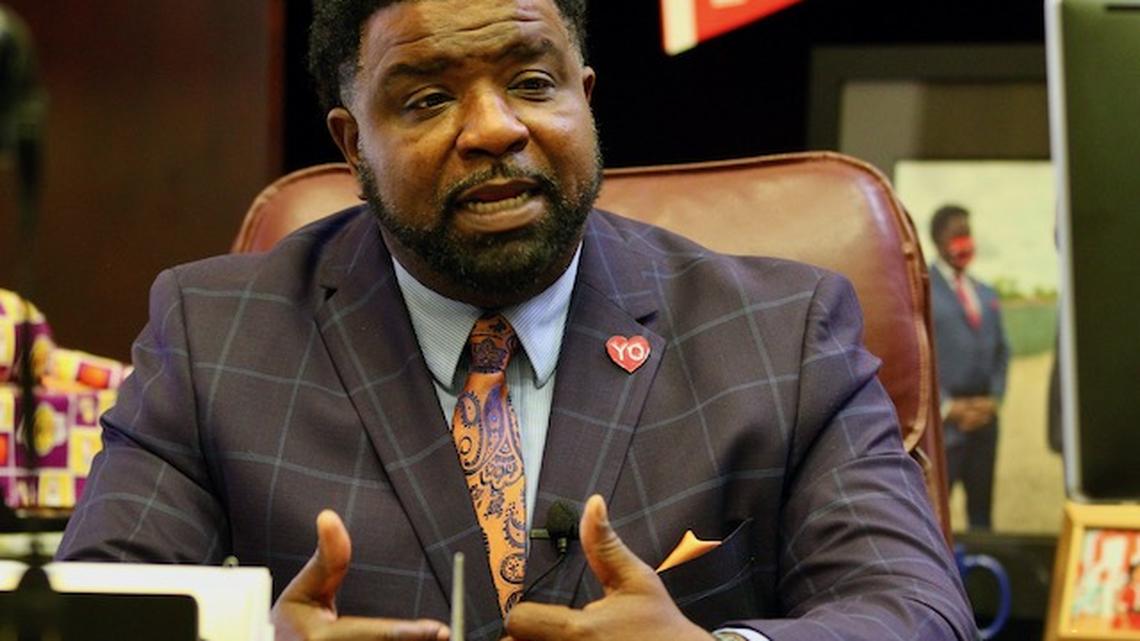
YOUNGSTOWN — When Jamael Tito Brown first ran for mayor four years ago, he said he wanted to put the city's residents first.
Brown won and took an oath to not cave in to the money, power and politics.
"[For the past three years], I've been able to keep that promise," Brown said.
Brown said he worked to restore the integrity at City Hall that had been missing since before he became Youngstown's 51st mayor in 2017.
About Youngstown's mayor
Brown is a lifelong resident of Youngstown. He earned his bachelor's and master's degrees and an honorary doctorate from Youngstown State University.
He is married to Lynette C. Frost Brown, and they have four children — Aaron, Camille, Clarisa and Quentin — and one granddaughter, Ariana.
He worked as a case manager for the Mahoning County Children Services Board. He was also a community organizer for the Youngstown State University Center for Urban and Regional Studies and director of the city's Human Relations Commission.
He has also served on the Youngstown City School District board, and on City Council as 3rd Ward representative and council president.
Prior to becoming mayor, he was the chief deputy treasurer of the Mahoning County Treasurer's Office for 10 years.
For the first two years as mayor, Brown said he focused on balancing the city's budget. The city had a $2.2 million deficit in 2018 and a $1.9 million deficit in 2019.
He also worked to build partnerships with other cities and townships in the area.
"Those that we had relationships with were strengthened," Brown said. "Those we didn't, we were building those relationships."
Brown's goals for the city shifted when the pandemic hit in March 2020.
Youngstown and the pandemic
Brown said the main focus when the coronavirus pandemic began was safety. The city worked to provide testing and personal protective equipment to residents.
The city also had to change how it operated. Government buildings closed, and working from home and virtual meetings became the norm. The pandemic gave the city the opportunity to master and even strengthen technology among city departments, Brown said.
"We've realized that we can do a lot more with technology," Brown said, noting that many departments now work completely virtually.
Brown said the pandemic revealed the most vulnerable of the city's residents: The minority community was dying faster due to underlying health issues.
Gov. Mike DeWine appointed Brown to the Minority Health Task Force, which worked to make sure the most vulnerable were able to continue to work and feed their families throughout the pandemic. In talking with DeWine and the Ohio Department of Health, Brown said one of the state's biggest concerns was access to the coronavirus vaccine to have some barrier of protection against COVID-19 variants.
Brown said the COVID-19 team in place has been making sure those who need vaccinated will get vaccinated.
Within the next year, some mandates might be lifted, but the pandemic won't be completely over, he said.
"I think we are going to be having this conversation a year from now to some degree," Brown said.
Bringing resources to the community will be a critical piece moving forward into recovery from the pandemic.
Pandemic recovery
Brown said he thinks the pandemic will be the No. 1 challenge the city faces in the next mayoral term.
"The one thing I continue to stress is that I don't want us to come out and just survive. I want us to thrive," Brown said. He added the city will have to figure out how to retool operations since some jobs or businesses may not be open post-pandemic.
Brown said workforce development is going to be a key factor in future months. Flying HIGH Inc. launched the Professional Development Center in April to help with job training and assistance.
The city is expected to receive $88.6 million from the American Rescue Plan and will have until 2024 to spend the funds. The city is expecting to receive the first half of the funds in May and the remainder in 2022.
Brown called the $88.6 million a "legacy opportunity" for the city.
The city needs a comprehensive plan that involves citizens, community partners, City Council and the mayor's office. He would also hire a compliance officer to make sure that funds are spent the right way.
"Those are some of the pieces that we're going to be able to put in place that will not only affect my children, but will affect my grandchildren," Brown said.
He said he wants to continue cleaning up blighted properties in the city and develop a new housing strategy to create quality and affordable housing.
"The first thing we probably can do is get rid of the worst of the worst," Brown said, noting there are about 500 blighted properties that the city would demolish to help stabilize neighborhoods.
Other spending plans include a full-scale grocery store to address food insecurities and infant mortality. Brown said there would be a lot of factors to determine where the store would go, including land availability and access to bus routes.
Brown said being actively engaged with other Ohio mayors and the U.S. Conference of Mayors helped the city get the $88.6 million in relief funds.
He was able to talk with then-presidential candidate Joe Biden. When asked by Biden what he would like to see, he told Biden not to forget about cities like Youngstown and to make sure mayors have a seat at the table.
"There's $88.6 million we've been advocating for the last year across the nation," Brown said. "[Biden] did not forget about cities like Youngstown, Ohio.
Youngstown Police Department
In January, former YPD Chief Robin Lees retired, and Brown hired Chief Carl Davis. Davis was hired because he wants to have the community trust the police department again, Brown said.
Brown said he wants all police officers to be part of a community policing effort; to be involved in the community — and not just when they are responding to crime.
YPD received an $800,000 federal grant that will be used to support the community policing initiative.
"I want my officers to be involved in projects [and] organizations that are out in the community so that we can build trust," Brown said.
One example is the Respect Basketball League that was launched April 17. The league is for young men age 19 to 25.
"It's basketball, but it's building character," Brown said. "It's also connecting the police officers with the young men."
The police department will also purchase body cameras by the summer, which he said will be helpful to both officers and city residents.
"I want to make sure Youngstown is not part of that national narrative," Brown said, noting officer-involved shootings elsewhere. "We have our own little local narrative, where we're leading from the front."
Other plans to reduce crime in the city include putting cameras in neighborhoods and having working street lights.
Brown said it's important for residents to understand what officers go through and for officers to understand what citizens go through. While he supports the idea of a citizen's review board to oversee police issues, Brown wants to see it developed beyond the mayor's office, City Council and the police chief.
He said officers and residents need to be engaged in the development of a review board.
"We've got to have it where it focuses on what we need and what's our purpose of doing so," he said.
Other city issues
As a former school board member, Brown would like to see local control returned to the Youngstown City Schools board.
While he said it's unfortunate that the state adopted House Bill 70, the so-called "Youngstown Plan," he also believes City Schools CEO Justin Jennings has done a great job.
As for other goals, if re-elected, Brown said his second term would represent "a continuation" of current efforts. Those goals include having a better communication plan with the community. He would look to hire a communications director to share the work the city does every day.
Ten years from now, Brown sees Youngstown as a vital part of the "Voltage Valley," focused on 21st-century renewable energy.
Brown sees Youngstown as being a part of that new industrial revolution. With the expansion of Youngstown State University and Eastern Gateway Community College, it's going to be a place for what's happening and changing, he said.
"I think the more we work together, the more we're going to be a benefit to the future," Brown said.
This story was originally published April 23, 2021 at 3:52 AM with the headline "JAMAEL TITO BROWN PROFILE | ‘I don’t want us to come out and just survive. I want us to thrive’."