
High inflation leaves food banks in the Valley and across the U.S. struggling to meet needs
Kendall Nunamaker and her family of five in Kennewick, Washington, faced impossible math this month: How to pay for gas, groceries and the mortgage with inflation driving up prices?
Like many other working families, the Nunamakers are grappling with the 8.3% inflation in the consumer price index in April announced Wednesday — slowing slightly from the March figure which was the largest year-over-year increase since 1981, according to the Labor Department. The national average gas price reached a record high Wednesday of $4.40 a gallon. And global food prices are climbing after shortages caused by Russia’s war against Ukraine and other supply chain problems.
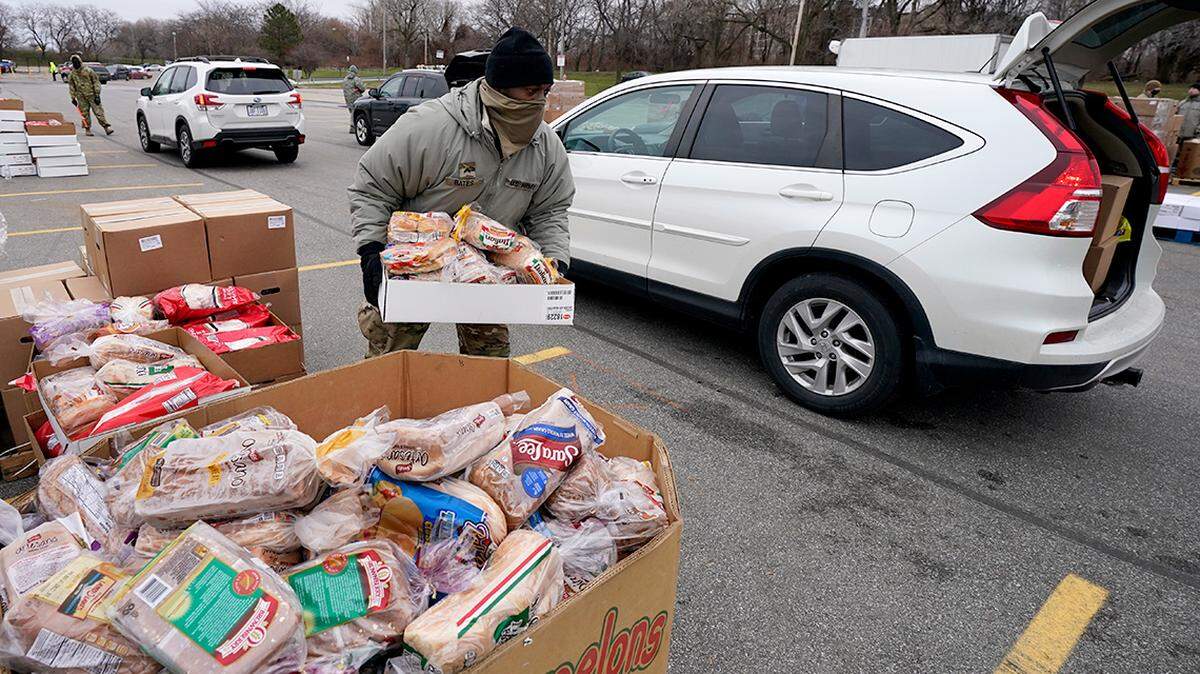
Food banks across America say those economic conditions are intensifying demand for their support at a time when their labor and distribution costs are climbing and donations are slowing. The problem has grown to the point where last week President Joe Biden called for a Conference on Hunger, Nutrition and Health in September, the first since 1969.
For many families like the Nunamakers, food insecurity became a painful surprise.
“There’s no reason us as a couple and a family should be struggling so hard,” Nunamaker said. “We make decent money.”
She works three days a week at a home décor store for $15.25 an hour; her husband, Nick, works a full-time union job as a paratransit driver at $27 an hour. Though they receive some money from a state nutrition program for young children that their two youngest qualify for, they still spent $360 on groceries last week.
Because of inflated prices, those groceries didn’t go far enough to feed everyone. And the family still lacked money to pay other household bills, leaving Nunamaker wondering how she would stretch their next paychecks to cover those bills and their mortgage this month.
In the past, to bridge the gap, the family sold off possessions like VR headsets and firearms.
“At some point,” Nunamaker said, “we’re not going to have anything because we would have sold everything.”
So Nunamaker and her husband visited two local food banks for the first time last week.
The pandemic forced roughly 60 million Americans to seek help for food insecurity, according to Feeding America. At the end of 2021, as hiring boomed, demand for food banks returned to regular levels. But the relief was short-lived.
“In the last few months, with this increase in inflationary pressures, we’re seeing 95% of our 200 member food banks saying that they have seen either leveling or an increase in need,” said Claire Babineaux-Fontenot, CEO of Feeding America.
In the area along the Columbia River where Nunamaker lives, the number of clients seeking food aid at a church pantry jumped 40% between December and March, according to Eric Williams, director of community partnerships at Second Harvest, an organization that works to supply local pantries with food.
He said his organization must make more happen with less because its suppliers are subject to the same cost increases. The price that Second Harvest pays for obtaining donated produce has risen from about 6 cents a pound a year ago to about 10 or 11 cents a pound now, Williams said.
In the Valley
All of Ohio’s 12 food banks buy surplus produce from Ohio farmers — including potatoes, squash, apples, pears and sometimes beef — but even those prices are now more than 30% higher, said Mike Iberis, executive director of Second Harvest Food Bank of the Mahoning Valley. It’s the same for shelf-stable goods the food bank buys from suppliers, like beef stew and macaroni and cheese, he said.
At the same time, the amount of food the Valley’s food bank receives through the U.S. Department of Agriculture is down about 30% from this time last year, he said. Several recent food shipments have been postponed or canceled — presumably due to supply chain issues, he said.
Iberis said the price of pasta is expected to see a 40% hike this summer due to the ongoing shortage of wheat, which is one of Ukraine’s crucial exports, Bloomberg reported last month. When producers can’t source raw materials for goods, there’s less inventory, and fewer federal donations, Iberis said.
“Without question, it’s affecting the seniors more than anybody because they’re on fixed income,” he said. And those are the folks now coming to food pantries more often, he added.
Rising gas prices mean the local food bank’s fleet costs more to run for pickups and deliveries, Iberis added. Trucking costs are also up 40%, he added.
“I think people need to realize that the pain is being experienced all over the board. It’s retailers, it’s wholesalers, it’s even food banks,” Iberis said. “A lot of people think the food banks are immune to this.”
Across Ohio
Some of Feeding America’s food pantry partners have closed because of dwindling donations and higher costs for receiving and delivering food. Others have less food on their shelves even though they have higher demand.
“Our network emphasizes access and equity,” Babineaux-Fontenot said. “So we are working extra hard to reach people who have the deepest food insecurity rates. Well, how far out can we go when gas prices are high? We have data that shows that race and place are significant indicators of whether or not you will be food insecure and how deeply you will be food insecure.”
Because of inflation and a reduction in aid, a food bank that serves Champaign, Clark and Logan counties — also called Second Harvest — is facing a drop in the amount of food it’s able to provide.
“Compared to last year at this time, we’re about 50% down in what we have received in the past in federal food donations and then about 20% down from food drives in our collection of food at the grocery stores,” Executive Director Tyra Jackson said. “All of that combined is truly having an impact on our budget because we’re needing to purchase more food outright.”
Donations for the Valley’s food bank, however, have been steady, Iberis said. Fundraising in this year’s Harvest for Hunger campaign is “on track with last year,” he said. The campaign runs through the end of May.
‘Everybody needs help sometimes’
The struggles of families are heightened by the fact that government benefits that were increased during the pandemic like food stamps or unemployment insurance have stopped or will end shortly.
“Our work is always important,” Babineaux-Fontenot said. “It’s increasingly important when we have all of these headwinds.”
Williams, of Spokane, extended gratitude to the donors and volunteers that keep his organization running, some of whom worked more than 100 shifts last year. He said it can be difficult to witness first hand the scale of the food insecurity in his community when helping with distributions at a mobile food bank.
“You see the need and you just go, ‘Oh God, oh my God,’ ” Williams said. “But then as you hand somebody a box of food and they drive off: ‘Yeah, we were able to help,’ which is heart-wrenching on one hand and heartwarming on the other.”
Because it upsets her so much, Nunamaker said, she hasn’t discussed her family’s struggles with her three children, age 2, 4 and 7, or her network of friends and relatives. She said the food banks helped her family last week.
“People should know that just because you have to go to a food bank or you have to seek assistance, that doesn’t make you any less of a parent or a person,” she said. “Because everybody needs help sometimes.”
___
Associated Press coverage of philanthropy and nonprofits receives support through the AP’s collaboration with The Conversation US, with funding from Lilly Endowment Inc. The AP is solely responsible for this content. Read all of AP’s philanthropy coverage here.
Go here to donate to Second Harvest Food Bank of the Mahoning Valley.
Mahoning Matters staff contributed to this report.