Youngstown Black voters take redistricting discrimination claims to the US Supreme Court
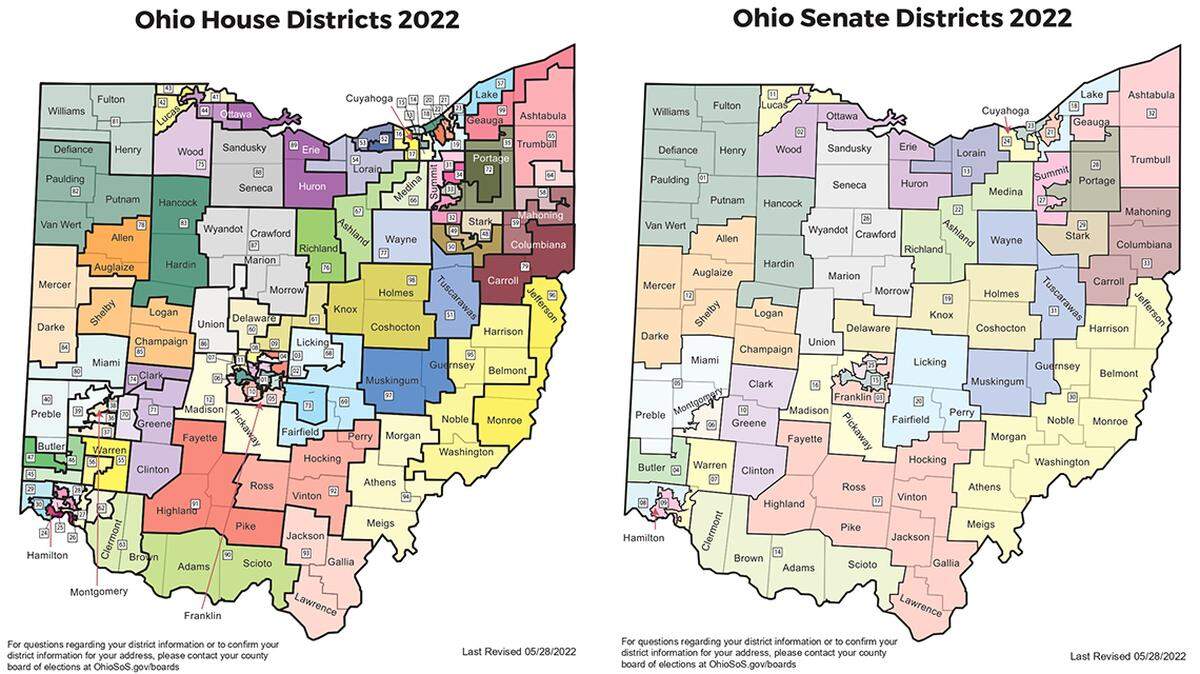
The state legislative district maps to be used in Ohio’s upcoming special election further erode Black voting power in the Mahoning Valley, activists say, making it more difficult to nominate and elect candidates who will serve Black voters’ interests.
Mahoning Matters’ analysis of racial demographics among the voting age population under the new temporary districts also suggests racial voting bloc power will be more diluted in the Aug. 2 election.
Now, a group of Youngstown-area Black voters wants the U.S. Supreme Court to decide whether the state’s mapmaking process violated anti-discrimination provisions of the Voting Rights Act.
Looking at the maps
The Youngstown group’s appeal focuses on Ohio’s 59th House District as well as the 33rd Senate District, which, prior to the 2010 redistricting process, historically included Youngstown and Warren, where the majority of Black voters reside.
“What we are complaining about is the division of the Black communities in Warren and Youngstown,” the group’s attorney, Percy Squire of Columbus, told Mahoning Matters on Tuesday.
Jaladah Aslam, president of the Youngstown Warren Black Caucus, told Mahoning Matters she feels the redistricting process intentionally and precisely carved off Black voting enclaves — folks who usually vote blue.
“The largest portion of Democratic voters in both districts are in Youngstown,” she said. “The statistics are clear that the Black population votes nearly 90% Democrat, as of right now.”
Under the temporary maps, the 59th House District would include Youngstown — which currently comprises most of the 58th — as well as Beloit, New Middletown, North Lima, Poland and Sebring in Mahoning County, and the northwestern part of Columbiana County.
Campbell and Struthers would be split off from Youngstown and remain in the 58th, however, which Squire said was “not appropriate.” That district would snake west to also include Austintown, Boardman, Canfield and Craig Beach.
Whereas the current 58th has nearly 25,000 Black voters who make up 27.6% of the voting age population, according to 2020 Census data used by Dave’s Redistricting App, the temporary 59th would have nearly 21,000 Black voters, or 21.4%.
Likewise, the 33rd Senate District currently has about 30,000 Black voters, making up 11.4% of all voters. Under the temporary map, there’d be a couple hundred more Black voters, but they’d make up 10.6% of all voters.
All the House districts representing Valley voters under the temporary maps would have a combined voting age population of more than 476,000, but about 45,000 of them would be Black, according to Dave’s Redistricting — that’s about 9.5%, down from 10.3% under the current maps.
The Voting Rights Act compels state mapmakers to take those racial demographics into account when drawing new districts, Squire said. But amid the state’s redistricting process that began in 2021, the seven-member Ohio Redistricting Commission — five Republicans and two Democrats — decided it wouldn’t consider them, he said.
“That decision diluted the Black vote all over the state because it deprived Black voters of the opportunity to present information to the redistricting commission on how their proposed lines were unfair,” Squire said.
The background
Squire in February filed to intervene in a federal redistricting case on behalf of two Youngstown pastors, the Revs. Kenneth Simon and Lewis Macklin, and Helen Youngblood on federal discrimination claims.
“These maps are flawed at the very fundamental level, from the dilution of Black voting power in the Mahoning Valley and really throughout the state of Ohio,” Squire told Mahoning Matters earlier this year. “It’s pure racial gerrymandering.”
The federal court in April denied the group an injunction to delay certification of the May 2022 primary election results, and last month rejected a temporary restraining order against the map.
Though the map has been rejected by the Ohio Supreme Court for being gerrymandered to favor Republican candidates — alongside four others — the federal court last month ordered the state to use that rejected map to hold the special election on Aug. 2, after the commission missed a deadline to submit a new map that met constitutional requirements.
On Monday, Squire filed a notice of appeal to the U.S. Supreme Court, which must now decide whether to take up the case.
“The Voting Rights Act is still the law — that’s the law of the land,” Squire said Tuesday. “Not only did the Republican members of the Ohio Redistricting Commission thumb their nose at the [Ohio] Supreme Court, they really thumbed their nose at U.S. federal law, because they just act like the Voting Rights Act didn’t exist.
“It’s an injury to all voters in the state.”
The federal court’s three-judge panel in its ruling last month against the Youngstown group said its claims didn’t meet certain Voting Rights Act conditions set in the 1985 U.S. Supreme Court case Thornburg v. Gingles — specifically, that the minority group be large yet compact enough to be a majority; that it votes in lock-step; and that it’s usually defeated by a white majority voting group.
Squire said he’s able to show the federal court how the Valley’s Black voter demographics can satisfy those conditions, but court rules also prohibit consideration of racial demographics — a catch-22, he said.
Also, the Gingles case came out of North Carolina, where voting rules are much different than in Ohio, Squire said. North Carolina nominates by majority vote thresholds and holds runoff elections, unlike Ohio, where J.D. Vance earned the Republican nomination for the state’s U.S. Senate race this November just by getting 32% of the vote.
Why district lines matter
Squire argues the federal court applied the Gingles decision incorrectly. It’s possible for the Valley’s Black voting bloc to at least nominate the party candidate they want, making the primary the more important election for minority voters, he said.
But if the state’s final legislative maps are similar to the map to be used in the special election, it’ll be harder for those voters to nominate a Black candidate, Aslam said.
“Even if it looks like there’s a possibility for a district to maintain a Democrat, the possibility of a person of color being nominated in those districts becomes more unlikely,” she said.
“For me, it’s just proof of why voting matters,” Aslam said. “By not participating in that, we’re allowing people to put together systems and maps that are going to disenfranchise and hurt working people and people of color for decades.”
___
[Editor’s note: The Rev. Lewis Macklin is a regular contributor to Mahoning Matters.]